Gain Consistency & Advantages With the Right Packaging Machinery

man inspecting a machine

By: Gerald Dlubala

There are distinct advantages to packaging your craft beverages, with perhaps the most important aspect being that of reaching new customers and increasing your brand recognition. Packaging is a form of marketing, and by using your own filling and packaging machinery, a craft producer obtains autonomy over their brand and gets their product into the hands of consumers. But is owning your own equipment right for you?

Gaining Advantage: Pneumatic Scale Angelus

  “Purchasing canning machinery is a huge step,” said Mike Davis, product line and technology leader for Pneumatic Scale Angelus (PSA), part of BW Packaging Systems. PSA is a global industry leader with over 130 years of experience in craft packaging technology. “Because of the investment, you must partner with a machinery supplier that offers a system that complements your product mix, the formats you’re using and things like the necessary carbonation and temperature levels.”

  “It is an investment, but comparing the cost of purchasing versus working on a mobile canner or copackers schedule is just the start,” said Kyle Kelleher, seamer account executive. “Owning provides the canning operation when needed but adds additional advantages and opportunities, like expanded e-commerce and customer reach with more frequent and unique offerings. In addition, craft producers can themselves become copackers to help offset costs and keep the lines in use, or even partner with community organizations or local sports teams for fundraising or charitable collaborations.”

  “Most importantly, the brewer has total control over their beer, including variables like DO and carbonation levels, and package it at the optimal time rather than on someone else’s schedule,” said Connor McCaulley, account executive. “They can package smaller batches, test the market to find what sells and build networks and relationships with suppliers and distributors.”

The Right System for Your Needs

  “It really is important to start with the packaging function first when starting a brewery,” said Davis. “It provides the first impression consumers see on the shelves, and proper packaging will have your product consistently taste as good as it does in your taproom. In addition, craft beer is typically not pasteurized, so it’s critical to have a quality Cleaning-In-Place (CIP) system to keep all things clean that come in contact with your product.”

  PSA account executive Mark Saylor adds that adding any packaging equipment depends on the specific location’s variables. Producers should know the limitations of the available utility supply, the space required for the packaging machinery (mobile units or full stack) and the space allotments for additional supplies, finished goods and shipping needs.

  “At its most basic level, packaging is about your goals,” said McCaulley. “Is it to stay small and build upon small batch offerings? Is it distribution? Can the equipment and utility supply keep up or be upgraded to do so when needed? Can you expand raw material storage and finished goods areas? Do you have the personnel to devote to packaging without making yourself work 16-hour days? Does the machinery offer remote access capability? Compare overall designs. Applying the closure ASAP is important to ensure accuracy and consistency.”

  “And you need consistency,” said Saylor. “Product consistency can either build or lose customer base. Packaging systems must be versatile enough to adapt to the different tolerances in cans from different suppliers. Product mixes like beer, cider, kombucha and RTD (ready-to-drink) products present changeover needs, so look for systems like ours that offer minimal changeover times.”

  For smaller craft brewers, PSA offers their CB50 and CB100 inline canners with proprietary technology to perfectly fill up to 100 CPM (cans per minute) with little waste. Additional units like the CB50C trade open-air filling for counter-pressure filling to meet the demands for higher carbonation drinks. Heavier producers can use rotary beer canning systems to increase throughput without requiring an expanded footprint. Inline and rotary volumetric options offer packaging solutions at speeds from 15 to 100 CPM, meeting the need for small-batch or frequent-changeover production schedules.

  For additional information about Pneumatic Scale Angelus products and how they can jumpstart and improve your packaging function reach out to Gigi Lorence, global marketing director, at Gigi.Lorence@bwpackagingsystems.com.

Fillmore Packaging Solutions: Small-Scale Production Solutions

  After spending more than 20 years as a winemaker and craft brewer, Tony Saballa, owner of Fillmore Packaging in St Louis, started focusing on the mechanical side of craft beverage production. During that time, he found a continuing, unmet, small-scale packaging need for those beginning craft brewers trying to expand from the serious hobbyist ranks to craft beverage production.

  “There just wasn’t anything feasible and available at the time,” said Saballa. “A small craft brewer had to either import something costly from Germany or settle for used soda bottling equipment that was usually large and bulky.”

  That’s when Saballa started to build his own machinery, versatile and built for the micro and craft brewer to alleviate the more tedious manual filling work. He began making fillers for his needs and posting the process and results to his YouTube channel. With the corresponding boom in craft brewing, he became inundated with requests to build and sell his fillers. Fillmore Packaging was born, eventually branching out and now exporting all over the world.

  “Canning is still the most popular, but many craft brewery offerings are well-suited for glass containers,” said Saballa. “Small-scale producers need and want a versatile machine with quick changeovers, which is an advantage our fillers can provide. We supply two changes with the filler, with additional sizes available for purchase, so a brewer can customize the machine to their liking and offerings.”

  “Fillmore Packaging sells directly to the users, immediately cutting out the middleman and allowing the user to speak directly with us for support if needed,” said Saballa. “We provide quality, consistent filling systems and provide excellent support. We always pick up our phones.”

XpressFill Systems: Experience, Quality and Service

  Rod Silver handles marketing and sales for XpressFill Systems LLC, providing expert filling and packaging options for small to medium-sized craft beverage producers. XpressFill offers several filling machines for quality packaging of beer, wine, spirits, ready-to-drink options, vinegar, kombucha and more.

  “As with most production machinery, the right unit depends on your situation and needs,” said Silver. “Owners must weigh the costs, benefits and overall advantages and disadvantages of manual labor versus the automated machines counterparts. We encourage craft producers to perform a basic evaluation of labor costs to help them get a filler and determine what manual and semi-automatic options will work the best for them. The result of that evaluation is usually the sweet spot for filling and production because they’re reducing manual labor but not jumping into full automation, which can get very expensive and cost-prohibitive for craft producers, especially in the early stages of their growth.”

  Many breweries and distilleries are now crossing over, with breweries distilling their house spirits and distilleries coming out with signature brews. However, Silver warns that there is no one best type of machine that will consistently handle the packaging of both on a high-quality level.

  “You need the counter pressure filler to have the adequate shelf life for your beer, but it’s not the best choice for packaging spirits,” said Silver. “We help breweries when they need guidance on the best choice of equipment for their operations. We offer affordable and efficient filling machines in two or four spout models specifically designed for the craft beverage markets and to be easy to use. Their customer service and support are unmatched and have long been a hallmark of the company.

  XpressFill’s counter-pressure machines, XF2500/ XF4500/XF4500C, are perfect for beer, kombucha, soda or any other carbonated beverage filling in bottles, cans and even the popular crowlers for the to-go market. Open filler options like the XF4400/XF2200 use level filler technology and can increase efficiency using a gas purge cycle and automatic level sensor. Volumetric fillers are useable with many different bottle sizes and are ideal for bottling spirits, vinegar, oils and more. Level fillers for wine packaging use a sensor probe that shuts off the filling function at a specified height, giving the product that perfect visual for shelf presence.

  Silver tells Beverage Master Magazine that XpressFill is rolling out a brand-new filler that is already generating market interest and buzz. Their latest offering, the XFW200C, is a weight-based filler that ensures accurate and reproducible fill volumes while canning your beer. It’s a significant advantage since you can’t see the level and volume of the product inside the can.

  “Canning is still the most popular method of packaging beer,” said Silver. “With our new Weight-Based filler, you know that your 12- and 16-ounce beer cans are holding the proper amount. It eliminates the guesswork and ensures accuracy in your packaging, utilizing weight sensing technology to ensure accurate and consistent fills.”

  This weight-based filler is ideal when filling 12- to 16-oz cans, and the logic-based board makes it easy to learn and operate. It features an industrial-grade touchscreen display that lets the user enter the desired weight and then keeps track of how much dispenses into the can. The larger flow path allows for a smoother fill with product flexibility to include your craft products that contain a small degree of particulates, accommodating products like beer, kombucha, juices, RTDs, mixers and more. As a semi-automatic machine, it can be a producer’s first step into a more automated system if and when needed.

  Silver says the XFW200C Weight-Based Filler is slightly more expensive than other, more traditional fillers, but that additional expense negates the guesswork and worries over improper filling amounts.

SKA FABRICATING: Effortlessly Getting Your Product into Optimal Packaging

  “For canning operations under 50 CPM, the level of automation needed is fairly low,” said Jake Kolakowski, chief customer officer for SKA Fabricating, an automated packaging line fabricator in Durango, Colorado. “But, for smaller applications, I would recommend our Microbus depalletizer. It appeals to the most basic setup needs but performs a tremendous amount of labor-saving, manual work. It’s compact and folds down to about the floor size of a standard pallet. Mobility is key for smaller production areas and can be moved from area to area or folded away for storage. And it’s built for the budget conscious, working as a manual lift or easily adjusted with a cordless drill.”

  SKA FAB’s Nimbus depalletizer is built on the same technology as the Microbus. The half-height depalletizer system adds auto lift technology and can easily handle speeds of 50-80 CPM.

  “Our popular, full-height machine is our Can-i-bus,” said Kolakowski. “It’s customized for speeds up to 300cpm and has much more accumulator space before the rinsing operation so that it can run continuously through pallet changes. Then the user can add gravity-based ionizer air rinsers before filling on systems requiring speeds at or above 110 CPM. The Can-i-bus integrates seamlessly with our Dual Twist Rinse Cage, making size changes effortless with no tools needed. Post-fill operations are customized to what the producer wants, but automated can inspection is a must at these speeds since human visual inspection can’t keep up.”

  “SKA Fabricating’s core competency is building customized systems built to a manufacturer’s needs,” said Kolakowski. “We always strive to fit operator-friendly equipment into small spaces with optimal flow patterns. Coming up with the right working layout to limit any awkward or unnecessary movements of the operator is a built-in, value-added part of our service with no extra cost.”

  Kolakowski said that although bottling isn’t a significant component of most beer packaging, it is an essential segment of other sectors, including distilling, winemaking, heritage products, RTDs and many smaller craft producers. SKA FAB’s equipment for those operations is made with the same care and customization detail to automate the high labor parts of those processes.

Better Employee Retention Through Automation

  “Any manufacturer should take a return-on-investment approach to automation,” said Kowalowski. “Look for your highest labor input and where your employees spend most of their time. Then, look at the employee’s quality of life within those jobs. Any high-labor, repetitive task that machines can do will free your employees to perform higher value, more fun and more meaningful production tasks that ultimately lead to higher employee satisfaction and retention. We continuously see examples that investing in automation has led to better employee retention rates. And that’s important in today’s workforce availability.”

  SKA FAB works with many manufacturers on integration to make your packaging line the best it can be. They feature in-house tech support and dedicated installation/training teams to close most open tickets within the same reporting day. SKA FAB also sells components individually so a manufacturer’s capital outlay can be budgeted and controlled, resulting in a fully integrated, matching and functional packaging line.

Nelson-Jameson Inc: Reduce Costs with Proper Stretch Wrap

  “Craft beverage producers put a lot of effort into crafting and packaging their product, so it’s vital to keep that detailed effort up by utilizing the recommended stretch wrap to secure craft beverages and distilled spirits,” said Melissa Pasciak, director of marketing for Nelson-Jameson, a leading food and beverage industry distributor. “The proper stretch wrap keeps your products secure during shipment and storage, avoiding damage that results in loss of product and profit.”

  “It’s worthwhile to note the different types of stretch wrap that are used for different applications,” said Pasciak. “One size does not fit all, which is why we offer on-site stretch wrap audits to ensure that craft beverage producers get the most out of their budget. We perform a complete analysis on multiple areas of your stretch wrapping operation, including wrapping patterns, load dimensions, stretch percentage, actual applications and film weight. In addition, our expert auditors continue to optimize stretch film through recommendations, education and training on the proper film for your applications and best practices on use.”

  Pasciak says that if the same stretch wrap gets used for all applications, a beverage producer will likely spend more money and cause more damage because different situations benefit from particular gauges, strengths and load capacities.

  “The wrong choice of stretch wrap can significantly increase downtimes, needlessly raise unit load costs and negatively impact the environment and its energy resources,” said Pasciak.

  Nelson-Jameson has been a trusted source of food processing supplies to the food and beverage industries for 75 years. They represent over 850 vendors and distribute over 55,000 products in the categories of processing and flow control, safety, sanitation and janitorial, production and material handling, building and facility maintenance, laboratory and QA/QC and packaging and ingredients. Through comprehensive product offerings, industry expertise and expertly curated food safety programs, Nelson-Jameson is ready to lower your transaction costs while providing the products and services you need to produce safe, quality beverages.

  For more information or to schedule a stretch wrap audit for your business, contact Nelson-Jameson today.

Toll Free: (800) 826-8302 Website: nelsonjameson.com

The Right Tools Make All the Difference

man brewing alcohol

By: Cheryl Gray

The right tools, technology and know-how go a long way in protecting the integrity of beer and spirits. In fact, they make the difference between a great product and a mediocre one.

  Many breweries and distilleries now rely upon state-of-the-art tools to protect the integrity of their products. Companies that manufacture items for production lines of every size provide industrial equipment, such as pumps to transfer liquids and testing equipment to gauge important components, such as temperature. 

  One of the industry leaders is Milwaukee Instruments, specializing in precise digital analysis for industries including breweries, wineries, hydroponics and greenhouse growers, laboratories, aquariums and education. The company has a global presence, with products designed with ease of use and accuracy in mind. It makes everything from simple pens to more advanced testers, monitors and controllers. The products, made in Europe, have multiple applications to help customers manage critical parameters, such as pH, conductivity, salinity, BRIX and temperature.

  Carl Silvaggio is the president of Milwaukee Instruments. With nearly 40 years of broad-based experience in the industry of scientific instruments, Silvaggio has been part of virtually every facet of this manufacturing sector, including research and development, warehousing, sales and customer service. He walks us through the process from the moment his company makes contact with a client.

“Milwaukee Instruments is a customer-centric company that focuses on the customer’s needs. From the moment of contact, we ensure the information and service the customer receives is accurate, complete, expeditious and fits the application at question. Our product line is designed and tailored to provide the customer with a choice of features and benefits that fit the application and offer competitive price points for the features and benefits that the customer needs. We do not oversell what the customer does not need.”

  Silvaggio adds that his company’s wide range of products allows customers multiple options in transitioning from antiquated testing to more advanced choices.

  “We’ve made it possible for hundreds of thousands of professionals, enthusiasts and beginners around the world move from difficult and inaccurate visual testing to accurate and precise digital analysis.”

  Some of those products include the Milwaukee digital BRIX refractometer, which comes in different versions but all feature user-friendly functions and make precision measuring a priority. Case in point: The Milwaukee digital BRIX refractometer is temperature compensated with a zero to 85 percent BRIX range and plus/minus 0.2 percent accuracy. Ease of use is achieved with simple, two-button operation, followed by a lightning-fast response time of under two seconds. The low maintenance design of a steel glass prism and stainless steel wall makes cleanup simple.

  Milwaukee Instruments also offers a wide range of pH and temperature testers, such as the Milwaukee Waterproof pH55 PRO. This version is one of several used by the company’s brewery clients as a cost-effective, accurate tool to calculate the pH and temperature of the beer. The tester features dual-level LCD readouts, easy-to-replace probes and extended pH ranges to meet the applications required for a brewery. The tester has simple one or two-point automatic calibration and two sets of memorized buffers from which to choose. And, of course, it is fully waterproof to IP65.

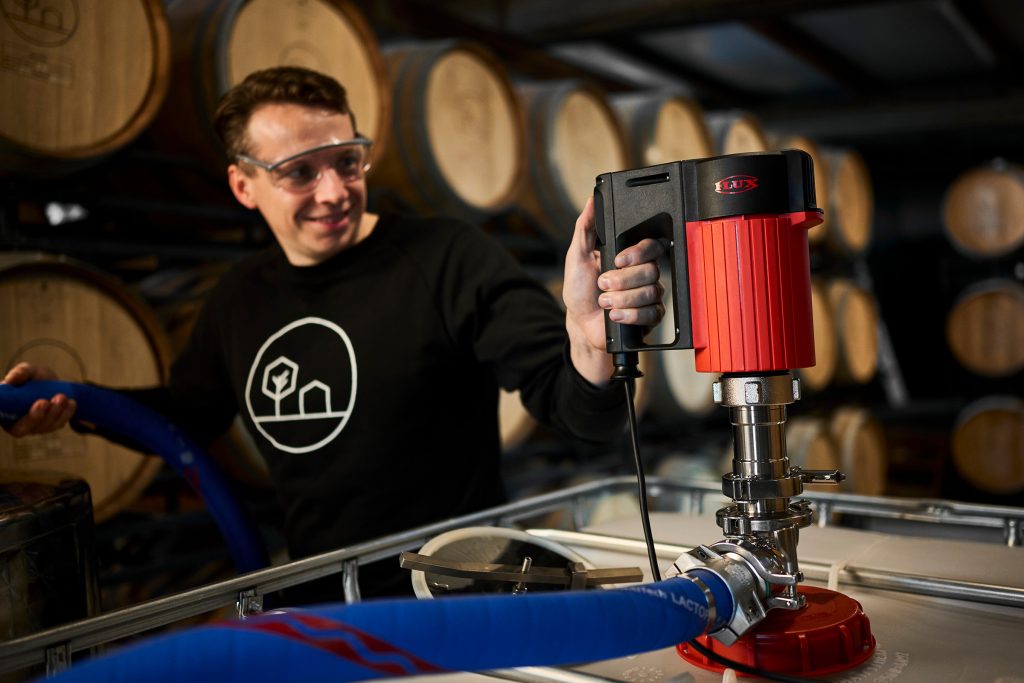
  FLUX Pumps, a Georgia-based company, is a global leader in the arena of flow technology, and it creates pumps for breweries, distilleries and other industries. For more than 70 years, the company’s innovations have drawn upon the invention of the first electric drum pump responsible for FLUX Pumps being established.

  Glenn Mulligan, president of FLUX Pumps, says new products are in store for 2023.

  “In 2023, we will be releasing our new VISCOPOWER product line,” Mulligan said. “These pumps will replace our existing F550 and F560 pump models. The new pump design is much easier

to dismantle and assemble, which reduces cleaning time and maintenance time while simplifying the pump design. VISCOPOWER pumps will also be built from a modular configuration that allows for streamlined spare parts, while still offering a pump design that can be customized to a degree for each customer application. VISCPOWER products will continue to stand the test of time in durability and product quality, both of which are customary to FLUX products.

  Other products for FLUX in 2023 are standardized offerings of flow meters and control panels that can turn your standard drum or tote pump into a one-touch batching/metering system. Too often, companies rely on operators to dispense just the right amount of product for their needs. By adding just a few components to the pump, we are able to give customers accurate, repeatable dosing, which will save time and money and prevent mistakes. We have also partnered with a company so that FLUX can also provide high-quality drum and tote mixers/agitators for customer needs. This gives our customers the ability and peace of mind to buy everything they need for moving fluids from drums and totes from a single source.”

  The Yamada Corporation, which touts itself as an industry leader in pneumatic pumping technology, is headquartered in Tokyo and has been in business since 1905. It has facilities in the Netherlands, Shanghai and the United States. The stateside facility is a 40,000-square-foot, state-of-the-art complex in Illinois known as Yamada America, Inc., equipped to provide service and support for a full array of Yamada industrial pumps and parts for the company’s clients throughout the Western Hemisphere. 

  Yamada offers diaphragm metal and plastic pumps. Its metal pumps are best used for waste yeast, sump and general wastewater. Its plastic pumps are used for CIP chemicals, wastewater treatment chemicals and also general wastewater. The pumps are used in liquid transfers, including liquid hops, liquid sugars, bottling, keg-filling and hops slurry.

  Specific tools and industrial equipment promote safety in the production and quality of the product for breweries and distilleries. Knowing what to consider in selecting these products comes with choosing the right company that can guide the process from purchase to customer support.

Vodkows, Crystal Heads and Icebergs-Oh, My!

By: Tod Stewart

Writing about vodka some years ago, I joked that for $25, you could get something that smells and tastes like nothing $55 gets you the “premium” version of something that smells and tastes like nothing, and $100 gets you the “ultra-premium” version that’s been distilled nine times and filtered through six feet of diamonds, ensuring an ultra-premium smell and taste of nothing. Somewhat ironically, the top-selling vodkas at the time were the flavored variety.

  Technically, vodka is deemed a “neutral” spirit and is produced as such in most international markets. In Canada, however, more and more vodkas are becoming less and less bland.

  “Vodka! Tasteless alcohol in most places but not here in Canada,” reports Davin de Kergommeaux, co-author of The Definitive Guide to Canadian Distilleries. “Our regulators have decreed that traces of the feedstock can remain in the spirit, and so we have apple-based vodka with almost-hints of fruit, crispy rye vodkas and a most revolutionary Vodkow, distilled from fermented milk sugars. It’s creamy palate nearly betrays it, but no, it really is vodka.” More on Vodkow in a bit.

  To understand the evolution of vodka in Canada – and to better understand how some changes to Canadian regulations have altered the playing field for makers of “craft” vodka – it helps to get a high-level view of the industry.

  “Vodka, by tradition, is neutral, for sure, and it is also very boring until mixed with something,” de Kergommeaux concedes. “What many people do not know is that – across North America at least – some of the biggest names simply purchase beverage-grade alcohol from alcohol plants, filter it until it matches their profile and bottle it as their brand. By definition, each country makes its own laws, and in Canada, our laws – regulations really – require distillers to filter the spirit they use to make vodka but do not require that they remove all the flavor.

  “American regs are equally permissive, but in a different way, in that they define “neutral” as something that we in Canada do not consider to be neutral, and definitely not flavor-free. This focus on laws and what is legally vodka has pushed spirits production towards finding the legal loopholes, then filling them as inexpensively as possible. But that is not what is happening here. If the big players can buy alcohol from fuel plants and call it vodka, then I think it is fair that the smaller players be permitted to make vodka within their practical limitations, and that means leaving some traces of feedstock flavors in the final spirit. And we, as consumers, benefit because some of these new vodkas are quite tasty.”

  Going back to the Canadian regs de Kergommeaux cites, they were originally introduced by the federal government in 1959 and remained unchanged until a couple of years ago. The old definition stated that for a spirit to be labeled as “vodka,” it “…shall be a potable alcoholic beverage obtained by the treatment of grain spirit or potato spirit with charcoal to render the product without distinctive character, aroma or taste.” As of 2019, the definition reads that vodka “…shall be a potable alcoholic distillate obtained from potatoes, cereal grain or any other material of agricultural origin fermented by the action of yeast or a mixture of yeast and other micro-organisms.” The move was introduced to “…enhance economic competitiveness and improve trade.” Raw materials can now include things like honey, apple or dairy in vodka production in order to expand consumer choice and be more in line with vodka definitions in the United States and the EU.

  The upshot of the easing of restrictions has, as de Kergommeaux alluded to, been an uptick in the number of rather unique vodkas produced across the country, with a few of the smaller craft distillers definitely pushing the envelope. While the regulations still state that a Canadian vodka must be “…without distinctive character, aroma or taste,” one wonders exactly what defines “distinctive.”

  For example, the Liberty Distillery on Vancouver, British Columbia’s Granville Island distills a vodka that uses local, organically-grown oats as its base ingredient. It’s definitely aromatic, with traces of toasted nuts, white flower blossom and subtle fruit. It’s nicely viscous on the palate, with peppery end notes. Then there’s the aforementioned Vodkow.

  Though whey-based spirits are not unheard of (Wisconsin’s Copper Crow distillery and the UK’s Black Cow Vodka both produce them), they are hardly staples in most people’s liquor cabinets. (As an interesting aside, records indicate the indigenous people of the Steppes region of Central Asia had been converting milk to alcohol for thousands of years.)

  About a 40-minute drive southwest of Canada’s capital of Ottawa lies the sleepy town of Almonte, home of Dairy Distillery. It specializes in turning permeate (not whey, per se, but another milk processing byproduct obtained by removing protein and other solids from whey) into vodka. This is a beneficial thing for a couple of reasons. The first, obviously, is the end result: vodka (produced via the fermentable – and ultimately, distillable lactose). The second is that permeate disposal is headache-inducing, and anyone willing to take the stuff off a dairy farmer’s hands immediately becomes a good friend. A third bonus is that both distillers and dairy farmers can share in a revenue source.

  Unfortunately, fermenting milk sugar, as distillery owner Omid McDonald found out, isn’t quite as easy as fermenting fruit sugar. Regular distillers’ yeast doesn’t do the job. Learning of a yeast strain used in New Zealand to convert milk byproduct into fuel alcohol from a University of Ottawa biology professor (and employing the research of one of his students), a suitable strain was isolated, and Dairy Distillery was in business. Today it produces not only the original Vodkow but a range of (wait for it) cream liquors.

  I’m not sure how you’d react, but when I was first presented with a sample of Vodkow, I approached it with a degree of trepidation. I mean, there was something about a fermented, distilled, milk-based liquid that struck me as just, well, wrong. I was quite pleasantly surprised by what I tasted.

  Perfectly vodka-like in appearance (so, yes, the “colorless” part of vodka: check). Odorless? No way. I’d even go as far as to say the creamy, almost vanilla aromatic profile is decidedly “distinctive.” More vodka-like in flavor (meaning less of it), there were still sweet cream notes nestled among the peppery nuances. And there were certainly some lingering lactic notes in the otherwise clean, crisp finish.

  Of course, not all Canadian vodkas deviate from what would be considered more or less “traditional” local ingredients.

  Up until a few years ago, Prince Edward Distillery, situated not surprisingly on Prince Edward Island, was making vodka from locally-grown potatoes, a ubiquitous island crop. It’s now permanently shuttered, but the potato vodka torch is currently carried by Blue Roof Distillers in neighboring New Brunswick. In Alberta, rye whisky specialist Alberta Distillers Ltd. (ADL) crafts Northern Keep Vodka from a mash of primarily prairie-grown rye, with a percentage of winter wheat, while Dillon’s Distillery (see the December – January issue of Beverage Master for more on Dillon’s) in Niagara, one of Ontario’s wine regions, crafts a grape-based vodka (this would fall into the “less traditional” bucket, but it’s certainly local). And could there be such a thing as “varietal” vodka?

  Crystal Head Vodka, the one co-conceived by actor Dan Aykroyd and that comes in a bottle shaped like a glass skull, produces a range of vodkas, each using a different base to impart distinctive qualities.

  “Crystal Head uses only the highest-quality ingredients to create unique expressions of ultra-premium vodka,” points out  Daniella Vizzari, the brand’s marketing manager. “Our original vodka is crafted from locally sourced Canadian corn, offering a silky-smooth vodka with a hint of sweetness and vanilla. Aurora uses the highest-quality English wheat, offering a crisper, drier, bolder vodka. Our latest expression of vodka, Onyx, is the first globally available agave-based vodka with subtle hints of agave, citrus, green grass and white pepper. As a final distinctive touch, all expressions of Crystal Head Vodka are blended with Newfoundland water and filtered through Herkimer diamonds.” (See, I wasn’t kidding about the diamond-filtering thing.)

  Incidentally, the skull-shaped bottle caused much consternation among the province of Ontario’s liquor board (LCBO) executives, who worried that such a package might cause acute psychological trauma to any customer exposed to it – and bring on an inevitable lawsuit. I’m likely exaggerating things just a bit (but just a bit). Yet initially, the possibly offensive vodka was banned from the market. The public was not amused (nor traumatized when the bottles finally hit the shelves). If other Canadian markets could have it, why not Ontario?

  “The LCBO believed the skull-shaped bottle represented death,” recounts Vizzari (likely with a smirk…just saying). “Our bottle has always been a happy skull and a symbol of life. During this time, consumers pulled through for us. They wrote letters and web campaigns asking why it was unavailable in Ontario. Crystal Head Vodka was designed with the creative spirit in mind by creative people. Today, we continue to disrupt the industry with one-of-a-kind packaging and innovative thinking.”

  Of course, one very important vodka-distilling component hasn’t been mentioned yet: water. Marketers love to prattle on about cool crystalline waters bubbling down from glacier-fed mountain springs (and blah blah blah) as the water source for their brands of vodka. Newfoundland’s Iceberg Vodka would appear to have them all beat.

  I was somewhat skeptical about the brand’s claim to use water actually sourced from north Atlantic icebergs. I mean, c’mon. So I posed the question to Iceberg brand manager Karen Lai: Do you actually harvest icebergs to produce Iceberg Vodka? If so, how exactly is this accomplished?

  “Yes!,” she enthusiastically replied. “We use actual iceberg water in our iceberg vodka, which is what makes our vodka so smooth. It is the purest water you can find since it’s been frozen for tens of thousands of years. The process begins when iceberg bits break off from the Arctic and floats down past the coast of Newfoundland. The iceberg bits are tracked, then melted down to water that is used in our vodka.”

  Who would have thought?

  Vodkows, Crystal Heads and Icebergs: just a few of the characters redefining the spirit of Canadian vodka.

Beer Wholesalers: 5 Best Practices to Control Costs

Cost increases are Cost increases are coming from everywhere these days. Here are 5 Best Practices you can use to control and reduce costs in your beer business.

Use These 5 Best Practices to Control Costs

  1. Create a Financial Road Map
    • Purposeful spending
  2. Adopt a Zero Based Budget Mindset
    • Costs must justify themselves
  3. Review Vendor/Supplier Spending
    • Sort $ high to low
  4. Use Purchase Orders
    • Make it hard to spend money
  5. Set Regular Financial Reviews
    • Variance analysis, trends, ratios

Watch the 3 minute cost control video for your beer business

Buying New or Used Equipment & How to Decide

bronze brewing machine

By: Kris Bohm, Owner of Distillery Now Consulting

When it comes to starting a distillery or a brewery it takes money to make it happen. In most cases it can literally take millions. The cost of the equipment is a big chunk of the cost required to start up a beverage alcohol business. Most folks who start a business will buy all new equipment. An alternative to the high price tag and long lead times of new equipment is to buy used equipment. When it comes to buying used equipment there can be many hidden costs and problems that come with what outwardly appears to be an excellent deal. By seeking to understand the hidden costs and potential problems that come with used equipment you may just uncover the perfect opportunity to land a deal on the equipment you need to start your business. Our aim is to help you avoid falling into the proverbial used equipment money pit. Let’s look through key considerations of buying used equipment and explore its potential.

  There are many reasons for wanting to buy used equipment instead of new equipment for a brewery or distillery. Lead time is a strong factor that drives folks to look at used equipment. In 2022 there have been massive disruptions to supply chains across many industries. Beverage manufacturing equipment is certainly one of them. For many manufacturers of equipment they now have lead times of well over a year. That means from the time you put a deposit on equipment to that equipment being delivered will almost certainly be beyond 12 months.

The opportunity to buy used equipment and take possession of it quickly has become an attractive option as a result. The downside here is that used equipment is in high demand these days and as a result the price on used equipment has gone up.

  There are many factors to consider when looking at used equipment. Age and condition are the two that are most important. As equipment gets older it can sometimes become hard to source replacement and repair parts. In some instances replacement parts do not exist and will need to be manufactured or redesigned which can be costly. The key here is to be diligent. Take some time to talk with the manufacturer and ask if they are available and willing  to continue to support the equipment they built. Here is an example of a situation where this occurred.

  There was an equipment manufacturer (who will not be named) but we will call them Acme in this example. Acme Company built equipment that looked great but their engineering and quality of manufacturing was shoddy. Acme went out of business only several years after opening due to lawsuits from equipment buyers.  A person new to the industry bought some equipment from Acme second hand that was still in crates unused. The buyer quickly bought the new and unused equipment from a 3rd party seller at what appeared to be a good price but did not do any research. Acme is no longer in business, and buying replacement parts for the equipment is impossible. When the time came to assemble and start the equipment there were many missing parts. To make it worse the equipment needed major repairs just to function as parts of the equipment were not operable. For the folks who bought this equipment, they had to spend lots of money and time to have custom work done just to make the equipment function. The repairs and replacement parts were so costly that the buyer would have spent less money on new equipment from a reputable manufacturer. 

  If the equipment comes with automation and controls the age of the equipment is critical to consider. Some older equipment does not age well and can in fact be more outdated than an 8 track cassette player. This is not to say that old controls or automation will not work, but there is a strong chance they can break and become unrepairable. If the used equipment is decommissioned and sitting in a warehouse it may not be possible to test the controls. If the controls cannot be repaired they may likely need to be replaced. The cost of replacement can eat up the money saved from buying used in the first place. Furthermore the cost of parts on older controls can sometimes be astronomical. The best way to test this before buying it is to buy equipment that is currently operational and can be tested.

  An important consideration is the cost of relocation. The cost of taking possession of the used equipment can vary hugely from one opportunity to the next. In most cases the equipment can be removed quickly and cleanly in the hands of skilled tradesmen. Most of the time there is room to disassemble and remove the equipment and also a door that allows for easy removal. In some instances this is not that case. There are some facilities that are literally built up around the equipment. In most cases continuous column stills in distilleries are installed via crane. In these cases removal of the equipment can be quite costly and require extensive building demolition and heavy equipment to carefully extract the equipment from a building. In one instance we saw a distillery in which the column for vodka distillation was encased in a metal and glass shaft. To remove the column required extensive demolition and a crane to extract the column from the building. After reviewing a plan and considering the value of the column we found that the cost of removal and relocation was going to negate any savings from the lower cost of the used equipment. This instance was one in which the buyer backed out of the purchase after investigating the cost of relocating the equipment.

  A common question asked by those buying used equipment is why are they selling it. The owner of the equipment can be selling it for a multitude of reasons, and it is an excellent question to ask. It is common for a business to outgrow its equipment capacity and sell its equipment to make room for larger equipment. Sometimes a business is closing permanently and is selling its equipment to liquidate the business. New entrants to the industry often ask how it works to buy used equipment. The transaction of buying used equipment is straightforward.  The seller of the equipment and the potential buyer connect and work to meet an agreed upon price and terms on purchasing the equipment. The agreement will often include a written contract that stipulates what equipment is being sold, how much time is there for the equipment to be removed, timeframe for deposit and payments, details on process of decommissioning and costs associated. If the buyer of the equipment is unsure of how to approach this process it is wise to hire a group or consultant to assist with this process. Typically a 3rd party will handle the disassembly, crating and relocation of the equipment. The process of decommissioning and relocation definitely has a cost so it is important to consider this in the overall cost of purchase.

  There are many factors to be considered here before buying used equipment. Although there are stories of bad deals, there are many more stories of success. In some instances, we have seen and helped folks save tons of money through buying used equipment. We hope you will give careful consideration when buying used equipment. If you are unsure whether or not to buy used equipment, it is best to bring in a professional to aid in your assessment of a potential purchase.

Retaining Loyal Customers

customer retention statement

By: David Wachs, CEO of Handwrytten

Nearly every industry has been impacted by rising prices. While the price of craft beer, hard seltzer, and cider has not risen nearly as quickly as gasoline or groceries, prices have gone up. In addition to ongoing shipping delays and labor shortages, rising prices for grain and fertilizer after Russia’s war against Ukraine is intensifying price increases. Restaurant prices have had the largest gains since the 1980s, also reflecting higher costs for food and workers. As consumers become more discretionary with their spending, they have been paying more attention to prices across brands and have even been willing to ditch brands they have been loyal to for years to spend less whether they are enjoying a beverage at home or at a restaurant.

  Retaining loyal customers and recapturing their purchasing power once their budget can afford it or prices return to lower levels is reliant on brands having open and transparent communication with customers during inflation. While no one enjoys paying more for goods and services, it is something everyone is being impacted by, creating a universal understanding and acceptance that prices must go up. However, that does not mean that customers will be amenable to drastic or sudden price jumps, increases that seem out of alignment with competitors, or higher prices that appear to last longer than necessary.

  Most marketing and sales experts would agree that customer retention is more cost-effective for a business than new customer acquisition. As consumers and businesses watch their discretionary spending and cut back on perceived extras, savvy companies will invest more effort into maintaining positive relationships to protect their bottom lines. However, receiving an email, text message or phone call may be the last thing a customer wants. 

  They might also be the last thing a customer pays attention to. The amount of promotional email the average person receives on a daily basis can be overwhelming. Not to mention that many email services now allow users to filter emails considered to be promotional into folders where they may never be seen, let alone opened and read. Text messages from unknown numbers typically stir feelings of suspicion. An unexpected text message might even be viewed as a smishing scam trying to steal personal information. A handwritten note is entirely different, it invokes curiosity versus fear or annoyance.  

  Nothing says “pay attention” like a personalized handwritten note. No one flips past or does not see a handwritten envelope in their mailbox. These stand out from everything else that was delivered. Recipients wonder what could be inside and while envelopes that look like bills or advertisements and graphic postcards are set to the side, handwritten envelopes are usually opened immediately. The attention-grabbing nature of a handwritten envelope provides an instant advantage that even the biggest and most prevalent direct mail marketers cannot overcome.  

  Spending hours writing notes by hand can be prohibitive, especially for businesses that have been struggling to hire, so consider hiring a robot to pick up a pen and do the writing instead. Handwritten envelopes have been found to have a 300% greater open rate than standard envelopes. And handwritten marketing has response rates 7-21x greater than printed mail, with a return on investment 3-7x greater than print. Some companies have even found that retention rates are 50% higher for customers who receive a handwritten thank you note.  

  The value of sending a handwritten note is enhanced by integrations with CRM systems that automate the process of when to send a note to a customer and what message to include. For example, a brewer can automate notes to send to customers on the anniversary of their joining a loyalty program, when there are special deals or limited time offerings, events taking place at local tasting rooms, or on other special occasions like customers’ birthdays. 

  A handwritten note could even be used to explain to customers why price increases are happening. While an end consumer might have heard that the cost of fertilizer has gone up, that there is an aluminum can shortage, and that labor costs are rising, that does not mean the will think of these things when they are standing in the refrigerated section at the grocery store or ordering from a menu at a restaurant. In that decision-making moment, brewers do not want to be a faceless corporation that is raising prices to take advantage of a consumer. A more advantageous situation would be to be the brewer who sent a handwritten note thanking that customer for remaining loyal to the brand, when possible, despite price increases that were necessary for x, y and z reasons. Reminding customers of the people behind the production scenes of their favorite beverage and explaining the challenges being face humanize the situation and remind customers that everyone is in this together.

  Not all of the information a brewer may want to communicate to customers could be explained in one card, but that tool could be the gateway inviting a customer to visit a landing page that breaks down the need for price increases. Instead of just skirting the issue with a message from the founder, dive into the issue. Profile employees who go to great lengths to get to work on a daily basis and highlight the increased cost for them to put gasoline in their vehicles. Explain the challenges being faced by farmers who have had to pay more for diesel to run farm equipment, on top of fertilizer costs that rose 80% in 2021 and another 30% or more in 2022. Provide insights into the costs of operating the brewery and how higher energy bills might be impacting the bottom line. Knowing they why and how behind price increases will certainly not help retain or win over every customer but making the effort could be the difference-maker for some people. And if others cannot afford to continue buying while prices remain high, the good intentions of a brewer’s transparency could be what brings that customer back sooner or wins them over from another brand once prices are reduced. Especially if they feel a brand that they were fans of in the past took advantage of the situation and turned inflation into “greed-flation”.

  In addition to providing insight to customers about why price increases are happening, invite and give them the opportunity to provide feedback and ask questions. Ensure that customers have multiple avenues to contact a customer service representative at the company and that feedback and answers are provided in a timely manner. Allowing customers to provide feedback makes them feel more invested in the brand and can help build stronger relationships that can withstand difficult times.

  By offering customers opportunities to provide feedback via the company website, email, or social media channels, brands can have more control over their ability to monitor and respond to the feedback they are receiving compared to customers leaving feedback and reviews on public forums or other social channels that are more difficult to track and can damage reputation. Responding to customer feedback is just as important as asking them to provide it.

   Customers will feel more valued, appreciated, and heard by a company that thanks them for supporting the brand. And if feedback is negative, a brand might be able to win over a new customer while impressing those that are already loyal by listening and maybe even implementing change based on customers’ opinions. This makes customers feel that their feedback did not go to waste and was important. Building a feedback loop with customers creates more of a community, can help with customer retention, and is what brands that last the tests of time get right. Imagine getting a thank you note from a brand because of a review left on a website or commentary posted on a social media channel. Most customers would be amazed that a brand would care enough to go to that effort and would remember it.

  There is no quick fix to help businesses recover from pandemic complications and now inflation. How deeply inflation will impact consumer spending habits remains to be seen. Identifying ways to recruit and retain employees as costs increase and labor shortages persist will take creativity and new approaches. As brewers develop solutions and evolve to thrive in the post-pandemic era, the need for effective communications will not diminish. After two years of a seemingly never-ending stream of new problems, making the most of upcoming opportunities will be critical to making 2022 as successful as possible.

CO2 Struggles Breed Innovative Practices & Alternative Gas Use

bubbles accumulation close up

By: Gerald Dlubala

Shortages, surcharges and sketchy availability: that’s not what any craft brewer, distiller or winemaker wants to hear about their supply stream. Yet that’s the reality that many brewers have been, and still are, living with after the pandemic played havoc with CO2 (carbon dioxide) availability.

  The lack of regular, planned delivery and variable costs and surcharges of CO2 has brewers looking at ways to cut their costs or amount of usage of CO2, including replacing CO2 with nitrogen in some capacity. Nitrogen is readily available and an inert gas that does not typically   react with its surroundings, so there’s no worry of adverse reactions with the brewed products.

Reducing and Replacing CO2 Use

  Matt Malloy is the founder and CEO of Dorchester Brewing in Boston, Massachusetts, a contract partner brewery usually brewing for and partnering with 12 to 15 breweries at any given time. When facing a 75 percent reduction in planned CO2 deliveries from their supplier, Malloy knew it was time to look into new and alternative ways to keep his taphouse and brewery producing, especially as he is responsible for brewing beer for his partner breweries.

  “We’ve long had a great relationship with our gas supplier,” said Malloy. “But this became a serious issue for us. We are a contract brewer for others, so production and quality are always our absolute priorities. We adhere to strict best practices with the required equipment for our industry and have to perform at a certain expected level. We have a bulk CO2 tank but couldn’t get the supplies necessary to keep us going, so we had to start looking at other options and even other suppliers than we had previously. We began by looking at where we use CO2 in our production. (Like other brewers, they found it in use virtually everywhere in their process.) We decided that the 25 percent supply we could get would go towards the most needed tasks. Then we would look for alternative solutions for other tasks that would cut the CO2 usage or, in some instances, replace the need for CO2 altogether with a better, more economical option. In our research and testing (Dorchester Brewing has a full-time quality control and testing lab), we found that we could initially replace CO2 with nitrogen in our canning, seaming and kegging operations. Additional notable savings came from using it to purge our two 60-bbl and one 120-bbl brite tanks. It was pretty much a one-for-one swap between CO2 and nitrogen. Our gas supplier helped with suggestions, and we were able to use our current piping systems by installing T-valves for switching use to liquid nitrogen supply, vaporizers and dewars when needed. We also found that cleaning under pressure used less gas than cleaning in place. All of these changes were made incrementally, using slow and steady testing to ensure that using nitrogen in place of CO2 did not compromise the quality of the beer in any one step of change.”

  Malloy told Beverage Master Magazine that one very effective thing he and his brewers started doing is incorporating the German method of Spunding in their brewing process, using special valves attached to your tanks. Spunding literally means bunging, and the old German technique is making a comeback and something that Malloy says every craft brewer should at least try. It involves carefully monitoring the present gravity and sealing off the tank after the initial, aggressive fermentation stages have been completed. Once the wort ferments to near the targeted final gravity and orifices are closed off, you set the Spunding valve on the tank to your desired hold pressure setting. The valve’s attached gauge monitors PSI levels, and any levels above your set pressure tell the variable pressure relief valve to open automatically and release pressure down to the preset level when the valve will once again close. Spunding traps the naturally occurring CO2 created during fermentation so that it absorbs into the wort as it turns into beer. When done correctly, a brewer ends up with a perfectly carbonated beer ready for packaging and a decreased need for additional purchased CO2.

  “Right from the start, we reduced our CO2 needs by 30 percent,” said Malloy. “Spunding saves us money, but I also believe it makes better beer. There is an increased sense of quality with better aroma components. We are making better beer, with less cost and more flexibility.”

  Malloy encourages brewers to initially consider ways to save on and reduce CO2 usage before blindly transitioning everything to nitrogen.

“As brewers, we have to be super nimble and flexible in our thinking,” said Malloy. “Here at Dorchester Brewing, we’ve looked at and studied every step in our brewing and production process. As a result, we now see some of the duties that traditionally call for CO2 use, like purging and blowing down, as valid ways to use nitrogen instead and save money.”

  Malloy says that Spunding, combined with an intense review of brewery practices, has gotten their facility down to a 50 percent reduction in the amount of CO2 they would typically require, but he’s not stopping there. He is currently testing nitrogen use in his can seamers and fillers. As a result, he expects to reduce his CO2 deliveries from once a week to once a month, resulting in even more savings.

  Nitrogen offers a way to create your own gas supply or have a less costly bulk option. Onsite nitrogen generators provide nitrogen on demand and, depending on use, can pay for themselves in a short time, sometimes within the same year. Cryogenic bulk tanks offer an onsite nitrogen supply with fewer deliveries, and dewars are available for more minor production needs.

Innovation Leads to a Change in Philosophy and Brewery Practices

  “Spunding and nitrogen use have changed how we approach brewing, but those practices have also built a new philosophy within our brewery,” said Malloy. “We are always looking to improve, and now we see a change in behavior within our team. We’ve changed cleaning protocols and team behavior. Our team now sees value in every pound of gas used. Each pound used is sacred, and this type of thinking breeds innovation. We’ve used these protocols with all our brews, with no issues, differences or deficiencies noticed.”

  Malloy says that these changes help production, but just as significantly, they also add up to reduced costs for brewers. The cost savings in buying bulk is significant, with some breweries paying up to eight times as much for supply as Dorchester Brewing.

  “I would recommend that craft brewers first look at all of their production tasks in detail and, where applicable, incorporate the Spunding valves in their process,” said Malloy. “The upfront cost would be that of the valves, but the savings resulting from Spunding can be significant. Getting caught short can cause irreparable harm as a craft brewer, so you should also work with your gas supplier to investigate and research the possibilities of using nitrogen for as many practices as possible. It’s a win-win situation for both of you.”

  Malloy is invested in the brewing community and is willing to discuss his experiences and help to show other craft brewers how they can start reducing costs through Spunding, nitrogen use or both in their brewery, pub or taproom. In addition, Dorchester Brewing offers free lid seaming checks and DO (dissolved oxygen) testing for area brewers.

Reusing Produced CO2 Through Carbon Capture: Earthly Labs

  Due to the nature of the brewing process, breweries produce large amounts of CO2. With CO2 supplies being in such short and erratic supply, plus variable pricing structures, it may make sense for breweries to consider recapturing some of that produced CO2 for their use. Earthly Labs, a division of Chart Industries, is at the forefront of CO2 capture technology, manufacturing plug-and-play carbon capture units that enable a brewery start capturing and using their own produced CO2 within one day of installation.

  The Earthly Labs CO2 capture technology is designed to capture CO2 waste from smaller sources that ultimately make up more than half of all CO2 emissions. For breweries specifically, this translates to allowing brewers to capture their own produced CO2 and subsequently purify it to food-grade gas for reuse in the packaging and carbonating processes.

  Using recaptured CO2 for your beer immediately allows a brewer to reduce CO2 purchases and the associated delivery fees and surcharges. Additionally, peace of mind comes with decreasing worries and making an environmentally conscious decision to increase sustainability. Earthly Labs compares the capture and reuse of CO2 to brewers or distillers disposing of spent grain because it is also a way to become more sustainable while also simultaneously benefitting your brewery’s bottom line.

  Amy George, founder and CEO of Earthly Labs, says that while distilleries and wineries don’t have the amount of need that breweries have, they are also in the early stages of showing interest. Distilleries are continuously looking for ways to reduce their carbon footprint, with some having plans featuring net zero carbon futures. Wineries are also exploring ways to capture and reuse CO2 onsite to help with tank purging or carbonation needs for specific products.

  George says that their CO2 capture units are about the size of a double-door refrigerator and can be running and capturing gas the next day after installation if the brewery is producing gas. Training is straightforward, taking one to two days. After that, the brewery employees will be fully able to use the system under the oversight of the Earthly Labs team. Additional support is always available, including the possibility of remote monitoring. Return on investment timetables varies by producer, based on the amount of gas captured versus what a craft producer would have to pay for supply, surcharges, frequency of delivery, and more. As the price of CO2 rises, the return-on-investment timeline shortens, but on average, the client can expect the units to pay for themselves within two to three years.

  Earthly Lab’s units are currently in use by breweries and craft producers of all sizes, but George says that the sweet spot for their workhorse unit, the CiCi ® (Oak), is for producers in the 5,000 to 20,000 bbl range. They can accommodate smaller producers with their CiCi ® (Teak) units, and larger producers will benefit from their CiCi ® (Elm) units.

  George believes the complex, ongoing supply and delivery conditions will ultimately lead breweries to explore ways to remain viable and become more efficient in their operations. This includes capturing the CO2 waste for reuse that would typically be released into the environment and looking at replacement alternatives for CO2 within production operations. 

  Earthly Labs works to accommodate all producers, including offering a winery leasing program to provide flexibility during harvest seasons and to help eliminate the upfront expenditure by spreading payments into more manageable monthly programs. Additionally, the recently passed Inflation Reduction Act also allows for tax credits for these types of purchases.

  Chart Industries CO2 storage solutions and partner networks offer opportunities to turn waste streams into value for businesses while reducing environmental impact. Chart also partners with buyers and distributors to help sell excess CO2 to other partners in the exchange ecosystem. The ultimate goal is to reduce as many emissions as possible to help achieve overall climate goals.

Customizing Beverages the Easy Way

can beers in a beer table

By: Angelo Coletta, CEO – Zakeke

Enabling customers to customize their purchases is a quick and easy way to expand into new markets and boost profits. Some distilleries and craft brewers are beginning to take advantage of this innovative approach to scale their businesses. For example, Silent Pool Distillers increased their orders fivefold in 2020 in part with the help of product customization.

  Possibilities abound for other distillers and craft brewers to do the same. Moreover, it’s easier to enable customization than most business owners think. Today’s product customizers offer automated processes that reduce the required amount of attention and manual labor to little or nothing.

What is Product Customization?

  Product customization allows customers to change the visual appearance of products according to their own individual needs and desires. Sellers empower consumers to build their own unique products, perhaps by adding their names or those of others. Depending on the specific product and customization service, customers may also be able to add photographs or longer messages of their own writing. In a sense, the product becomes a canvas for them to create upon.

  Some of the beer, wine, and spirits industry’s biggest names allow their bottles to be customized, offering proof of concept. Tito’s Vodka and Hennessy VS Cognac bottles can be etched, and a large selection of bottles can be engraved, including Don Julio tequila, Woodford Reserve bourbon, and Dom Perignon champagne. Other makers, such as Maker’s Mark, Jameson, and Jack Daniel’s, offer bespoke labels. Silent Pool Distillers does this for four of their distinctive gins.

  A wide range of items can be customized, including purses, jewelry, keychains, apparel, towels, and bedding. There are even services that customize things you wouldn’t expect, like USB drives, coffee sleeves, drinking straws, bobbleheads, and — believe it or not — cookies or cakes.

Why Enable Product Customization

  The answer is simple: product customization improves the bottom line. According to a 2019 Tech Clarity survey of 285 companies that offer customization, 71 percent listed increased sales as one of its benefits. More than 50 percent pointed to differentiation and higher margins. Thirty-five percent nodded toward customization’s “cool factor,” and 34 percent said they experienced higher close rates. Forty-two percent indicated that offering customization had become a necessity in their industry to stay competitive.

  Product customization elevates profitability for a number of reasons. First, customers are willing to pay more for customized products. According to Bain & Company, they will reach into their wallets to the tune of 20 percent more than the uncustomized version. This means manufacturers who customize can set higher prices. Meanwhile, they don’t incur new costs, since automated processes minimize the work required. While customers may only purchase a single customized item or a small lot, these sales are a painless way for the business to expand, and they do add up.

  Secondly, product customization encourages customer loyalty. The same Bain & Company report also found that, “customers who had customized a product online engaged more with the company. They visited its website more frequently, stayed on the page longer and were more loyal to the brand.”

  Happy customers can result in repeat business and referrals to their friends and family. The ability to customize sets a business apart, distinguishing it from competitors in the eyes of consumers.

  If that wasn’t already enough, Bain reported lower rates of return for customized products than for their mass-produced counterparts. When customers take ownership of the look and feel of their purchase, they tend to be more satisfied with the outcome and less likely to change their minds.

  All of this adds up to increased sales and a better business.

Why Customers Love Customization

  Customization appeals to customers for many reasons. Part of the draw is that it makes customers feel special. They are willing to invest their time and effort into creating a unique product that is tailored to their own tastes and exacting requirements. Since they are the ones who determine what the final product looks like, it is sure to please them.

  Another reason is that customization provides customers with a sense of control, that all-too-scarce commodity in today’s hectic, stressful, and sometimes overwhelming world. They are in the driver’s seat throughout the process. This is one element of their lives that they can impose their will upon and be confident of receiving gratification.

  It can also be just plain fun. For instance, Silent Pool Distillery’s user-friendly website steps prospective customers through the creation process. After clicking on the option to personalize their gin, they are taken to a new web page with four varieties that may be customized: Original Juniper, English Garden, Fresh Grapefruit, and Spiced Pepper. When customers click on the name of the flavor they want to purchase, a new page comes up with the product’s specifications.

  Beneath the “Add to Cart” button, a “Customize” option takes customers to an interactive interface where they design their bottle’s label. A large button with an upward-pointing arrow invites them to upload photographs of themselves, their loved ones, pets, or places special to them. Alternatively, they may choose from a library of 140 million stock photos arranged by helpful categories like “Business & Finance,” “Sport & Extreme,” or “Travel and Vacations.”

  Next to the upload arrow is a button that allows clients to add text to the label, giving it a special name or writing warm messages to recipients. Customers can change the font size, make the text bold, position it anywhere from top to bottom, center the words, or align them to the left or right. They can even bend the letters along a curve of their own making. Magnifying glass icons allow them to zoom in to view fine details or zoom out to gauge the overall look.

  If a given component starts to mess up the label, then the customer can delete it. If the whole design ends up being a disaster, they can reset the label with the click of a button and start over.

  The result is a unique, bespoke bottle of high-quality, sustainable gin that’s perfect for gift-giving on birthdays, anniversaries, and holidays, as well as for celebrations, bachelor and bachelorette parties, showers, and weddings.

  Throughout the process, customers delight in the knowledge that they are putting together a one-of-a-kind present. Surprise is guaranteed: No matter how hard the recipient might try to guess what’s coming, they will never be able to guess what this gift is going to look like. Connection also seems assured — people tend to react positively to seeing their own name on an item, which often translates to feeling good about the person who gave it to them.

No Hassle Customization for Sellers

  Savvy distillers and craft brewers are understandably wary about adding a new feature to their already complex businesses. The last thing sellers want is to labor over a single item. Luckily, those days are over. Today’s customization services integrate with business’s existing websites and simplify the customization process itself.

  Take the case of Silent Pool Distillers. The distillery got their start offline, producing artisanal spirits with local ingredients in the Surrey Hills Area of Outstanding Natural Beauty, a nationally protected landscape in the United Kingdom. To take advantage of online sales, they built an online storefront on the e-commerce platform BigCommerce. Thus, the distillery was well positioned when the COVID-19 pandemic hit, closing pubs and restaurants in droves. The spurt in online shopping boosted their sales to new levels.

  When the business sought a way to start customizing their products, they wanted a service that would integrate with BigCommerce and not force them to reinvent their online shop. They chose Zakeke, a visual commerce platform that works seamlessly with not only BigCommerce, but also many other ecommerce platforms, including Shopify, Etsy, Wix and WooCommerce. It can also employ an application programming interface (API) for integration if needed.

  Silent Pool Distillers installed Zakeke’s software and configured its easy-to-use “plug and play” system. In the context of information technology, “plug and play” means software that does not require users to understand programming or make any adjustments. Instead, it is designed to work well immediately from the moment it is brought to life.

  After this initial setup, the distillery’s preexisting online shop gave customers access to Zakeke’s cloud-based platform for designing their own labels for certain products. Since the process is automated, this personalization happens without requiring attention from the seller. Once an order is placed, all employees at Silent Pool Distillers need to do is download the customer’s file, print it out, and attach it to an appropriate bottle.

  By equipping the Silent Pool Distillery to offer bespoke labels on their bottles, Zakeke boosted their sales while allowing the distillers to remain focused on what they do best: making high-quality spirits.

The Power of Personalization

  Today’s customers increasingly expect the ability to personalize their products. A 2020 report by Dassault Systèmes and CITE Research found that 83 percent of consumers “expect products or services to adapt [to their individual specifications] in a matter of moments or hours.”

  The future belongs to businesses who can meet this challenge. Local distilleries and craft breweries stand to gain by incorporating customization, just like the big names in the industry. Branching out in this direction enabled Silent Pool Distillers to capture a valuable new market segment and increase sales even during the dark days of the pandemic.

  The power of personalization helps retailers please long-standing customers and attract new ones. That’s why distilleries and craft brewers of all kinds should consider adding product customization.

What to Do if EIDL Payments Become Due

SBA logo

By: Raj Tulshan, Founder of Loan Mantra

Restaurants, bars and other businesses within the hospitality industry were hit hard by the COVID-19 pandemic. For instance, restaurant industry sales in 2021 were down a staggering $65 billion from 2019’s pre-pandemic levels. During shut-downs, quarantines, social distancing and other pandemic-related disruptions, many hospitality businesses struggled or shut down, including 90,000 restaurant locations that temporarily or permanently closed because of COVID.

  During the pandemic, bars were forced to reduce capacity limits, negatively impacting their profitability. Reopening after quarantine was expensive, requiring costly adaptations, including air filtration systems, plexiglass dividers, equipment for touchless transactions, cleaning and sanitation supplies and personal protective equipment for staff.

  Hospitality businesses – like companies across many industries – also struggled with employee shortages, supply chain issues and soaring inflation.

  This “perfect storm” of unprecedented challenges led four million small businesses to take out $390 billion in loans through the Economic Injury Disaster Loan (EIDL) program. The EIDL was part of the U.S. Small Business Administration (SBA) and US Treasury as an expanded part of The Coronavirus Aid, Relief and Economic Security or CARES Act.

  Although the loan payments were deferred for two years, they’ve still been accruing interest until the first EIDL payment was due.

  Many small business owners have questions and concerns about the repayment process. The timing is not ideal, as many businesses – including restaurants, bars, hotels, and other hospitality venues – need funds to prepare for holiday sales and events.

If you took out an EIDL loan, here are some valuable tips to act:

      Contact:  Business owners can contact their local district legislators by calling, e-mailing, or writing letters to express concern. Loanmantra.com has put together a tool kit with:

        A sample form letter, an e-mail draft, a phone script and phone numbers to save time. Unsure of who a district representative may be? Find them here.

      Share:  There’s strength in numbers, so share this message with other businesses, business networks, chambers of commerce, businesses in the same area, associations and like groups.

      Reach out: Talk to people every day for the “sphere of influence” to gain community support.

      Ask for help: Don’t be afraid to ask for help when and where it’s needed.

Also, here are some valuable repayment tips:

      The loans won’t be forgiven:  Unlike the Paycheck Protection Program (PPP), EIDL loans won’t be forgiven and need to be repaid. All Economic Injury Disaster Loan recipients received an email from The U.S. Small Business Administration (SBA) with the subject line: Important EIDL Reminder, which contains important information regarding your EIDL account setup and payment.

      Set up a repayment schedule:  Payments were deferred for the first two years, during which, interest accrued. Now, business owners must start making their monthly payments on their due date, which is determined by the “Effective Date” noted on your business’s promissory note.

        Another payment can seem overwhelming stressful given inflation, staffing and supply-related pressures. Don’t look at the big picture. Instead, think about the incremental payments today as steps in the right direction. Set a calendar reminder or appointment to make this payment every month so you will stay ahead of schedule.

      EIDL loans must be paid via a special platform: There are two separate platforms you will need to access your loan information and pay your loan balance.

        First, Capital Access Financial System (CAFS) maintains your EIDL & PPP loan information. This includes your original balance, interest, accrued interest balance, etc. To obtain the EIDL loan information for your business, please select ‘EIDL’ and then ‘borrower search’ from the menu options. When registering on the CAFS website, carefully follow each step. There is no room for error when using this system, so be thorough and accurate when inputting your information.

        Secondly, pay.gov allows businesses to input their bank information and to set up recurring payments online. Inside your profile, choose ‘Make an SBA 1201 Borrower Payment’ as the menu option. While registering on pay.gov may be simpler than registering on CAFS, it is not easy to change bank account information after you begin your loan payments.

      Use the right number:  Keep in mind that your SBA loan number is different than your EIDL loan number. This information can be found on the top of the second page of the promissory note.

      EIDL loans accrued interest:  Many business owners received their first EIDL loan in early 2020 and a second EIDL loan in 2021. For many borrowers, that means interest has been accruing for more than 24 months, with additional interest accruing for more than 16 months. Borrowers are responsible for paying back the loan plus all accrued interest.

      This type of loan program has ended:  The COVID-19 EIDL program is not accepting new applications, increase requests, or reconsideration.

  Business owners should focus on what they do best: Run the business and do it well. That’s why Loan Mantra is providing advocacy tools for business owners on  loanmantra.com so they can be empowered to take action and have the latest information to make the best decisions.

  Small businesses have been the backbone of the US economy and deserve fair economic terms and transparency. Loan Mantra is here as a resource to serve companies of all sizes and types during both good and turbulent times.

About the Author

Neeraj (Raj) Tulshan is the Founder and Managing Member of Loan Mantra, a financial advisory firm with best-in-class and proprietary fintech, BLUE (“Borrower Lender Underwriting Environment”). Loan Mantra, Powered by BLUE, is next-level finance: a one-stop-shop for business borrowers to secure traditional, SBA or MCA financing from trusted lenders in a secure, collaborative, and transparent platform. Clients turn to Raj because they know he will always pick up the phone and offer unparalleled financial counsel in a remarkably human—even friendly—way.

About Loan Mantra

  Small business owners identify two obstacles to their success: access to capital and financial education. Loan Mantra removes these hurdles so business owners can spend more time actually building their business.

For more information visit their website…www.loanmantra.com

The Rise of Aquavit in the United States  

batch 22 beer bottle

By: Becky Garrison

The word aquavit derives from the Latin word aqua vitae meaning “water of life,” a testament to the belief held by early distillers that alcohol infused with herbs was a healing spirit. Also known as aquavite, akvavit, akevitt or snaps, this national spirit of Sweden, Norway and Denmark represents an integral part of Scandinavian culture.

  A typical Nordic household has a bottle of aquavit in the refrigerator or freezer, which is brought out during festive gatherings like Christmas and Midsummer celebrations. Also, aquavit functions as a digestif in helping to digest rich food.

  Traditionally, Scandinavians shout skol (also skål) while maintaining eye contact as they down a shot of aquavit. Supposedly, this custom stems from the Viking sensibility of keeping one’s eye on others, even during a celebration to avoid potential threats. As a testament to aquavit’s celebratory role, the Historical Museum of Wine & Spirits in Stockholm, Sweden, currently lists over 200 drinking songs dedicated to aquavit, with new ones created each year.

  Families without means often made aquavit at home, similar to distilling Prohibition-era gin in the United States. While these homemade brews tended to leave a very bitter aftertaste, aquavits produced by licensed distillers elevated this spirit considerably.

  Commercially produced aquavit tends to range in ABV from 40 to 45 percent, with most aquavit classified as Taffel Aquavit. This term refers to aquavit that is either entirely unaged or aged in spent casks that impart nearly no character. Aquavit found in other parts of Scandinavia use a base consisting of clear, grain-neutral spirits, though Norwegians often distill theirs with potatoes as a base. Also, Norwegian aquavit is usually aged in barrels.

The Birth of Aquavit Distilled in the United States

  Until recently, Scandinavians in the United States wishing to replicate these Nordic traditions had to rely on imported aquavit. The most popular imports available in the United States were Aalborg (Denmark), Linie (Norway) and O.P. Anderson (Sweden).

  The first instance of aquavit produced in the United States can be traced to Christian Krogstad, founder of House Spirits and Westward Whiskey in Portland, Oregon. As his family is Norwegian, he grew up with the foods and drinks of Norway and a particular fondness for aquavit. As Krogstad reflects, “The caraway in aquavit is particularly good as a palate-cleanser if you have oily fish, like mackerel or pickled herring.”

  Since aquavit is such a niche category, Krogstad focused his efforts on distilling gin while waiting for his American single malt whiskey to mature. However, distribution issues in 2006 prevented aquavit from being imported to the U.S. in time for the holiday season. So, he decided to produce some aquavit, which he made using a neutral corn spirit. He then maturated the botanicals and redistilled it.

  His aquavit was kept at the distillery for marketing uses with no intention of selling or distributing this spirit commercially. But he discovered that whenever “cool kid” bartenders visited the distillery and sampled the aquavit, they indicated an interest in using this spirit at their bars.

  So in 2007, he made a label for his aquavit and started selling Krogstad Aquavit. Even though House Spirits took a minority investment in Westward Whiskey from Diageo, he still retains full ownership of his aquavit. Recently, he added Krogstad Gamle Aquavit, barrel-aged in French oak pinot noir barrels from various Oregon wineries. Currently, this is available in about 42 states and online, with approximately 1,000 nine-liter cases sold per year.

The Growth of U.S.-Based Aquavit  

  Initially, the TTB’s Distilled Spirits Beverage Alcohol Manual (BAM) specified that only spirits possessing the flavor of caraway could be labeled aquavit. After receiving correspondence from an aquavit producer, which explained that Norwegian law allows aquavit to retain the flavor of caraway, dill or both, they amended the entry for “aquavit” on pages 4-13 to read: “A caraway and/or dill flavored distilled spirits product.”

  This loose definition has allowed for experimentation among distillers in producing an aquavit that maintains the Scandinavian character of the spirit but has characteristics unique to that particular distillery.

Aimsir Distilling Co. (Portland, OR)

  According to co-founder Christine Hopkins, aquavit production emerged as their distiller’s passion project. “We learned a lot about aquavit together, and we got to try a bunch of aquavits, as my co-founder and husband, Steve, and I knew nothing about this specialty spirit.”

  Their aquavit is made with the same neutral grain spirit used for their gin and vodka, which Hopkins describes as very caraway but balanced with fennel, star anise, a lot of citrus and a little bit of lavender. Most of their aquavit cocktails have been very summer-inspired, following the success of their Nordic Summer, a drink that includes aquavit, lime and Aperol. 

Long Road Distillers (Grand Rapids, MI)

  While most distillers purchase their neutral-grain spirit for their aquavit, co-owner Jon O’Connor proclaims they craft all their small batch spirits from scratch using local ingredients. Around 2015, they distilled about 100 pints of aquavit as a passion project. But after sending off a bottle to the Denver International Spirits Competition, where they tied for Best of Show with a $200 bottle of scotch, they felt they were on to something. “We just kept sending it off to these big spirits completions, and it just kept winning all these awards,” O’Connor states.

  They use red winter wheat for their base spirits, adding a mixture of dill seed, fresh dill and caraway seeds along with curcumin, star anise, fennel and cinnamon. This recipe is also used in the Old Aquavit, which is barrel-aged in used whiskey barrels.

Norden Aquavit (Chelsea, MI)

  As a bartender, Robyn Cleveland, co-founder and distiller, explored making cocktails using unique ingredients. He fell in love with aquavit through a Danish childhood friend and his wife, who is half-Swedish. Cleveland created a brand focused on aquavit’s rich traditions with approachability and versatility as a cocktail ingredient at the fore. Cleveland says, “Aquavit’s potential was relatively untested outside areas with larger Scandinavian strongholds. It’s exciting to share the spirit with an ever-growing audience.” 

  At 45 percent ABV, their citrus-forward flagship, Original Taffel Style, embraces both caraway and dill along with clementine, coriander, angelica, orris, juniper, clary sage, staghorn sumac and anise. Also, they produce an American Oak Reserve using the same botanicals that have been aged for a minimum of 12 months in previously used rye casks.

Spirits of French Lick (West Baden Springs, IN)

  As a distiller and distillation historian, aquavit has always sparked head alchemist Alan Bishop’s interest. He opines, “Aquavit can trace its roots under various names back to the Aquavitae Treatises of the 1400s to1600s. It has deep connections to Sparagyic medicine, so three of my major interests were piqued: alchemy, history and complex botanical distillations.

  Bishop notes they push coriander and caraway to the forefront of their aquavit, with a small amount of juniper and some floral and citrus elements. Their base distillate is a blend of both neutral and 100 percent oat whiskey spirits, which Bishop states provide mouthfeel, aroma and perceived sweetness.

  Production of their Aquavit requires the production of three separate products. This involves high-proof corn ethanol and 100 percent oat whiskey, both taken through the full distillation steps. Then there is the blending, hand-mashing of various botanical elements, heat-up digestion period and 24-hour maceration. What follows is the distillation of the finished product and heavy cleaning of the equipment, which is shared with other products. 

Tattersall Distilling (Minneapolis, MN)

  When Tattersall Distilling began distilling in 2015, aquavit was one of the first spirits they made. “I have Swedish heritage, and my business partner has Norwegian heritage. So being up in Minnesota and given our backgrounds, we felt we had us an opportunity to make something unique that interested us,” Jon Kreidler, co-founder and chief officer, opines.

  Their aquavit is caraway- and rye-forward with a base of organic, corn-based spirits. While Kreidler is aware some U.S. distillers use cumin in their aquavit, he discovered this use is due to a translation error from Swedish to English. Instead, he prefers to use 20 locally sourced botanicals, many of which are also present in their gin.

  After customers expressed interest in their Tiki-style cocktails, they decided to bottle a coconut-infused version of their aquavit. “The citrus and pineapple create some very interesting notes when mixed with the caraway,” Kreidler notes.

Vikre Distillery (Duluth, MN)

  As a Norwegian and American dual citizen, Emily Vikre grew up with a cultural understanding of aquavit as a celebratory spirit. Her aquavit starts with organic, Minnesota corn that she either distills herself or augments with Minnesota, organic spirits. Next, she combines direct and vapor infusions with 12 organic botanicals, including caraway. Also, she produces aged aquavit with used cognac casks. “These casks shift the flavors of how the botanical come through,” Vikre reflects.

Marketing Aquavit in the United States   

  According to distillers, the biggest challenge in marketing aquavit is that most consumers don’t know what aquavit is. When Hopkins markets aquavit at a farmer’s market and other public events, she educates potential consumers by calling it a Scandinavian-style gin. “Aquavit is very similar to gin, but the botanicals are different. As they already have the vocabulary for gin, using this descriptive term allows them to transition from gin to aquavit.”

  Also, Vikre observes how some people think they won’t like aquavit as they don’t care for caraway or dill. This is especially true if they had a bad experience with an aquavit that was too caraway-forward. Cleveland adds that some Scandinavians need to be convinced that the poor quality aquavit of their youth does not represent the craft aquavit on the market today.

  Vikre classifies her customers into two types. First are the people who wear Norwegian sweaters and celebrate the Scandinavian holidays. The number of people who fit this description varies according to the number of Scandinavians living in that particular region.

  The second group is a growing collection of consumers interested in pushing the boundaries of craft cocktails. Within the cocktail culture, aquavit is emerging as a substitute for gin or vodka by those bartenders looking to offer a unique drink to their clientele. In particular, the caraway lends a tangy bite to a bloody Mary. Other cocktail recipes referenced by these distillers that can be made with aquavit include aquavit and tonic, banana daiquiri, dirty martini, eggnog, gimlet, julep with rye whiskey, mai tai, Manhattan, negroni, old fashioned and Tom Collins.

  Select Scandinavian festivals held across the country from New Jersey to Portland, Oregon offer opportunities to embrace the Nordic culture. While some festivals are alcohol-free, others, like ScanFair held this year on December 11 and 12, 2022 in Portland, Oregon, include aquavit among their festive offerings. Shawn MacArthur, festival and fundraising events manager, opines, “Having aquavit at ScanFair is one of the many ways attendees can get a taste of a Nordic Christmas market! Along with food, shopping and activities, it’s the perfect way to kick off the holidays.”

  Also, in 2012, Jacob Grier, co-author of Raising the Bar (Chronicle Books, November 2022), hosted Aquavit Week at Metrovino in Portland, where he served as the bar manager. He wanted to share his enthusiasm for the spirit and highlight its use in cocktails. Since then, it has grown into an annual tradition, with a range of citywide events and an opening party featuring a wide selection of aquavit, aquavit cocktails and Scandinavian fare hosted by Broder, a Portland-based Swedish restaurant. As the state opens up post-COVID, Grier hopes to relaunch Aquavit Week in January or February 2023.