Enhanced Single-Serve and Ready-to-Drink Markets Need Updated Point-of-Sale Systems   

By: Gerald Dlubala

Whether online ordering for pick up, requesting additional items to-go or purchasing single-serve containers from a local market, these options reflect the alternative and increasingly essential revenue streams for craft beverage producers. Additionally, they have proved to be a popular and effective way for craft producers to get their products into the hands of new and potential consumers. According to data supplied by Arryved, a leader in Point-of-Sale (POS) systems for food and drink businesses, many of the consumers that participate in the online and to-go craft beverage markets are different than those that choose to frequent brewpubs, tasting rooms and taprooms in person.

  The good news for craft beverage producers is that participation in the single-serve, ready-to-drink and to-go markets continues to grow. Consequently, it makes sense to nurture those relationships and make the off-premises consumer experience an event that provides value and enjoyment while enhancing your bottom line. The proper POS system can do that.

Your Business, Your Point-of-Sale System: Arryved

  “Of course, there was a sea of change beginning with the pandemic,” said Nancy Trigg, chief people officer for Arryved. “It seemed like, over the course of one night, the brewpubs, wineries and taprooms all had to scramble and pivot business models to come up with a functioning online and to-go ordering system, as well as a safe and viable delivery or customer pickup option. Point-of-Sale systems had to evolve and quickly match that change in direction. In haste, many businesses simply installed a separate system for this newfound revenue stream. It all seemed good until the businesses realized that, in reality, they were using two separate systems pulling out of a single inventory base, causing supply confusion and accountability problems. Point-of-sale systems, like Arryved, that looked at the situation and responded in a more business-sensitive, proper way were the ones that not only helped their clients survive but also helped them grow their consumer base during the uncertainty and shutdowns.”

  Trigg says that a proper POS system is one of the most crucial tools a craft producer has to understand and analyze for how they are doing business, and she urges owners to approach their businesses with that exact mindset.

  “If you have the proper POS system set up for all of your revenue streams, including on-premises, single-serve purchases and online ordering with customer pickup, you will immediately receive valuable insights into what you are selling, when you are selling it and how your products are being used,” said Trigg. “Are some products more popular at certain times, like lunch or dinner? Are some being consumed more with food? Which beverages are more popular at which times? Are they being sold in smaller pours? Larger pours? Are certain products more popular for carryout over in-house consumption? For flight purchases? So much data related to your specific craft products concerning single-serve and online-ordering revenue streams can be harvested from the right POS system.”

  Trigg told Beverage Master Magazine that the applicable laws about these types of sales will generally stick around because of the great work from the guilds, communities and cities to help food and drink businesses remain afloat during the height of the pandemic. Now, craft beverage producers must have a POS system that integrates these transactions into their daily business practices by highlighting and providing data tailored to their specific products, customer profiles and unique business situations.

  “When craft beverage producers start packaging their products, the inherent level of their risk rises, if only based on the costs of packaging,” said Trigg. “That little extra risk can be just enough to inhibit the creative experimentation that makes up the backbone of what a brewpub, taproom or tasting room is supposed to be. But with the right information derived from an inclusive and detailed POS system, that risk is minimized. Now they can offer the right products to the right consumers at the right time, including single-serves, ready-to-drink varieties or a wide range of to-go flight-type options or mix-and-match packs tailored to specific tastes. Unfortunately, not many POS systems properly provide these types of flight tools or pick-six options within their makeup. Arryved does just that, providing the craft producer meaningful insights into what is and isn’t working, and when.”

  Trigg said that Arryved is a POS system genuinely built to care for an all-inclusive beverage program, including those that, either now or in the future, want the option to offer food sales. In addition, Arryved enhances brewpub or tasting room atmospheres by allowing its customers to order drinks to-go, online or in single-serve, ready-to-drink options.

  “There are always developing options within the single-serve and ready-to-drink markets that craft beverage producers need to stay aware of,” said Trigg. “This includes the growing popularity of flight options and different sizes of mix-and-match take-home packs that the customer can customize. Craft producers need a POS system that recognizes these trends and supports mobile guests just as well as it does with on-premises guests. Arryved supports craft beverage producers in all facets of their revenue streams, while featuring unmatched support for the industry. In addition, we stay engaged in the business sector and always have someone available to speak with directly.”

Ready-to-Drink, Single Serve and To-Go Markets Thriving

  The ability to try and enjoy craft beverage products off-premises was, and still is, a game-changer for many craft brewers, winemakers and distillers. For the past couple of years, these markets have helped many establishments remain open and proved they could be a robust, new revenue stream. Breweries have traditionally offered their products in growlers and crowlers so their consumers could enjoy the beer at home. Additionally, the popularity of individual can seaming devices, like those offered by Oktober Can Seamers, gives craft beverage producers more flexibility in to-go offerings and allows consumers more flexibility in how and where they choose to use the beverage.

  In its primary function, can seamers allow craft beverage producers to get their product out the door and into the hands of consumers for off-premises enjoyment. But Dennis Grumm, CEO and lead engineer for Oktober Can Seamers, told Beverage Master Magazine that many clients realize additional untapped revenue possibilities by canning beer, mixed drinks and specialty cocktails for to-go orders. Brewpubs, distilleries, and wineries can all use a can seamer to offer their beverages, unique brews and house cocktails on a to-go basis. It’s an economical and very effective way to get new customers to try your products while satisfying your current customer base. Distillers have had great success canning their best-known, ready-to-drink cocktails, but canning is also an effective way to offer seasonal or limited-release drinks and cocktails.

  Pouches are another way to get your product in the hands of consumers that would not normally spend time in your place of business or would just like to take your crafted offerings with them on the go. Pouches range from those in the refrigerator for individual pours of wine to the single-serve cocktail and wine pouches that resemble the child-friendly juice pouches. The benefits of using pouches include offering a resealable, portion-controlled package that reduces packaging weight by up to 94 percent and can be shipped and packed using fewer resources.

Enhancing the Single-Serve and Ready-to-Drink Market: O-I Glass

  O-I Glass, based in Perrysburg, Ohio, is looking to elevate the single-serve, to-go and ready-to-drink markets to better reflect the on-premises, brewpub and tasting room experience. Megan Henry is the global marketing communications business partner for O-I Glass. She told Beverage Master Magazine that they are transforming the to-go, single-serve and ready-to-drink markets by offering a new glass packaging alternative called the Drinktainer™ for these markets.

  “In an increasingly common world of to-go packaging, we feel that it’s time for craft beverage producers to elevate that part of their business and the consumer experience,” said Henry. “Growlers and crowlers are great, but they have limitations. As soon as you open them, you’re under a time constraint as to how long that product will be good. Using our wide-mouthed Drinktainer™, you’re promoting a sustainable packaging option with the recyclable glass and RipCap® closure, and you’re allowing the consumer to enjoy your products as if they were in your brewpub, taproom or tasting room.”

  Henry said that capacity and shortage concerns still affect many industry players, but those worries are not an issue with Drinktainer™, which is currently available in inventory.

  “We know that many beer aficionados prefer to consume their beer out of a glass, straight from the tap,” said Henry. “Offering to-go, single-serve options in a recyclable glass container is just a naturally better way to enjoy beer and craft beverages in general. Glass packaging provides great flavor retention in any environment and allows producers to feel more comfortable offering their consumers different types and combinations of products without the fear that alternative packaging, like plastics or pouches, will taint their beer, cocktails or wine. In addition, with the wide mouth (42mm), consumers get the deeper flavor and more robust aroma experience as if they would be drinking from a glass on premises.”

  Sustainability is a significant issue of consideration in every phase of craft beverage production, and the Drinktainer™ is a fully sustainable product, available in clear that is customarily used for beer and in a flint tone that highlights the color combinations of cocktails and other beverages. It’s sealed using a RipCap®, an easily applied and highly secure closure that O-I Glass believes brings a nostalgic feel to the products. Drinktainer™ has been successfully used to offer pick-six trial packs and beer flights, and it requires no other glasses or barware to enjoy as the beverage maker intended.

Find more information on the Drinktainer™ at www.o-i.com

TANK & TANK SYSTEMS: Streamline Production and Maintenance

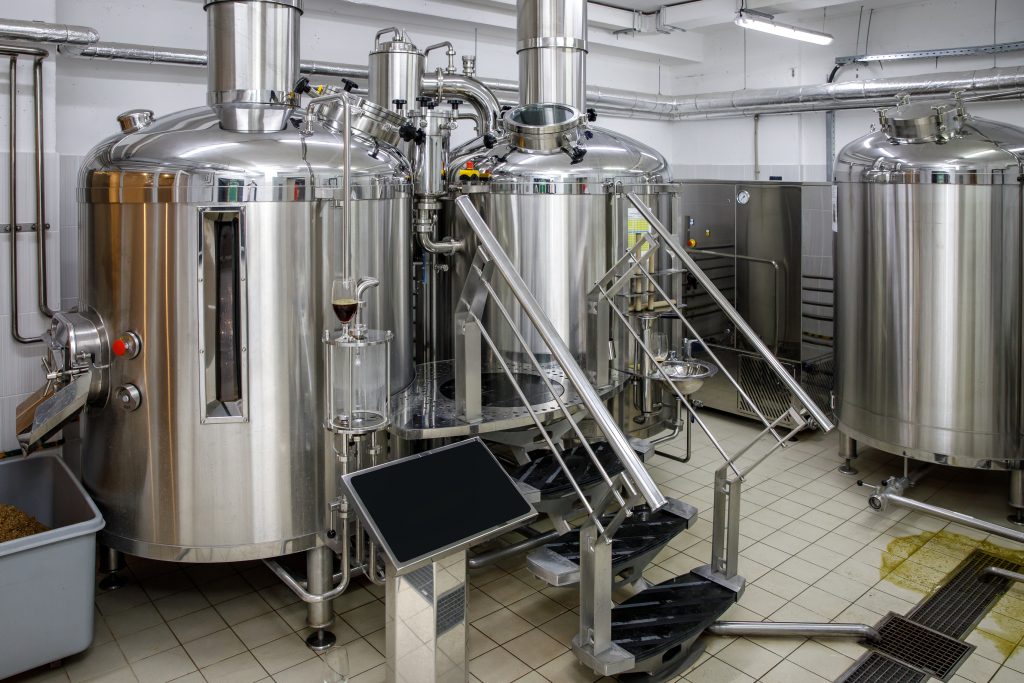
2 huge brewing machines

By: Cheryl Gray

The tanks and tank systems that support the production of the brews and spirits of the craft beverage industry work to keep the quality and safety of those beverages on target.

  No matter the size or brand of the tanks involved, craft brewers and distillers want optimal results and a minimalistic cleaning and maintenance routine to ensure productivity goes uninterrupted. Some companies cater to the industry to provide multiple options.

  Among them is Quality Tank Solutions (QTS), headquartered 35 miles outside of Milwaukee. The company, founded a decade ago, is a stainless-steel tank manufacturer. Jimmi Jean Sukys is the

company’s owner.

  “We are about 100 employees in size and we serve the brewing, food and beverage, dairy and pharmaceutical industries,” Sukys said. “Aside from manufacturing, we also install and repair stainless steel vessels. Our talented engineering team helps you refine your process by increasing efficiency, quality and cleanability.”

  QTS provides a wide range of complete stainless-steel tanks and tank systems for craft breweries, whether it is a start-up or an established brewery. This includes custom-built brewhouses with two to four vessels of 3-1/2BBL to 100BBL in size. The systems are configured to accommodate any height or space restrictions. Standard construction offers features that include either manual or fully automated operation and either steam or direct fire. QTS also supplies brewhouse equipment, such as boilers, chillers, keg washers, bottling lines and walk-in coolers. Sukys explains what additional innovations set QTS apart, including the top-priority use of high-quality materials, efficiency and cleanability.

  “Our QTS cellar tanks are versatile and are completely customizable to meet your specific needs,” Sukys said. “The tank system industry has been around for some time now. What QTS has brought to the table, in just 10 years of service, is consistent and trustworthy results with emphasis on quality standards. Our tanks are engineered and manufactured in Wisconsin, USA using only U.S. stainless steel. Tank longevity is a priority. QTS is with you every step of the way. Even after you receive your tanks, we can help you install, repair or expand. Our expert team members offer amazing customer service.”

  Solid customer service and buying American-made products are among the reasons behind Potomac Distillery’s decision to buy tanks and tank equipment from Idaho-based Corson Distilling Systems, Inc. The Washington D.C.-headquartered distillery is the home base for Thrasher’s Rum, which takes its moniker from owner Todd Thrasher.  “I worked with Corson because I wanted to source American-made products,” said Thrasher.

Corson Distilling Systems is a family-owned business founded a little over a decade ago by brothers Josh and Tory Corson. Today, the company hand-builds each system from materials that include raw stainless steel and copper. The firm also turned to SOLIDWORKS Premium 3D design software to boost its output, streamlining the process of creating models and drawing files while supporting automatic configurations of equipment designs within the SOLIDWORKS products family. Combining the productivity of SOLIDWORKS with another technology solution, COUNTERPART ERP, shaved off a considerable workload and further streamlined processes for the team of draftsmen responsible for the products sold by Corson Distilling Systems, Inc.

  Breweries count on a variety of tanks and tank equipment to get their products out. That includes brew kettles, lauter tuns, mash tanks and more. 

  QTS brew kettles feature what the company describes as a steam-driven Omega Heat Transfer Surface Jacket. The company touts this feature as one that allows precision boiling designed to eliminate over-boiling, which can negatively affect the final product. In addition to some of the other features that are standard on QTS products, its brew kettle standard features include a vent stack with DMS drain, flanged and dished top head, shallow cone bottom and a vortex breaker. 

  Options include a combination brew kettle and whirlpool, so-called “China-hat” assembly, direct fire and vent stack installation. The company’s whirlpool tanks can either stand alone or be combined with other functions. They are customized to handle a brewery’s system capacity. Standard features incorporate many of those offered in other products by QTS, along with a feature known as Trub Guard. The whirlpool tanks can be customized to combine the functions of a whirlpool tank with a brew kettle.

  The company also offers steam-driven calandrias designed to achieve boiling point temperatures without using a heat transfer surface jacket. The calandrias are made of a cylindrical shell and a tube design that is custom-sized to meet the requirements of breweries of virtually any size. The calandrias feature an insulated shell and tube design, accessible flanged ends, a square tube frame with adjustable feet and an optional flexible design to fit a brew house.

  Mash tanks by QTS include standard features such as flanged and dished top head, turbine agitation, glass stop manway, tank light, side wall baffles, shallow cone bottom, NORD gear drive, removable CIP assembly, steam jackets and, of course, 3-A standards. Options include a combination mash and lauter tun, a hydrator and a knife gate.

  The company’s lauter tuns incorporate a tight wedge screen wire fit at the bottom of the vessel, which is designed to eliminate the possibility of the screen bending under the pressure of a heavy mash bed.

  This tight tolerance design prevents excess grains from seeping through the screen. Features of the QTS lauter tuns include gear drive and agitation, which are configured based on the size of the vessel. Other standard construction features include a freeboard above grain bed depth, flanged and dished top head, shallow cone bottom, rake assembly with plow bar, glass top manway, tank light, removable CIP assembly, rectangle side entry manway and wedge widescreen false bottom. Optional features are a combination mash and lauter tun and underscreen CIP.

  Lager tanks designed by QTS feature a horizontal design that the company touts as more efficient since the tanks have more surface area coverage. The lager tanks feature flanged and dished heads, an insulated vessel design, a heat transfer surface jacket, a quarter-inch thick formed saddle with adjustable feet and an oval swing-in manway. They also have a removable CIP assembly with a “whirly spray” device and come fully equipped with a PRV, sample valve, butterfly valves and a CIP accessory. Available options include a stacked tank design and a visual sight gauge assembly.

  For distilleries, QTS offers custom-made hot and cold liquor tanks with features that include flanged and dished top heads, an insulated vessel, a round cross-arm manway, a heat transfer surface jacket, overflow control, F&D and flat-pitched bottoms.

Options include a visual sight gauge and an immersion heater. 

  One QTS product used for adding ingredients during the brewing process is the QTS Q-Bot. It can be used as a dry hop or slurry vessel. The tank’s flexibility helps in the work of adding ingredients at different points in the production process. Among its features are a shallow cone top head, a 24-inch round pressure manway, interchangeable perforated baskets in sizes of one-eighth, one-fourth and one-half inches, a tangential side inlet, a rolled push ring and caster wheels.

  Cleaning tanks and the accompanying equipment are very important, not only for protecting the investment in production, but also for protecting the distillery products. At Potomac Distillery, Thrasher favors a non-chemical approach to cleaning his tanks, which he says are all jacketed.

  “We clean the still and fermentation tanks about once a month. We typically use a combination of water and citric acid and then clean again with distilled water.”

  Experts say that designing, manufacturing, installing and maintaining tanks and their accompanying equipment is done with a combination of craftsmanship, innovation and ever-evolving technology. The aim, of course, is to preserve the products that craft brewers and distillers pour their time and resources into making and getting ready for market.

Inviting Sustainability into The Vodka Industry

a lone white flower

By: Tina Karras, Founder & Owner — Tina’s Vodka

As a founder and owner of a vodka distillery, I regularly contemplate our industry’s sustainability. I want people to have what they enjoy, but I also want a future for our planet.

  The process of sourcing, making, and packaging alcohol has environmental implications that we can no longer afford to ignore. It varies by the liquor and production method, but the Beverage Industry Environmental Roundtable’s research reveals that each 750-milliliter bottle of liquor produces an average of 6.5 pounds of carbon dioxide into our atmosphere. This cannot continue.

Sourcing Sustainable Ingredients Through Regenerative Agriculture

  I’ve always been disheartened by the nagging fear that nothing I did as a single business owner would impact the global environment. However, after watching the documentary “Kiss the Ground,” I am hopeful at last. This film asserts that if we commit to changes that regenerate our planet’s soil, we will simultaneously balance our changing climate, replenish the Earth’s water supply, prevent species extinction, and raise more abundant crops. Here, at last, is a film with solutions that leaves me optimistic about our planet’s future.

  The documentary inspired me to embrace regenerative agriculture in my vodka production process and spread the news to others. This type of farming is not new by any means. Instead of industrial farming methods that deplete the land with a lack of biodiversity, pesticides, and fertilizers, regenerative agriculture applies traditional farming methods to maintain healthy soil, plants, and water. It seeks to reverse environmental damage through no-till systems, crop diversity, planned livestock grazing, and biosequestration (the method of trapping and storing carbon in plants, microbes, and other organisms).

If We Implement These Solutions, We Will See A Rapid Shift In Our Planet’s Health

  Regenerative agriculture is the simplest way to heal the soil, and soil health is the key to solving the climate problem. If every alcoholic beverage producer sourced grain from fields farmed with regenerative agriculture and bio-sequestration, massive amounts of CO2 would be drawn down into the soil and out of the atmosphere. Tilling fields for corn, wheat, barley, rice, and other ingredients we source for our products releases massive amounts of CO2 into the atmosphere. No-till plows can plant those seeds without allowing CO2 to escape. The healthy soil that resulted would capture carbon and reduce runoff. If we keep the soil covered and healthy, CO2 remains in the ground where it belongs.

Resistance to Regenerative Farming and Organic Ingredients in the Liquor Industry

  Leading scientists and soil experts claim that capturing atmospheric carbon and replenishing the Earth is possible with the technology we already have. Unfortunately, this type of farming faces strong opposition, and many remain resistant to change. I haven’t yet seen regenerative agriculture become a significant part of the spirits industry. Perhaps this is because organic, non-GMO corn is simply more expensive to produce than GMO corn.

  Today’s farmers are able to keep the cost of industrial agriculture low through the extensive use of harmful chemicals. These become necessary because their way of farming creates an ecosystem centered around only one crop. Over time, it depletes the soil of nutrients and throws the environment out of balance. Natural ecosystems are filled with a variety of plants and animals, each designed to keep the others in harmony. When massive amounts of one plant cover an area, it is natural for predatory insects and weeds to move in and take advantage of the surplus. In an effort to protect their crops, farmers spray tons of poisonous pesticides and herbicides on the fields. To replace nutrients in the soil, they turn to harmful fertilizers. 

  For example, glyphosate has had a major impact on the production of corn for vodka. For over four decades, this chemical has been the leading tool farmers in the United States used for killing weeds before planting their corn. According to the United States Department of Agriculture (USDA), glyphosate — the main ingredient in Roundup — has become the most widely-used herbicide in the US since 2001.

  The problem was that this chemical killed all plants indiscriminately. In response, scientists created “Roundup-Ready” crops in 1996. Genetically engineered plants were then able to tolerate the herbicide. After this, farmers could spray their entire cornfield without worrying about being selective. Today, farmers who grow Roundup-Ready GMO crops use glyphosate as a desiccant to speed up their harvesting timetable. Spraying their plants with the herbicide kills the crop, causes it to dry out sooner, and produces more consistent yields. This allows them to harvest crops as much as two weeks earlier than they could have otherwise, which proves to be an advantage in colder climates.

  Exactly how glyphosate impacts long-term human health is still being debated, even though its use has increased almost 20-fold during the last two decades. The World Health Organization’s International Agency for Research on Cancer (IARC) declares that glyphosate is a carcinogen. The IARC also claims that Roundup is linked to Parkinson’s disease, Alzheimer’s disease, and autism.

  Regenerative farming employs biodiversity to control weeds and pests. It is more expensive, but the cost is worth it. When spirit brands embrace this way of farming, they discover exciting benefits. In addition to the environmental gains, they will also be pleasantly surprised by a vast improvement in the quality of their product. Vodka made with organic corn and without added sugar simply tastes better, since it has its own natural sweetness. There are no additives — just organic corn and water.

  The best way to ensure the corn and grains sourced for the production of spirits are organic and farmed sustainably is to purchase them locally. Eliminating the need for transporting large volumes of grain over long distances is also a way to reduce the liquor industry’s carbon footprint.

  Despite the cost, a growing number of farmers are looking into the possibility of producing their crops with sustainable farming methods and regenerative practices. Because of the damage that has already been inflicted on our planet and the harmful practices still going on today, regenerative farming requires commitment. Some of these farmers have to spend up to three seasons restoring the soil in their fields. On top of this, many are forced to plant a 25-foot buffer crop to block the overspray of pesticides from neighboring farms. It is time for the liquor industry to show these farmers our support.

  Farming is inherently risky, and farmers are resistant to change. When you ask them to do something they have never done before, especially when neighboring farmers aren’t doing it, you are asking a lot of them. It’s hard for farmers to learn new techniques because so many of them are already working another job to avoid losing their farm. Greater education is key to getting more farmers to adopt regenerative practices.

  The best means of persuading large farms to commit to regenerative agriculture is by demonstrating that it makes financial sense. If large distilleries can work out long-term contracts to source grains directly from the farm, it could be a win-win scenario for both parties. The distillery could share a regenerative story about the farm and about their product. Likewise, if a farmer knows there is demand for sustainable ingredients, they will be willing to meet it. There are so many positive stories that can come out of these partnerships.

Reducing Waste in the Distilling Process

  Sourcing quality ingredients is paramount because it offers us a chance to restore our planet’s health. However, the most unsustainable part of liquor production is distillation. It leaves us with waste products that are harmful to the environment if not disposed of properly.

  Inspired by shortages during the Covid-19 pandemic, some distilleries began turning these waste products into hand sanitizer and are still doing so even after the commercial producers restocked the shelves. I have known certain distilleries to give away a bottle of sanitizer with every purchase.

  Distilleries are also forming partnerships with industries such as fish farms, livestock farmers, and bakeries to put waste grain and water products to good use. At TimberFish Technologies, spent grain is converted into fish food and pumped into growth tanks brimming with speckled trout, Atlantic salmon, and shrimp. Distilleries also send waste products to farms that raise livestock — often the same farms where they purchased their grain initially. Upcycled waste products are not just for animals. Bakeries use mash to make sourdough bread and grain byproducts to make flour.

  Other distilleries are exploring ways of reusing their waste products to keep the machines running. Converting waste into energy can be achieved by an anaerobic digester system that uses waste to produce methane. Cyclically, this methane helps to fuel the very distillation process that produces it.

Reducing The Impact Of The Liquor Industry’s Packaging Materials

  After distillation, packaging is the second most significant environmental challenge in our industry. A 2019 assessment finds the carbon footprint of glass vodka bottles accounts for 43 percent of the product’s carbon footprint. Recyclable PET plastic bottles account for around 27%.

  Ideas for making the packaging of our products more sustainable include recycled glass and cork. Larger distilleries are funding research into biodegradable bottles, recycled paper-plastic hybrid bottles, and plastic bottles made from wood pulp.

Hope for a Sustainable Future in the Liquor Industry

  As more and more of our consumers become aware of climate change and its implications, they are adopting a new understanding of what it means to drink responsibly. Today, people are reading labels. They are aware that their purchases have an impact on our planet and want to know where their food and beverages come from. We should give them the opportunity to make a difference with the products we provide.

  There is a new climate story that is optimistic and simple, and the liquor industry can be part of it. If we learn how to support sustainably-farmed ingredients, manage our waste products responsibly, and package our products in environmentally-conscious ways, we don’t have to live in fear.

The Most Important Opportunity for Brewery Owners

Why So Many Are Missing It

employee retention tax credit

By: Catherine Tindall

The Employee Retention Tax Credit (ERTC) is one of the best ways for those in the beverage industry to regain their footing in a post-COVID age. Unfortunately, according to current estimates, many eligible businesses are missing out on this historic opportunity. For those who received or may otherwise be familiar with the Paycheck Protection Program, also known as the PPP, the concept is similar, but there are key differences that make the ERTC a much more generous program overall.  To understand why I will outline some of the key provisions and eligibility parameters, explain the process for claiming the credit, and answer some common questions I encounter in my own practice, such as “why haven’t I heard of this before?”

  The ERTC is a tax refund credit entitling employers to up to $26,000 per employee, depending on the number of quarters a business qualifies for. Eligibility is determined by either revenue disruptions or government orders on a quarterly basis. Many breweries are unaware that they are eligible for the ERTC due to the capacity and operation restrictions on their indoor dining and/or tasting rooms that occurred during the pandemic. Financial disruptions to that aspect of the business trigger ERTC eligibility for all the divisions of the brewery, not just the restricted segment.  We routinely see businesses qualify for six or seven-figure credits under these parameters.

  There are a number of features that set this credit apart from other programs designed to aid businesses affected by the pandemic, like the PPP. Unlike the PPP, the credit itself comes back as paper checks from the IRS, and also unlike the PPP funds, which were restricted to certain uses, a business owner is free to use the ERTC however he or she sees fit. This is because the credit is actually a refund of wages and payroll taxes your organization has already paid. A consequence of this is that there is no overall program limit on the funds to be disbursed through the ERTC, in contrast to the PPP which had a limited fund pool. Businesses affected by government orders are entitled to every cent they qualify for. Taken together, all of these factors are what gives this program its power. The only limitation is time. This credit will begin to be phased out in April of 2023, meaning that business owners need to ensure they submit their claim as soon as possible. 

  Given the tremendous upsides, every business owner in the beverage space should try to see if their business qualifies, even if it seems doubtful. There is no need to become experts in the credit’s provisions, which can often be nuanced. The important thing is to find the right professional, and, to this point, one must be careful. There are unfortunately a lot of bad actors in this space looking to make a quick buck, and many of them are very good at seeming legitimate. 

  The following are some of the most asked questions associated with the ERTC.

  Should I get a second opinion? Because of the substantial nature of these credits, it’s often worth speaking to multiple providers for the credit to get a sense of the relative merits of each, and to look to the expertise and experience of those working on your case rather than fancy marketing or smooth sales tactics.

  Why haven’t I heard about this before? There are several reasons why many business owners have not heard of this important credit. One is that, in contrast to the PPP program, the ERTC has not been well advertised by the government (after all, since when did the IRS advertise refunds you’re entitled to). Another is that many tax practitioners are hesitant to pursue it given the sometimes complex nature of the claims, if this isn’t their area of expertise. Finally, we commonly find that too many CPAs mistakenly believe that their clients do not qualify for the credit, and so never bring up the possibility of claiming it with them.

I would encourage all brewery owners to actively explore eligibility. The potential benefits of qualification, hundreds of thousands of dollars in obligation-free money from the IRS, is one of the highest value things you could do for your business in the current environment of economic uncertainty.

  There are certain pitfalls to avoid, such as dishonest companies operating in the space, but if you choose the right firm or professional to partner with, the process is remarkably painless. Just be mindful that this is an opportunity with a time limit attached. With less than a year before it begins to phase out, now is the time to claim the credit you’re entitled to.

  Catherine Tindall is Partner & CPA, Dominion Enterprise Services (DES), a full-service CPA firm providing tax planning and consulting alongside specialty tax credit processing. The firm has more than 50 years of collective experience and recently announced the launch of its Employee Retention Tax Credit (ERC) Division to help restaurants assess their eligibility for the ERC and properly secure the maximum refund allowed. Learn more at…

Back on the (Rye) Ranch

whisky bottle and glass

By: Tod Stewart

Just close your eyes…“You can see Faith, Hope and Charity as they bank above the fields….” – Al Stewart, “Flying Sorcery,” from the album “Year of the Cat.”

  Stewart was likely referencing the nickname of the three Gloster Gladiator fighter planes flown during the Siege of Malta in WWII in that line. From 10,000 or so feet, I was looking down at a different, though similarly named, trio as my Bell 407, flown by Alpine Helicopters Inc., banked languidly port-side. Referred to as the “Three Sisters” (Faith, Hope, and Charity – or Big Sister, Little Sister and Middle Sister, respectively), their peaks jut skywards as part of the South Banff Range of the Canadian Rockies.

  The breathtaking flight was just one of the many memorable activities arranged by my host, Alberta Distillers Ltd. (ADL), as part of the “Rye Ranch” experience. Over the course of four days, I was to get an intimate look at all facets of Canadian whisky production. I would also have the honor of being one of the first “civilians” (i.e., not a member of the Bean Suntory, ADL’s parent company team) to taste ADL’s latest rye whisky expression. Both of these would go a long way in helping answer the question: what makes Canadian whisky unique?

  Founded in 1946, ADL has risen to become perhaps the most respected and significant distiller of rye whisky on the planet today. In fact, its Alberta Premium expression is the top-selling rye whisky in the world. Davin De Kergommeaux (DDK), who, as I mentioned in my previous Beverage Master Magazine story, literally wrote the book on Canadian whisky, doesn’t mince words. “I think ADL is my #1 Canadian distillery right now for quality whisky and straight-shooting staff. [It’s] the best rye distillery in the world, and they make so much else besides.”

  Seeing as how I had DDK on the line, I thought this might be as good an opportunity as any to get an expert’s opinion on what, precisely, makes whisky from Canada unique.

  “The key to making great Canadian whisky is blending many components to make a whisky with consistent flavor from batch to batch,” he began. “Each component is made to emphasize specific qualities which blenders then integrate batch by batch. The amount of each component used can be adjusted as needed for each new batch, to even out any differences in the grain from different growing seasons, and any differences among barrels.”

More about barrels in a bit. Carry on DDK….

  “Making individual components also allows distillers to tailor maturation to the specific distillate – charred oak for corn, toasted for rye, for example. Spirits aged in a variety of barrels and for different lengths of time give noticeably different whiskies and blenders are able to use just the right amount of each in the final blend so they get exactly the flavor profile and texture they are looking for.”

  He simplifies the concept this way: “American whisky-makers blend the grains together in mash bills, while Canadian whisky makers blend them as mature spirits. Each has its advantages, and each gives the resulting whisky its own personality, so one approach is not better than the other, just different.”

  While at the Rye Ranch (and before a truly superb dinner prepared by Chef Corinna Murray from Personal Thyme), I managed to corner George Teichroeb, ADL’s general manager, into one of those unprepared for, unscripted and (likely for him), totally annoying one-on-ones to pepper him with similar questions. Dressed in my awesome boots and Stetson from Lammle’s Western Wear (if you wanna look like cow-poke, this is the place), I brashly asked questions like, “Did I hear you say earlier in the day that making bourbon is easy, but making Canadian rye whisky is more challenging?” (Teichroeb has spent time in Kentucky – at distilleries, not in prisons, as far as I know –  so, he’s up on the ins and outs of both whisky styles.)

Beverage Master Magazine: Did I hear you say earlier in the day that making bourbon is easy, but making Canadian rye whisky is more challenging?

George Teichroeb: Well, to be clear, I didn’t say making bourbon was necessarily easy.

BM: Okay, fine. It was a bit loud on the distillery floor. But you said something along those lines, right?

GT: What I said was that with bourbon, there are guidelines set out for its production that remove some of the complexities of the process that we, as Canadian whisky producers, face.

  We can use continuous distillation, batch column distillation or kettle, and we can determine how much of each style make up the final blend with a fair amount of flexibility. If we were making bourbon, we would be much more regulated. With Canadian whisky, the distiller can decide which spirit and at what strength can go into a specific type of barrel. At ADL, we use ex-bourbon, new Canadian and multi-use barrels – and we have the advantage of deciding which option to choose.

BM: It would seem that Canadian whisky is “a thing” again. Why, from your point of view, is this happening?

GT: I read an article about three years ago that said from 2009 to 2019, there was a 230 percent increase in global distillers’ use of rye grain in their whiskies. Consumers and distillers have started to understand that the use of rye creates a flavor profile that is very unique, and this has led to a refocusing on the country that’s been a pioneer in rye distillation—namely, Canada.

BM: So, it really is a ryevolution!

GT: [Deadpan glance].

BM: Um, sorry. What, then, from your perspective, sets Canadian whisky apart from all others?

GT: I think there are certain historical standards that play a large part. Canadian whisky has to be matured for at least three years. It has to be aged in wood and on Canadian soil, but these are requirements that are similar to those of other countries. It’s in the blending process where Canadian whisky makers’ expertise comes to the forefront, and consumers are really starting to understand the value of skillful blending.

BM: Anything about the Canadian whisky industry you’d like to see changed?

GT: You shouldn’t be able to call a whisky “rye” if there isn’t, in fact, any rye in the blend! [In my previous Beverage Master piece, I mentioned the somewhat strange situation that distinguishes “rye whisky” as a category rather than a reflection of what is distilled.]

BM: Where do you see ADL, and the Canadian whisky industry in general, heading into the future?

GT: It’s been great that ADL has always been seen as a pioneer rye distiller, but this doesn’t mean we won’t continue to try new things in the future. We will continue to consistently use prairie rye as a main whisky ingredient, and I think this association with specific, regionally-grown grains will take hold in other Canadian distilleries. You might see different strains of corn being used in the eastern Canadian provinces. The prairies will likely remain heavy on wheat, which is a great base for vodkas.

  While touring ADL’s barrel warehouses a few days back, I noticed another unique feature of many Canadian distilleries: the use of pallets rather than racks for barrel maturation. While this is common in the majority of Canadian whisky distilleries and significantly improves efficiency, the verdict is out on whether it has any negative effects on the aging of whisky. To play it safe, ADL incorporates both rack and pallet warehouses. Racking barrels increases airflow around them and gives the liquid greater exposure to the barrel heads, both of which have a beneficial impact on development.

  Other features that are unique to ADL’s whiskies are the use of predominantly unmalted rye and (because of this) the reliance on in-house reactors that yield one of the two types of enzymes that make up the “enzyme cocktail” used to convert rye starch to glucose.

  One aspect that’s unique to all Canadian whiskies, and the one that stirs up the most consternation, is the “controversial” 9.09 regulation, which, in reality, is much ado about nothing. I won’t go into a long dissertation on how this regulation came about (there has been plenty written about it), but the upshot is that a Canadian whisky distiller is permitted to add up to ten percent of another liquid to every 100 liters of mature whisky. So, for example, ten liters added to 100 liters brings the total volume to 110 liters, and ten percent of that volume works out to one-eleventh or 9.09 percent). This “other liquid” is typically un-aged whisky or wine.

  While purists like to rant about this, think of how much “non-scotch” winds up in Scottish whiskey finished in casks that once held sherry, port or Madeira. Teichroeb sees this regulation as beneficial in that it adds a degree of flexibility to the generally ridged requirements whisky makers are governed by. And it allows blenders to introduce subtle flavoring elements to a final blend, the result of which I was about to taste.

  As the sun dipped low behind the majestic Rockies in the distance, and as the embers of the campfire contributed to the glow of our already-somewhat glowing group, Teichroeb poured us drams of ADL’s latest whisky: Reifel Rye. Named in honor of the distilling family that helped establish ADL, it is a 100 percent Canadian rye whisky showing distinctive, dusty/spicy rye on the nose, with subtle hints of vanilla custard and dried fruit. Smooth, warm, mildly fruity/spicy and beautifully balanced, it was the perfect nightcap to wrap up with what had been a pretty much perfect stay in Canadian whisky country.

Slowly Sipping Premium Sake

bottles of sake

By: Hanifa Sekandi

You have most likely sipped on this subtle, smooth spirit at your favorite sushi restaurant. Sake is a drink that warms up your soul and shockingly excites your senses. Some would say it brings the same joy as tequila. But you do not see it coming. Sake is a humble beverage that does not announce its presence immediately on the palette. Its balanced flavor profile satisfies the desire to sip and dine without overpowering the experience. Alas, a few sakes in, there it is, a feeling unlike any other alcoholic beverage you have sipped on before. It does not hit you in the chest or burn the throat. That tipsy feeling comes later, even for those who don’t consider themselves lightweights.

  Sake has enchanted North American imbibing culture. So much so that it has transitioned from the beautiful Japanese restaurants where most people first experienced it to liquor stores across the US. As of late, luxury sake brands are making headway, creating an alcoholic beverage niche just like wine and other high-end spirits and liquors. Like premium tequila, it is becoming a staple on bar carts for those who value a selective drinking experience where just anything will not do. It is about quality and the story that makes the alcohol they drink meaningful.

What is Sake?

  Sake is a Japanese alcoholic beverage. The word sake in Japanese describes all alcoholic beverages. Nihonshu is what sake is called in Japan, most likely something sake enthusiasts in the West are unaware of since this designation is rarely used in western Japanese restaurants. For most people, their first experience with sake is at a Japanese restaurant. While dining on seafood dishes, sake is served and an excellent pairing for this type of cuisine. So, what is sake? Sake is a translucent rice wine. It is often served in a small cup called an Ochoko. It is made with rice and water and brewed by converting starch to sugar. From the sugar, alcohol is produced. The brewing process of sake involves several steps.

  The sake brewing process starts with polishing the rice to remove the outer layer. Once this stage is complete, the rice is soaked to ensure that any leftover bran is removed. Next, the rice is steamed to cultivate koji cultures, an imperative component of making sake. While one batch of rice steams, Koji mold is added to the steamed rice. The steamed rice and rice with added koji mold are mixed in a tank containing yeast to create a starter. Next, the mashed ingredients are transferred to a tank with steamed rice, water and koji, frequently added during the alcohol fermentation period of approximately one month. The fermented mash is then pressed and stored.

  As you begin the at-home sake experience, you need to buy the appropriate cups since the size of the cup, the shape and the material it is made with influence the fragrance of sake. There are several vessels that one can use to serve sake. For example, a masu container is a small wooden box with a shot glass placed in the center. Another vessel is a Sakazuki, a flat wide-mouthed cup used for Shinto ceremonies and rituals. Small shot glasses are another option for serving sake since thin glass supports a rich tasting experience. It is also suitable for high-quality sake. Shuki is a commonly used vessel. Shuki is a term generally used to describe all sake vessels. Wooden shukis are favorable since they enhance the aroma of sake and provide a milder aftertaste.

Sake Beginnings

  To truly appreciate an alcoholic beverage, it is essential to understand its beginnings. These stories over a warm meal with friends bring us together. Further, history demonstrates that bridges and communities have been built simply by sharing spices and drinks with people from different cultures. Sake has its own story. Although the birthdate of sake is hard to determine, its roots are intriguing. The Book of Wei in the Records of the Three Kingdoms contains Japan’s earliest record of alcoholic beverages. It is believed that sake dates back to the Nara period (710–794). Initially, sake was used during religious ceremonies. During the Heian period, sake was consumed as part of games and festivals.

  In the earlier stages of sake, before it became a viable commodity. The Imperial Court during the 8th and 10th centuries governed and controlled its production. The types of sake that people could drink were also determined by the rank they held in court. For example, clear, robust-flavored sake was reserved for those in high-status positions. People viewed as a lower class could only consume unrefined, cloudy brews. During this time, people drank sake for festivals and offerings to the gods.

  In the 12th and 14th centuries, shrines and temples became sake brewers and the central producers for over five hundred years. It was at the temples where the brewing process was perfected into three stages. Sake’s longevity, stronghold into the future and availability to the general public are due to these efforts that ushered in the production of sake at a scale. It is important to note that the upper-class nobility only had access to sake during this time. A move into commerce created a demand for this once-exclusive drink.

  Once specialized brewers entered the market in the 14th and 16th centuries, temples and shrines no longer held a monopoly on production. Innovations for serving sake made headway during this sake rebirth. New sake vessels offered an easy way to purchase sake to-go, a departure from the wooden pails. Fast-forward to present-day sake production, where technological advancements that commenced years prior and continue to improve brewing methods have allowed sake producers to distribute it globally. New avenues opened the door for the sale of refined luxury sake. It is no surprise that premium sake brands are finding a space among elite alcoholic beverages.

What Is Premium Sake?

  So, what is premium sake? Is it worth the price? Does it stand out among other luxury beverages? Luxury sake brands are just getting started. It will not be long before such brands are found next to top-shelf wines and spirits on bar menus in North America. Premium tequila has reigned supreme in recent years. It is now sake’s turn.

  Sake has an average ABV of 15% to 16%, quite compelling for those looking for an alternative to high alcohol content spirits. Not bad for a rice wine! Sake Hundred, a high-end sake developed by Ryuji Ikoma, a sake connoisseur who also founded Japan’s Saketimes, is gunning to shake up the fine wine and high-end Japanese whiskey terrain. Ikoma aims to “expose drinkers to the most outstanding examples of Japan’s national drink, showcasing its many styles and sophisticated complexities that allow it to pair with a myriad of cuisines well beyond that of simply sushi.” While developing his brand, he visited hundreds of Japanese breweries to learn about the techniques and art of making sake from those who have gained expertise through their lineage. In 2018, he launched Sake Hundred, a new portfolio of sake for a new generation of sake drinkers. He partnered with select breweries to help him produce his new line of high-end sake.

  “Our collection of sakes will take drinkers through a journey of both culture and taste, two elements that are closely intertwined in sake making. You can taste the personality of the sake brewer in our sake, just as you can taste the terroir of a fine wine,” noted Ikoma. He added, “Each part of Japan has its own culture and there is no better way to get to know that culture than through sake.”

  Sake Hundred released the limited edition Gengai with an eye-opening price tag of $3,100. Their flagship sake, Byakko Bespoke, made from the “king of sake rice,” Yamadanishiki retails at $380. Of course, other premium sake brands are eager to enter the U.S. Kikuhime ‘Kukurihime’ Ginjo Sake, produced by Kikuhime Brewery, is a top-shelf sake named as a tribute to the Goddess of Hakusan Mountain. The water near this mountain is used in this renowned, slowly aged sake for approximately ten years. Some retailers sell it for $650. Another notable high-end sake is Shukondeinoshiro Kamutachi. Producers of this sake only make 60 bottles a year. Luckily, the price tag on this sake is not as shocking. Getting a taste of this premium slow-matured rice wine is a possibility for those who do not mind splurging just a little. It retails at $229.

  Those in the know do not mind lower-priced sake while dining at their favorite sushi restaurant. Even if it sits at a lower price point, it is a great accompaniment to your meal. For many, this led them to explore the world of sake. Its rich cultural roots and the unique brewing process bring each bottle to life. Do not be surprised if it also becomes a member of the new-age beverage trend for individuals seeking wheat-free and gluten-free alcoholic drinks. For now, sipping on warmed sake feels just right.

Use This Idea to Save on Taxes

No one likes paying too much in taxes. In this post we’ll review an idea to use an outside service to reduce one of your tax obligations: the dreaded, and ever-increasing property tax.

Property tax is calculated by multiplying the tax rate by the assessed value of the property – land and buildings. For breweries, this can be a sizable expense.

Both the property tax rate and the assessed value change on a regular basis. Some years the rate goes up and the assessment goes down. In other years it’s just the opposite – the rate goes down and the assessment goes up.

The one thing that doesn’t change is that the total tax bill always goes up.

The process to assess the value of a property is subjective at best. Assessors will use comparable property sales and other metrics to gauge value, but rarely are two properties alike. Therefore, the value assigned to our properties is an approximation, an estimate, a best guess.

So, why not hire your own consultant to make a better estimate?

That’s what we did and the result was a savings of $20,000 per year on our tax bill.

The firm of DuCharme, McMillen and Associates guided us through the process, took up very little of our time, and saved us a lot of money in taxes.

DMA performs Assessment Reviews to identify opportunities for reducing real and personal property tax assessments. DMA’s comprehensive review is customized to your specific needs, and we focus on reducing both current and past assessments.

Our property tax professionals will review your entire portfolio of properties or individual properties of concern to you. Both real and personal property tax assessments are scrutinized to determine the accuracy of the data used by the taxing authority, valuation issues, state-specific treatment of property, and overlooked exemptions.

We communicate the results of each property’s review and, with your approval, take all necessary steps to implement the assessment reduction strategies available, including refund recovery. DMA’s property tax professionals have generated billions of dollars in real and personal property tax savings for our clients, many of which pertain to the beverage and bottling industry. We are leaders in identifying industry-specific issues having an impact on value.

Our property tax professionals have reviewed thousands of assessments in nearly every jurisdiction. DMA’s national scope and jurisdictional expertise means our clients realize the maximum benefit available.

If you’re interested in following in our footsteps, reach out to the folks at DMA. There are other firms that do similar work, but we had a good experience with these guys.

No one likes paying too much in taxes. Check out this idea and reduce property taxes in your beer business today.

New Brewery, Winery or Distillery Start Up

a cozy winery

By: Kris Bohm: Distillery Now Consulting, LLC  

Starting up a new beverage alcohol business is hard. Whether making beer, wine, or spirits, the challenges are daunting and upfront costs are huge. No one takes the leap to start a new business knowing it will fail, but many of them will. Based on industry data, up to 40% of new beverage alcohol businesses fail. To create a successful business, there is a common question that arises during the planning phase of launching a new beverage alcohol business.

What is the difference between a successful business and one that fails?

  This massively important question should be answered early on for a new business. In doing so, key strategies will be defined for the business from the beginning as it ventures forward. In the following paragraphs, you will find not only the answer to this question, but also a further analysis of successful business practices.

Defining Success: Let’s take a moment to define and measure success in a beverage alcohol business. This definition applies whether in a brewery, winery, or a distillery. These measurements of success will allow us to look closer at the internal workings of the business. As you look closer you will find common traits among nearly every business that is successful. For the sake of this article we will narrowly define success using the specific individual metrics of profitability, sustainability and velocity.

Profitability: The first key metric and measurement of success is profitability. A business must either be profitable, or at a minimum near self-sustaining, with revenue covering the cost of operating the business. Achieving profitability is one of the biggest metrics that defines success. Reaching profitability is essential, as every successful business must be self-sustaining after a certain amount of time. If a business is not profitable for too long of time, it is almost certain to fail.

Sustainability: A successful business must be sustainable in the capacity to produce the products it intends to sell. To clarify, we do not mean sustainability from an environmental impact or energy usage standpoint. Sustainability in this model means the ability to sustain and meet demand for products through growth. For a business model to be sustainable the equipment must have the capacity to grow and meet new demand as the company grows. The reason this metric is so essential is that most businesses must grow to reach profitability. If your business cannot sustain growth it most likely can not grow to become profitable.

Velocity: A business needs to have regular sales to provide consistent revenue for the business. Velocity is a measurement of how quickly your business is turning raw materials into finished goods and selling those goods. High velocity of product means there will be more consistent cash flow for the business. As product velocity increases it is followed by increases in revenue and often economies of scale. Both of which help a business become successful.

Tripod Business Model: Most businesses achieve some of these measures of success, but not too many will achieve them all. Among those who do succeed in meeting all three, there is a common thread that these successful businesses share. They will usually have three separate divisions that perform distinct business activities. These three divisions are production, sales, and marketing. This concept we will refer to as the tripod business model. If the top of a tripod is a successful beverage alcohol business as measured by our success metrics, then there almost always exists these three divisions in the business that make up equally important legs that hold up the business. If you remove any of the three legs, it only leaves the business on two unstable legs, and in time the business will fall and is likely to fail. It is easy to take this observation and call it as incorrect, but if one was to look closely at established successful beverage alcohol businesses they would find truth in this observation.

  When a sizable amount of time and resources are heavily invested into sales and marketing, the business has a strong probability that it will flourish. Often the business will flourish so strongly that production will often feel constrained in the resources it needs to meet the demand of the business. This is the correct way to invest time, financial resources and manpower to grow. If too many resources are dedicated to production in most instances production will have far too much capacity and there will not be enough demand for product to keep production running near its capacity.

  Now that we have defined some measures of success and the business practices that support them, let’s look closer at the three practices that hold up a successful beverage alcohol business, through the lens of a distillery.

SALES: Sales is essential and paramount to the success of nearly any business that has a product they sell. It can be the easier path for a new distillery to focus on their production with a plan to only sell spirits through a tasting room or cocktail lounge that is part of the distillery. A business plan like this can work, but it has a low ceiling that will often restrict a distillery from growing to a successful level. Real sales of considerable volume come from a distillery selling products in the same market as its competitors. This means working to sell spirits in liquor stores, bars, restaurants and other venues. In this market there is immense competition. The only way to compete in the larger spirits market is by investing into sales. This means having people working for your business who are full time employees whose job is to pull your spirits through the market and drive sales.

MARKETING: Marketing is the driving force that directly links to the success of sales. Marketing can come in a multitude of forms, some obvious and some not so obvious. Public facing platforms, such as social media, websites, billboards, magazines, newspapers, and influencers are all forms of marketing in action. The more a consumer or target consumer encounters a brand, the higher the chance that the consumer will buy your brand. Without an active marketing plan in place, consumers will quickly lose sight of your brand. A strong marketing plan and the person or people to continually implement, monitor, and drive a marketing plan is paramount to achieving success. Marketing is the key difference that will take a brand to the next level and keep pulling it up from there. Although it can be easy to not put an emphasis on channeling resources to marketing, it would be a mistake to do so. Many businesses have launched with little to no resources committed to marketing. Often these launches feel successful, but by our measurements are in fact not truly successful. Oftentimes the business will get going and be selling some amounts of product but in most instances a lack of marketing will cause a business to plateau quickly.

PRODUCTION: This practice of manufacturing is easy to give too much focus in the business of distilling. Whether you are distilling whiskey from scratch or bottling sourced spirits, the production part of this business is extremely important. While production is absolutely paramount to the business, this does not mean that the bulk of resources the business has should be invested into the production of spirits, nor the labor or equipment to produce the spirits. If the bulk of resources go towards production thus starving sales and marketing, there will invariably be a lack of sales to cover the costs of production. Now the manufacturing of distilled spirits is in no way inexpensive. Considerable resources have to go to production for it to function. We are trying to urge you to consider all resources the business has and properly allocate them to all three practices.

The battle between the practices: If you ask most folks who work in this industry, whether they work in sales, marketing, or production, they will all likely tell you that their business function is the most important to the success of the business. To be fair, all these folks can probably make a reasonably sound argument to support that statement. It is normal that there is some friction between all three practices because they all have unique functions and priorities that often do not align with one another. For a business to be successful, production, sales, and marketing must work together to achieve the goals of the business. When common goals are shared it is much easier for each part of the business to work in harmony.

Beware the Franchise Law Lurking Behind Your Distribution Agreement  

brewing stocks in a facility

By: Louis J. Terminello, Esq. and Bradley Berkman, Esq

No party enters a contract with the expectation that its terms will be unfavorable to them. Having drafted innumerable agreements of all sorts, including beverage alcohol distribution agreements, we have learned that the underlying principle for successful contract negotiations and drafting is fairness. Put another way, the rights and duties of the contracting parties must be clear on the face of the agreement and the detriment or consequences to the non-performing party are clearly stated and actionable. Brewers and their distributors are no exception. Each has their own expectations and definitions of success.

Generally, for the brewer it’s to gain points of distribution at on and off premise venues with the goal of obtaining volume expectations. For the distributor it is to see the long terms benefits of their distribution efforts within its assigned territory.  Distributors generally want a long-term relationship where they know their upfront efforts and costs will come back to them when any given brand attains a level of organic or self-sustained sales success. Brewers beware, however. Within the context of an ideal equitable agreement lies the malt-beverage franchise statute. These laws tend to favor the beer wholesaler and are superior in affect to any agreement executed between the parties. Many established brewers are aware of these statutes but many new brewers and brand owners are not. The purpose of this article is to introduce the new brewer and/or brand owner to franchise law basics and offer a few contract drafting suggestions that they can pass on to their contract lawyers that ultimately will create a brand success story that will benefit all parties to the agreement.

The Beer Franchise Law – the Basics

  First, virtually every state has codified the concept of “franchise” into law. An informal and unscientific survey reveals that only three (3) states in the U.S. do not have beer franchise laws on their books. As a brewer, it’s best to assume, without research, that the new wholesaler you’re considering appointing has the benefit of the law and to negotiate any distribution agreement with that in mind. By now, you’re likely wondering what these laws are.

  The National Beer Wholesalers Association (NBWA) rightfully states that that these laws are creatures of the 21st Amendment which grants the states the rights to regulate the distribution and sale of beverage alcohol within their borders. NBWA on its website states that these laws provide a number of positive regulatory contributions including providing consumers with beer choices by promoting the availability of diverse products,  they allow brewers access to the marketplace while preserving the distributors’ independence and act as a public safeguard by requiring responsible sales through the three-tier system. These benefits indeed may be true.

  But a closer look at the beer franchise laws also reveal that many statutory mandated provisions arguably benefit and favor the wholesaler operation and makes cancellation or termination of any brewer/distributor agreement an overwhelmingly difficult task for the brewer/brand owner. Broadly speaking, many beer franchise laws contain the following common elements:

•    Franchise agreements can be made either orally or written.

•    Franchise agreements appoint the distributor as the exclusive seller within an assigned territory and take effect at the time of first shipment by the brewer to distributor.

•    A franchise agreement can only be terminated or cancelled on a showing of good cause and by the showing of a material breach by a party. Almost always, the brewer bears the burden of the showing of material breach by the distributor.

•    Notice procedures and the timing of the same are explicitly stated in the statute(s) and must be complied with. Put another way, the brewer must notify the distributor that they are not performing according to the terms of the agreement.

•    Opportunities to cure must be provided by brewer to distributors in accordance with the statutory timeframes.

•    Buyout provisions and formulas to calculate brand buy-back are often included should the brewer desire to regain control over the brand.

  The above provides the reader with a basic framework of a franchise law. Given that these authors concentrate their legal efforts in Florida, a closer look at the Florida franchise law follows and provides a good example of some of the language that a brewer will likely see in the laws of other states. Florida codifies its franchise law in Florida statute 563.022. That statute is entitled “Relations between beer distributors and manufacturers.” Florida Statute 563.022 is lengthy indeed with over twenty-one (21) parts. To address each part and its subparts exceed this publication’s length requirements for this article. As a caveat, though, to the brewer/brand owner reader, the statute is detailed, carefully drafted and will be relied upon by the courts of Florida in any breach of contract case likely brought by a distributor as Plaintiff and brewer as Defendant.  A summary of the key points of the statute are offered below with an emphasis placed on unfair practices by the brewer/brand owner (supplier) and the grounds and procedures for terminating the distribution agreement.

Florida Statute 563.022

•    “Franchise” means a contract or agreement, either expressed or implied, whether oral or written, for a definite or indefinite period of time in which a manufacturer grants to a beer distributor the right to purchase, resell, and distribute any brand or brands offered by the manufacturer.

•    Any person who enters into agreement with beer distributors in Florida is subject to this section.

•    It shall be deemed a violation by supplier to:

o   Coerce or compel distributor to accept product they have not voluntarily ordered.

o   For supplier not to deliver reasonable quantities within a reasonable time after receiving a distributors order.

o   Coerce or compel or attempt to coerce or compel, a beer distributor to enter into any agreement (written or oral) supplementary to a franchise agreement by the threat of cancelling the franchise agreement.

o   To fix or maintain the price at which a distributor must resell the beer.

•    DISTRIBUTOR’S RESIGNATION, CANCELLATION, TERMINATION, FAILURE TO RENEW, OR REFUSAL TO CONTINUE. Notwithstanding any agreement a manufacturer shall not cause a distributor to resign from an agreement, or cancel, terminate, fail to renew, or refuse to continue under an agreement unless the manufacturer has complied with all of the following:

o    Has satisfied the applicable notice requirements.

o    Has acted in good faith.

o    Has good cause for the cancellation, termination, nonrenewal, discontinuance, or forced resignation. Good cause is defined as all the below occurring:

•    There is a failure by the distributor to comply with a provision of the agreement which is both reasonable and of material significance to the business relationship between the distributor and the manufacturer.

•    The manufacturer first acquired knowledge of the failure described in paragraph (a) not more than 18 months before the date notification was given.

•    The distributor was given written notice by the manufacturer of failure to comply with the agreement.

•    The distributor was afforded a reasonable opportunity to assert good faith efforts to comply with the agreement within the time limits provided for.

•    The distributor has been afforded 30 days in which to submit a plan of corrective action to comply with the agreement and an additional 90 days to cure such noncompliance in accordance with the plan or to sell his or her distributorship consistent with the provisions of this section.

•    BURDEN OF PROOF.—For each termination, cancellation, nonrenewal, or discontinuance, the manufacturer shall have the burden of showing that it has acted in good faith, that the notice requirements under this section have been complied with, and that there was good cause for the termination, cancellation, nonrenewal, or discontinuance.

•    The manufacturer shall furnish written notice of the termination, cancellation, nonrenewal, or discontinuance of an agreement to the distributor not less than 90 days before the effective date of the termination, cancellation, nonrenewal, or discontinuance; in no event shall the contractual term of any such franchise or selling agreement expire without the written consent of the beer distributor involved prior to the expiration of at least 90 days following such written notice. The notice shall be by certified mail and shall contain all of the following:

o    A statement of intention to terminate, cancel, not renew, or discontinue the agreement.

o    A statement of the reason for the termination, cancellation, nonrenewal, or discontinuance.

o    The date on which the termination, cancellation, nonrenewal, or discontinuance takes effect.

General Applicability, Takeaways and Contract Drafting Suggestions

  Although the above is specific to Florida, hopefully it provides the reader with a bit more knowledge concerning these franchise statutes. Once again, many of the concepts codified in Florida law can also be found in similar laws of other states. An essential term in the Florida law that will likely be found in the franchise laws of other states is “Good Cause.” A showing of good cause must be made by the brewer to terminate or cancel a distribution agreement with a wholesaler. In Florida all the elements noted above (see the italicized language) must be present to show good cause. Another essential element which will guide the next part of our discussion is this:

  “There is a failure by the distributor to comply with a provision of the agreement which is both reasonable and of material significance to the business relationship between the distributor and the manufacturer.”

  For the brewer, brand owner or manufacturer, it is elemental that the agreement contains provisions which are both reasonable and of material significance, which if breached and all other requirements are adhered to, may provide them with legally defensible grounds for termination or cancellation of the agreement. Many times distributors try to avoid the inclusion of material terms for obvious reasons by handing over boilerplate agreements for consideration by the brewer. These boilerplate agreements may look reasonable on their face but almost always lack “teeth” and rely solely on the statutory language that overwhelmingly favors the distributor.  But the smart brewer’s attorney will include reasonable material terms such as volume or points of distribution goals over a stated time period. Such material terms may be as simple as stating that the distributor must sell 100,000 cases for the first twelve months from the effective date of an agreement or establishing points of distribution by stating, as a rudimentary example, the distributor will achieve 75 placements (defining “placements” in a reasonable manner) in the first three months of the agreement and another 75 placements in the second three month period. As a contract drafting suggestion it is important to state that if the distributor fails to meet these goals these will be treated by the Parties as a material breach.

  The above recommendations are provided as suggestions only and are not intended as legal advice. The point of this article is to arm the new brewer with useful information so they may level the playing field to a limited degree with their wholesaler partners at the start of the sales and distribution relationship.  After all, the goal is to draft a fair agreement for all parties with the reasonable expectations of all are clearly stated. As a final caveat, beer wholesalers are powerful actors on the state stage. It is of paramount importance that the new brewer hire an experienced alcohol beverage attorney to assist in negotiations and contract drafting.

Is it Time to Order More Brick-and-Mortar Locations for Your Bar or Restaurant?

dark bartending area

By: Raj Tulshan, Founder of Loan Mantra

Is commercial real estate making a comeback in the hospitality industry? After several extremely disruptive years of a global pandemic – and the resulting lockdowns, inflation, supply chain disruptions, and staffing shortages – is the future finally brighter for hospitality and real estate? Is it time to invest in more bars and restaurants – and if so, where exactly should you invest and when do you know if it is the right time?

Investing in real estate is a major, long-term commitment requiring careful consideration. Business owners must do their homework before signing a real estate contract, thinking about a host of factors, including the building’s location, the economy, zoning laws, the projected value of the property, and its expected appreciation over the coming years.

  Location is a huge factor. Is the property you’re considering in a good spot that will attract customers? Is the property attractive, in a safe, high-traffic location? Is the community vibrant and growing, with a history of economic stability? Is there easy access with ample parking, or is there a subway or bus stop nearby? What’s the neighborhood like? Is there considerable competition in your space, with tons of other bars and restaurants nearby? Is the neighborhood hungry (pardon the pun) for your type of establishment? Are the demographics right for your type of business? For instance, a heavy metal-themed bar might not flourish in a neighborhood with an older demographic.

  Despite major difficulties in 2020 and 2021, the hospitality and commercial real estate industries are finally in growth phases again, and this growth is likely to continue in 2022. Some things to consider include:

  People are going out again. Demand for in-person goods and services is rising again, as people want to eat at restaurants and go out for some beers. This pent-up demand is good for commercial real estate – and the bars, restaurants, and other businesses that occupy these buildings.

  Hospitality is rebounding. Now that the worst of the pandemic is (hopefully) behind us, business and leisure travel will start increasing again, and people will be dining out more frequently. The growing travel demand means hotels, restaurants, and bars may take on renovation and expansion projects that stalled during COVID. And, increasingly, hospitality business owners will invest in real estate to house their bars and restaurants.

  Secondary markets are growing. The evolution of remote and hybrid work means many employers and employees are moving out of high-rent cities into smaller markets that are more cost-effective. Recently, people have been leaving big, expensive cities like New York in droves, in favor of smaller, more affordable markets like Nashville and Tampa. If you’re thinking of opening a bar – or expanding your brand to new markets – consider these geographies.

  Operators are opting for building ownership. Some restaurant and bar brands are opting to own real estate rather than leasing. When leasing, the building owner is making money, regardless of whether your business is profitable. However, when you own the property, you’ll be building equity regardless of how your business is performing. Many restaurateurs and bar owners are choosing to buy instead of lease because it makes more financial sense over the long term. If you’re the property owner, you won’t have to worry about surprise rent increases. You also won’t need to abide by your landlord’s rules, giving you more freedom with your business and your property.

  Add new revenue streams to boost profitability. With labor shortages impacting the operating hours (and bottom lines) of hospitality businesses, restaurants and bars have realized the importance of having multiple revenue streams to increase profitability, especially if they’re working to cover the cost of their mortgage. Some brands are selling their own beers online or selling branded merchandise at their brick-and-mortar location and online. While people are finally coming back to dine and drink in-person, it’s wise to have additional revenue streams to keep a steady stream of revenue flowing – and so you can cover your mortgage and property taxes if you’re the building owner.

  If you’re financially able to swing it, buying property for your bar or restaurant can be a wise move. As experts predict that the worst of the pandemic is behind us, it looks like the hospitality and commercial real estate industries are poised for a rebound. If you’re thinking about a real estate investment for your hospitality business, be thoughtful and consider the decision carefully before signing the contract.

About the Author:

  Neeraj (Raj) Tulshan is the Founder and Managing Member of Loan Mantra, a financial advisory firm with best-in-class and proprietary fintech, BLUE (“Borrower Lender Underwriting Environment”). Loan Mantra, Powered by BLUE, is next-level finance: a one-stop-shop for business borrowers to secure traditional, SBA or MCA financing from trusted lenders in a secure, collaborative, and transparent platform. Clients turn to Raj because they know he will always pick up the phone and offer unparalleled financial counsel in a remarkably human—even friendly—way.

About Loan Mantra

  Loan Mantra is a financial services company designed to serve small and medium businesses with offices in New Jersey, Charleston, SC and New York. At Loan Mantra your success is our success. This means that our attention, purpose, and intention are all focused on you, our client. We are your ally to overcome obstacles, bringing peace through uncertain times to achieve your highest goals and aspirations. Your friendly, responsive agent will listen respectfully, and service your account actively through one of three locations in the US. We speak your language whether it’s English, Spanish, Hindi, Bengal, Hospitality, Laundry or Manicure, let us help you today. Connect with us at…www.loanmantra.com or 855.700.BLUE (2583)