Company Distilling: Gather, Eat and Drink

Photo of Company Distilling's building from the front

By: Gerald Dlubala

Strolling into Townsend, Tennessee, on the peaceful side of the Smokies, you can’t help but notice the relaxed atmosphere. Located at the base of the Smoky Mountains, Townsend is an outdoor activity hotbed featuring some of the best hiking, mountain biking and camping you’ll find. Along the main parkway, you’ll also come across a unique, welcoming, 4,000-square-foot glass-enclosed building with a back patio with games and outdoor seating. Look a little closer, and you’ll recognize the shimmer of distilling and brewing equipment gleaming through the massive windows. This is the home of Company Distilling, and we’re all invited inside.

  Jeff Arnett, the Master Distiller of Company Distilling, was with Jack Daniels for 20 years, 12 of those as a master distiller. Although demanding, it was a dream job, and he loved the people he worked with. But after expanding the Jack Daniels portfolio from three to 11 products and winning “Master Distiller of the Year” in 2017, Arnett felt the urge to build his own brand from the ground up. At Townsend’s annual Grains and Grits Festival, a yearly event on the first Saturday of November featuring locally produced spirits and food, that urge began to pick up steam.

Photo of Jeff Arnett, Mater Distiller of Company Distilling

Great Location & Great People Produce Great Products

  “I thought Townsend was a beautiful location,” said Arnett. “I knew the people there, and I knew they were interested in having a distillery in Blount

County. I knew that you need great people to produce a great product. After talking with other distillers, they all pushed their chips in, so we had distillers who could make whiskey, gin and beer. We also had GM experience within the group, so as friends with a common goal, we decided to take a leap of faith and create Company Distilling. We’re not the first distillery in Blount County, just the first legal one.”

  “The name for Company Distilling was inspired by the pandemic when we all had to rethink how we were gathering and how we could get together with our families,” said Arnett. “We couldn’t just go to restaurants or bars and order what we wanted anymore. We entertained and gathered in our homes with those we held dearest. They were moments to be cherished and shared, so we wanted to make a product that reflected that sentiment here at Company Distilling. When I was little, my mom told me to clean my room and shower when company came. You put your best foot forward for the guests that come to your home. We made a product that, once discovered, you want to share with your closest friends and family. It was natural that we call ourselves Company Distilling to reflect that attitude. It became our inspiration.”

  Arnett wanted to explore wood finishing. He started doing it at Jack Daniels on a small-scale distiller series. One of the eight new products he brought into Jack Daniels’ portfolio was the No. 27 Gold. It was double-barreled and double-mellowed using maple barrels and charcoal, along with the original white oak barrel. Arnett said that it was one of the best products that they made. However, the maple barrels tended to leak more, losing more liquid and driving costs up. The process needed improving. Arnett worked to modify the process, and after several years of development, it has created additional opportunities to replicate a double-barreling method using non-traditional barrel woods. This proprietary process allows Arnett to offer products containing a new and natural range of character and flavor without additional additives.

  “As a distiller, you want to work with water, grains, yeast, oak barrels and woods as much as possible to create nuance and character,” said Arnett. “There are three native forms of American whiskey known to be created in the United States: Tennessee whiskey, bourbon whiskey and rye whiskey. We wanted to respect and reflect that history with three successful, wood-finished products and offer flights for comparison. Our first product was our straight bourbon whiskey finished with maple, and now we offer our straight rye whiskey finished with cherrywood and our straight Tennessee whiskey finished with applewood. These perfectly demonstrate how our natural, wood finishing process builds unique character and flavor enhancements.”

Company Products for All Tastes and Occasions

  Company Distilling also produces the Ace Gap brand of flavored spirits. Although Company’s brand is not about mason jar moonshine, East Tennessee is a hotbed for it. With Ace Gap flavored spirits, Company stays true to the Smokey Mountains history and Tennessee’s moonshine roots.

  “Before forming the Smokey Mountains National Park, loggers were cutting trees in what is now known as the Ace Gap Trail,” said Arnett. “There was a still out there, and the loggers would sit around, play cards and drink their shine. To honor that, the GPS coordinates for Ace Gap are on the back of the Ace Gap bottles. Our flavored spirits are available in eight flavors and, more importantly, are very cocktail-friendly in contrast to true moonshine. When Townsend is full, there are about 15,000 people in the campgrounds, including many families. We wanted to offer a product that allowed the campers to make a simple cocktail in the campground with ingredients they may already have or could easily pick up at the market, like lemonade, limeade, cream, tea, milk or whatever. Our flavored spirits taste like what the labels say they taste like, without the traditional corn nose and note of traditional moonshine.”

  In addition to the Townsend location, Company Distilling has a smaller site in Thompson’s Station, south of Nashville. The Thompson’s Station location distills their Ghost Rail Gin, which won “Best Gin” at the 2021 Ascot Awards.

  Company Distilling is a true brewstillery, offering six beers brewed in-house and on tap for visitors, thirsty campers and parched mountain bikers. For those that prefer a cold, refreshing, locally made, great beer, choices include Fest Bier, Kolsch, American Lager, Black Rye IPA, American IPA and a New England IPA.

  “We took out the traditional mash cooker and fermenter system and replaced it with Deutsche equipment to make 3 ½-barrel batches of beer,” said Arnett. “You have to make beer first and then distill it into whiskey anyway. The two processes are pretty well tied together, but we included lagering tanks, a boiling kettle, the lauter tun and everything you need to get grain solids out and pasteurize and make high-quality beer.”

You’re Not Just a Visitor, You’re Company

  Walking into Company Distilling in Townsend, you are immediately taken by the massive windows looking into the production area and providing spectacular views of the surrounding landscape and mountains. Live music enhances the experience on weekends. Of Company Distilling’s 4,000 square feet, one quarter of it is production space viewable through large glass panels. Here, you’ll likely spot Arnett and his team hard at work getting things just right. Both locations feature tasting rooms, bottle shops and cocktail menus.

  Along with regular tastings, visitors can fill a bottle and enjoy a premium tasting with the master distiller experience at the Townsend location. A small service kitchen, the Amico Deli, provides hot and cold food. Having had lunch and experiencing the exceptional folks and customer service at the Townsend location, I can tell you that they really do treat everyone as welcome and cherished company, and the food is on par with their handcrafted spirits and beer.

  “We want to share our success with everyone else around here because, ultimately, that’s what it is all about,” said Arnett. “Townsend has a lot of green space, where people come to tube the river, mountain bike and hike. We cater to outdoor enthusiasts by making our distillery a glass box that connects to the outdoor landscape and beauty. Townsend experiences precipitation that gets pushed here from the mountains an average of 100 days a year, so connecting with the outdoors is important even on those less-than-perfect days. We create our spirits thoughtfully on the peaceful side of the Smokies so our customers can enjoy them surrounded by spruce, fir and hardwood. We make our bourbon with a proprietary, toasted maple wood finishing process. We take hard sugar maple and toast it, caramelizing the natural sugars in the wood. We reduce the maple for entry into the oak barrel and then pull periodic samples to determine when the liquid is ready for bottling. Our products are ready when they’re ready, determined only by taste and time.”

Looking Ahead

  “Besides our two locations, we have a 30+-acre property in Alcoa, near Knoxville airport,” said Arnett. “It’s an old brick plant that made the brick for the Alcoa Aluminum plant. It would be able to hold up to 10,000 barrels. We hope to build our main distillery adjacent to it if we can purchase an adjoining five-acre tract of land. We’re working on it. Until then, it’ll be another year or so for us to have our main facility up and running.”

  Arnett tells Beverage Master Magazine that he plans to develop a new product yearly. The release date will coincide with Townsend’s annual Grains to Grits Festival, when Townsend hosts 1,000-1,500 spirits lovers ready to experience new and innovative products.

Enjoying the Work Makes it Worthwhile

  “It’s been a slow process, and we’re pushing it uphill, making progress,” said Arnett. “It’s good to see. Distilling is a lot of work, but it’s enjoyable work. I’m super hands-on right now, still toasting my own wood with a proprietary process. You have to love and do what you do for the right reasons. Townsend was the first facility we built, with the new build being in the same location with the same grandfathered-in footprint. All our town has is electricity and septic, so we won’t build a national brand out of here. But we are close to Cades Cove, the most visited spot within the most visited national park. Our location allows visitors to get to know who we are. We have nearly two million cars passing us annually and are within a day’s drive of half the U.S. population. We directly distribute to six states and look to double that soon. Others can get our products through Seelbach’s online.”

  Arnett says that Company Distilling tests and tunes its products before moving them into the recognizable Company signature bottle. Their Cherrywood Finished Rye won double platinum this year and entered the Company lineup. The Applewood Finished Tennessee Whiskey was released on International Tennessee Whiskey Day, May 21, commemorating the day Tennessee repealed prohibition in 1937. Arnett said they lost out on the award cycle by holding it back. But because the product has been so welcomed and is now one of their most popular, it was also moved into the Company lineup, fulfilling Arnett’s initial goal of offering wood-finished versions of the first three spirits made in the U.S. In addition to the tasting flights and master distiller experience, Arnett will begin hosting whiskey dinners and working to get his products available in nearby restaurants and country clubs.

  Take it from me: visiting is a must if you’re anywhere within reach of Company Distilling. After all, you’re always invited because you’re company.

Company Distilling

8351 TN-73, Townsend, TN 37882

www.companydistilling.com

(865) 366-4360

info@companydistilling.com

2023 – Quarter Three Lender Update on the Craft Brewing Market

Man standing by brewery tanks holding up and looking at a glass of beer with foam

By: Adam Stump – Managing Director at Hilco Valuation Services

Since our previous Craft Brewing article published back in mid 2020, fear of mass closures in the craft brewing industry has subsided, and the industry as a whole seems to have largely recovered.

  As of 2023 – Quarter Three, we have seen microbreweries faring somewhat better than brew pubs when comparing openings vs closings. This can be largely attributed to the higher food cost and lower margins associated with the pubs. The labor market, which continues to present challenges across all areas of customer service, also remains an impediment to brew pub operational efficiency and profitability.

  Closings of small breweries rose in 2022 as compared with 2021, but were only around 3% of the market, which is relatively low and further signifies that the industry is maturing. Meanwhile, the overall U.S. brewery count increased from 9,384 in 2021 to 9,709 in 2022.

  U.S. beer volume was also down just over 3% last year. While craft volume was up slightly, it is worth noting that total Craft volume stood at 21MM BBLs in 2014 and has grown by only 3MM BBLS over nine years to reach a level of 24MM BBLs in 2022, with quite a few ups and downs in between. Many in the industry and across the associated supply chain had hoped and, in some cases, banked on more significant growth.

  Year-over-year craft beer production volume was relatively flat in 2022 when compared with the previous year, while draft and distributed sales were down somewhat. We expect that this will require breweries to refocus on stronger brands and geographies while still innovating new products moving ahead.

  Craft breweries have continued to diversify their portfolios in an attempt to reach a broader audience via a variety of beverage offerings. These include items such as seltzer, canned cocktails, hard kombucha, and other creative options designed for today’s palate. Most are targeted at those who do not regularly drink beer, producers’ core offering. This year we have also seen greater numbers of operators with excess capacity more proactively seeking out and providing contract brewing services to third parties. While this practice can help generate necessary cash flow in the short term, it can have the unintended consequence of stalling out an operator’s longer-term planned growth strategy. In some cases, both in this and other industries, we have seen this lead to a lack of investor confidence and cascading funding issues.

  These factors, combined with the nature of a maturing industry with increased competition, make for an environment conducive to acquisition and consolidation. Accordingly, a number of deals have taken place recently. Already in 2023, Stoup Brewing acquired Optimism Brewing and Lucky Bucket was bought back by its original co-founder, now the owner of Brickway Brewery and Distillery. These transactions follow other notable sales that have taken place over the past couple of years, including the Bell’s Brewery sale to Australia/New Zealand-based Lion, a division of Kirin Brewing Company and Stone Brewing’s sale to Sapporo Breweries.

  As always, Industry-backed engagement with state regulators and legislators has been active this year. The emphasis of these efforts now is on further loosening laws such as those for differentiating malt-based and spirit based tax rates, direct-to-consumer shipping and self-distribution, as well as sports and entertainment sponsorships that result in near exclusivity. These are important issues for many operators that stand to directly affect their market share and profitability moving ahead.

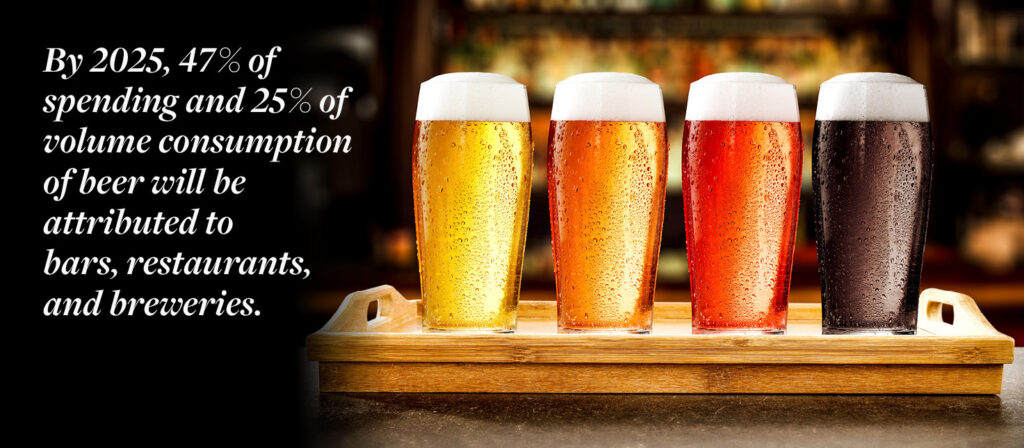
Photo of 4 different beers in glasses with caption saying by 2025 47% of spending and 25% of volume consumption of beer will be attributed to bars, restaurants, and breweries

  While supply chains have continued to ease, enabling faster access to new equipment, the cost of acquiring those new assets has risen notably as a result of inflation, the tight labor market, and higher raw material costs. Additionally, a continued CO2 shortage has impacted the industry. Because brewers use CO2 to purge oxygen levels during certain critical processes and for pressurizing tanks and moving beer through lines, some have taken to recapturing the gas during the fermentation process, for later reuse. The good news is that overall, import shipping and delivery costs have decreased by nearly 50 percent since the peak of the pandemic-driven commercial transportation crisis and fewer manufacturers are reporting cancellations on existing orders.

  With government assistance well behind us and capital harder to come by, producers and marketers across the beer market are having to refocus their efforts on their best performing brands. We are seeing this play out in many ways, perhaps most notably with Constellation brands which first signaled its exit from craft beer via the sale of Ballast Point to Kings and Convicts Brewing in 2019 for a fraction of its purchase price, and more recently with the divestiture of both Funky Buddha Brewery and Four Corners Brewing, presumably also at a significant loss.

  Lastly, it is important to point out a variety of trends that have been pervasive in the craft beer industry over the past year. Some of the most notable of these are summarized below:

•    Sour beers have continued to gain popularity, transitioning from niche to mainstream and driving impressive sales for many of those brewers who have embraced the trend.

•    After being largely disregarded on the craft scene, lagers are enjoying a healthy resurgence alongside dominant IPAs.

•    The rise of CBD’s popularity has resulted in many craft breweries experimenting with CBD-infused beers targeted at those likely to appreciate their relaxing properties.

•    Appealing to those who prefer or frequently drink wine, the wine-like notes of rosé beer are growing in acceptance and popularity.

•    Greater access to hops is allowing more breweries to produce fresh hop beers that are generating solid enthusiasm from customers.

•    Hazy, fruity beers are continuing to thrive, attracting first-time and experienced beer drinkers to their ranks.

Concluding Thoughts for Lenders with Industry Exposure

  Because craft brewers specialize in regional, unique beer styles such as ales, stouts, and wheat beers, these smaller enterprises tend to encounter certain challenges that are unlike those faced by their large scale, mass production brewer counterparts. For example, craft breweries rely heavily on local water quality, which affects the flavor of their beer. The specific mineral content in water is also crucial for certain varieties. Importantly, for every gallon of craft beer produced, up to seven gallons of water may be used. This makes access to pure water sources critical and any disruption to that access potentially catastrophic.

  While craft beer aficionados appreciate a variety of flavors, brand loyalty can be fleeting. To remain relevant and successful, craft breweries must constantly be innovating and introducing new offerings. The cost of this type of constant innovation can be significant, particularly when the market does not respond well to one or more of a brewer’s releases. In addition to the industry lobbying efforts referenced earlier in this article, the Brewers Association is actively supporting pending legislation that would allow craft brewers and others to immediately deduct research and experimental (R&E) expenditures in the year these costs are incurred.

  Additionally, with thousands of players vying for market share, attracting skilled employees and standing out from the crowd has become difficult, particularly given the shortage of applicants that this and many other industries have been facing since the pandemic.

  With these thoughts in mind, we encourage lenders with exposure to the craft beer market to remain in close contact with, and provide guidance to borrowers. From margin pressure to inventory aging, it is important, as always, to understand the many distinct challenges that those borrowers now face– only some of which have been outlined here. Doing so can help build a strong, mutually beneficial relationship while serving to help limit downside risk.

  Hilco has engaged with multiple craft brewers and suppliers over the past year and we welcome the opportunity to share the many insights we have gained through those efforts. Accordingly, we encourage you to reach out to our team to discuss any current or imminent needs you may have. We are here to help.

  Hilco Valuation Services is the world’s leading provider of asset appraisals with a proven, decades-long track record of providing the most accurate appraisals across all asset categories. The scope of the valuations we deliver ranges from a single asset in one domestic location to millions of assets located around the world. We are able to affirm current asset value through proprietary market data sourced from the collective worldwide asset disposition and acquisition experiences of Hilco Global over time. In contrast to the aged data relied upon by others in the industry, access to this cumulative, real-time information ensures delivery of the most reliable valuations for our clients. From brewing, distilling and chemical processing, to aerospace, financial services, retail, energy, healthcare and technology, we have delivered valuations for all industries. Additionally, the breadth and depth of our team’s expertise enables us to provide services ranging from Lending and Financial Reporting to Enterprise Planning and Litigation Support.

  Adam Stump is a managing director at Hilco Valuation Services and has been active in the auction, liquidation and appraisal industries since 1998. He frequently consults with financial institutions on asset-based loans and recovery, and over the past 12 months has been instrumental in delivering appraisal and advisory pertaining to dozens of craft brewers. During the course of his career, Adam has conducted or managed thousands of valuations across a wide spectrum of M&E categories including Metalworking, Fabricating, Plastics Manufacturing, Production & Assembly, Packaging, Distribution, Fulfillment, Food and Beverage, Chemical Processing, among others. He also has testified as an expert witness in numerous litigation cases. He is an avid home brewer as well. Adam earned his Bachelor of Science Degree in Computer Sciences from Bowling Green State University and his Associate of Arts Degree from Colorado Mountain College. Contact Adam at 847.849.2953 or astump@hilcoglobal.com.

Real World & Digital Marketing Beverage Trends-2024

marketing trends seen in 2 monitors

By: Hanifa Sekandi

The beverage race requires a lot of grit and stamina. It is about the long game and certainly not short wins. Although, every brand aspires to be the viral brand of the moment. What the alcoholic beverage industry learned in 2023 is that not all trends are beneficial to your bottom line. Also, your consumer values quality more than social acclaim. Let’s be honest: online growth is integral to modern marketing success. Although out-of-home (OOH) marketing is still viable, it must be coupled with innovative digital marketing strategies.

  So, where do you start in your next marketing cycle? Now that you have wrapped up your holiday marketing campaign, a new year brings endless opportunities to become a standout brand or to keep your current notoriety.

Where the Real World Meets the Digital World

  Subliminal marketing will never get old. Although some consider it to be an archaic marketing strategy, it is not. Have you ever walked or driven by a billboard of a chicken sandwich by a popular food chain and then later that day see the same ad while you scroll through social media? By the end of the week, when that hunger strikes, it is likely that you will find yourself either making a chicken sandwich with a recipe you stumbled upon on TikTok or firing up your food delivery app to order one.

  Traditional marketing still works, although it is hard to measure the return on your investment with tangible metrics. Remember, before the digital world took over, advertisers spent a lot of time creating campaigns for magazines, billboards, benches, buses or anywhere they could display. It worked, and it still does. What digital advertisers understand from this method is that the more people see something, the more likely they are to gravitate toward it when they are browsing through beverage options at the store. Something new is always worth a try when it is familiar.

  A notable example of this is when Red Bull filled garbage bins with empty cans of Red Bull. They also had empty cans placed outside of London’s popular clubs while at the same time distributing their beverage to DJs. Simple but amazingly effective.

  Another fitting example of this is Taiwan Beer’s use of Honey Beer Drones to deliver complimentary six packs of Honey Beer, the brand’s new beverage, to those who registered on their website. As a result, within just 10 days, 15,000 people subscribed. This interactive guerilla marketing strategy worked well because it highlighted the use of honey in the beer and added a visual effect that people could see, film, share and talk about. It also added another great component: delivery through drones, and tech aficionados approved of this creative delivery tool. Both brands understood that real-time marketing strategies allow consumers to feel connected to the brand.

  As you look ahead at your marketing strategies, keep in mind that people are expecting more than just digital strategies. Also, the assumption that your consumer only exists in the digital world is erroneous. With that said, digital marketing does matter. It is up to you to do the research to discern what digital strategy will best position your beverage in this competitive landscape. Hopefully, your brand mission and messaging clearly define your “why” – why your brand was made just for your intended consumer, and your “who,” – who your consumers are. How does your brand complement their lifestyles and their buying decisions when they purchase an alcoholic beverage?

Beverage Marketing in the Digital World

  Welcome to the modern digital world. It is not old, but honestly, it feels new since every day, there is something new on the horizon. Currently, AI technology is said to disrupt modern-day advertising. As you begin to adopt some of these tools, do not get carried away. Remember, these tools are meant to enhance your digital marketing strategy and, in some cases, streamline processes so you can spend time on other tasks. So, what are digital trends to implement into your next marketing cycle in the new year?

Video Marketing: Creating compelling visual marketing is no longer an afterthought. Companies need to invest in the talent and tools to create videos, both long and short-form clips, to highlight online. Consider these videos as mini commercials that can be uploaded to your social media channels or used as strategically placed ads. Your marketing team should perform A/B testing on the desired platform to see which videos are worthwhile paid ads. You may find that some videos perform quite well on Instagram as a reel, while others perform better on TikTok, YouTube or Facebook. Many great and easy-to-use marketing tools allow you to create videos. The benefit of these tools is that they allow you to create a lot of visual content and allocate your marketing budget effectively. Video marketing should also include testimonials by real consumers.

Curated Marketing: As you know, it is a numbers game, so your company must understand analytics to develop marketing campaigns that target specific consumers. Email marketing campaigns fall short when you do not invest the time to understand your customers. Paired with mobile marketing, having a good grasp of analytics and using this data to create personalized marketing campaigns will improve your open rate and engagement. For example, some consumers prefer to receive newsletters that feature sales and discounts, whereas others enjoy reading blogs that are informative while also displaying your product. There are many CRM tools for marketing now. Finding one that works for your team should top your list as the new year approaches. For example, HubSpot and Klaviyo are great tools for segmented marketing campaigns.

Real World Beverage Marketing

  Once you have a digital marketing strategy, devise a real-world marketing strategy to enhance and complement it. You may also choose to start with OOH marketing strategies before you delve into digital ones, but the two are needed for a complete package. In addition, you cannot assume that your digital strategy is the only golden ticket to success. If your goal is to be in the alcoholic beverage sector for the long haul, it is best not to rely solely on one strategy. Although spending time online has become the modern-day norm, it does not account for the real-time moments that people experience in their daily lives. Endcaps at grocery stores, miniature bottles placed by the cash counter or free samples or coupons handed out on the way into a store create real-world experiences for consumers. Earned marketing builds trust. Other than advertising in magazines or utilizing display ads, what are other ways to market your brand in real-time?

Experiential Events: Create experiential events where people can taste your beverage. This is a common strategy by agencies when marketing to the press and influencers. Instead, invite your consumer to these events! Partner with bars and restaurants to create events such as tastings or food pairing menus that highlight your beverage. Most hotel bars and restaurants have happy hours. Offer to sponsor a happy hour. Not only does this encourage these establishments to carry your beverage, but it also creates a fruitful partnership. They are also more likely to recommend your drink to customers, as well.

Think Outside the Box, OOH Marketing: The more you are seen, the more likely you will become an option. Some brands have cut down their marketing budgets in this regard. Understandably, digital marketing appears to be the most viable strategy. Do not get lost in the idea of going viral. It is nice to have, but consider it as luck of the draw. Just make a high-quality product and build authentic, evergreen marketing strategies. Reserve some of your expenditure for OOH Marketing. Oddly enough, these ads make their way into the digital sphere if they are buzzworthy.

  A splendid example is Corona’s billboard display in Brighton, Great Britain. When Corona wanted to highlight that their beverage is made with natural ingredients, they painted a wall with their brand’s classic yellow and placed the signature Corona label in the center. At a specific time, when the position of the sun changed, between 6:30 p.m. and 6:45 p.m., a bottle overlay of beer appeared along with text that said, “made from the natural world.” During this time, people could view the classic Corona bottle. Now, this is not only something to talk about but also a great intersection of digital marketing via social shares. 

Make 2023 Holiday Beverage Sales a December to Remember

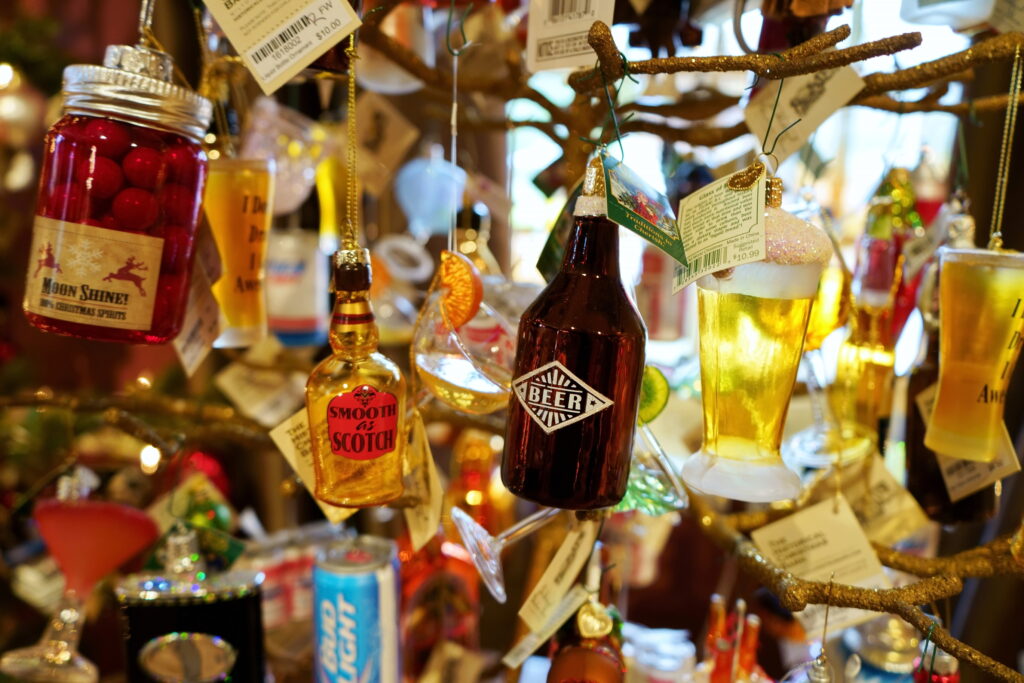
Photo of different bottles and glasses and cans of beer and spirits hanging from branches

By: Neeraj (Raj) Tulshan – Founder of Loan Mantra

It’s the most wonderful time of the year. The Holiday season is in full swing so it’s time for one and all to get out of the house. Celebrating the holidays looks different for many people whether that be shopping for friends and family, attending parties or making a toast with a good cocktail or beer. And it’s a peak time for restaurants and bars.

  Festivities can bring more customers into your restaurant as they spend more time eating out with friends and family. Plus, there’s always a lineup of Christmas parties, concerts and winter festivals, so many people don’t have time to cook at home.

  It’s the perfect time for a promotional strategy to kick into high gear. Holiday marketing campaigns capture the joy of the season and encourage valued customers to indulge in a special meal, dessert and/or drinks. There are a variety of options to help your establishment standout. Here are some thought starters:

●   Sponsor a Charity Nigh: Choose a charity of your choice (Toys for Tots, Make a Wish, or a local charity) and select a night or two during the month to donate a portion of your sales to that program. If you can, a local charity is much more likely to draw in more customers, as people flock to support their community. Make sure you market which date you are choosing to do this, and when it’s over, update your customers on the total amount raised. Fun fact: According to National Giving Month, 31% of annual giving happens in the month of December.

●   Offer Gift Cards: The National Retail Federation (NRF), surveys consumers on their spending on holidays and seasonal events throughout the year. Over the last decade, consumers have been kicking off their holiday shopping early in order to spread out their budgets and avoid the stress of holiday shopping. Continuing the trend this year, 60% of holiday shoppers started browsing and buying by early November. Having gift cards available makes it easy for consumers to grab a gift card, apply money to the card for their loved one/friend and stuff it away until their holiday for a present or a stocking stuffer. So, what gift made it to the top of the wish list? It’s gift cards!

●   Add Holiday Spirit to Your Online Presence: Use holiday-themed stock images, Create holiday-themed social media posts using free online templates as a guide on sites like Canva, Ripl and PosterMyWall. Use festive images to engage your audience and update your social media graphics to quickly freshen up your accounts and help boost engagement.

●   Host A Fun Event: Draw people in by hosting fun, quirky events such as an Ugly Sweater Party. This is sure to get everyone in the holiday spirit. Anyone who’s wearing an ugly sweater, enters the contest. From there, an ugly sweater fashion parade is a must. A few possible categories: most festive, most original, just plain ugliest etc. Winner of each category gets a free shot/drink of choice.

●   Holiday-Inspired Drink Menu: Spiked eggnog, peppermint cocktails, holiday-inspired shots, all these drinks help capture the essence of this loved season. With minimal risk and utilization of current inventory, launching a new drink menu is a no-brainer! Seasonal drink menus appeal to new customers and build intangible relationships with your restaurant’s loyal guest base by reinforcing brand concepts and generating spontaneity within the restaurant. This operation, if done efficiently, provides a foundation for increased profit margins.

●   Host a Tasting or Pairing Event: The National Restaurant Association research indicates that the sale of alcoholic beverages can be a key driver to restaurants. Eighty-four percent of adults who drink wine, beer, or cocktails say that restaurants are a good place to learn about new alcoholic beverages while 82% of these consumers say they trust the staff at their local restaurants to make good recommendations when it comes to alcohol beverages. These facts present a great opportunity. Why not host exclusive tasting events for VIP customers? Or hold tasting events which pair the perfect cocktail or beer with the perfect starter, meal or desert? In addition, 70% of beer drinkers, 69% of wine drinkers, and 67% of cocktail drinkers are more likely to say the availability of alcoholic beverages makes them more likely to choose one restaurant over another.

●   Neighborhood Bar Crawl: Feeling collaborative? Team up with nearby bars and restaurants to host a bar crawl. A successful bar crawl is often organized with a predetermined route, listing a selection of bars to visit within a specific timeframe. Oftentimes, bar crawls follow a theme, like a polar bear crawl. So have your bar themed out and guests dressed accordingly! A bar crawl can do wonders for your business. Bar crawls not only bring a flood of new customers to your bar but also creates an atmosphere sure to attract more customers. It’s a great mix of entertainment and growth for your business. Organizing a bar crawl, or getting your bar included in one, requires strategic planning. Partnering with other local businesses, advertising the event, and creating a fun and welcoming atmosphere are all key to a successful bar crawl.

●   Make a Seasonal Favorite: Create a themed drink or special brew that is only offered once per year – think McDonalds Shamrock Shake and Starbucks Pumpkin Latte to get customers talking. Keep the customers’ senses in mind – what visuals, sound and texture can be incorporated to highlight the experience? How will the customer interact with the brand (via server, bartender, store pick up)? How can the presentation be kicked up to give it a little more sizzle as it’s being served? What elements could be included to help recreate the ultimate customer experience each time? 

  Holiday marketing can help you boost revenue, solidify relationships with current customers and gain new ones this holiday season to help make this sales season a December to remember.

About the Author

  Neeraj (Raj) Tulshan is founder and managing member of Loan Mantra. Connect with Raj: https://www.linkedin.com/in/tulshan/, Raj@loanmantra.com or 855.700.BLUE (2583), Ext. 101.

Raising a Glass to the 90th Anniversary of the Repeal of Prohibition   

Photo of men and women at the bar in black and white during Prohibition being served alcoholic drinks by 2 bar tenders

By: Becky Garrison

December 5, 1933, marks the date the repeal of the 18th Amendment went into effect, thus ending the United States’ failed efforts to outlaw liquor. The 18th Amendment to the United States Constitution, which went into effect on January 17, 1920, prohibited the manufacture, sale and transportation of alcoholic beverages and their import into or export from the United States and all its territories. The National Prohibition Act designed to enforce this amendment became known as the Volstead Act after Rep. Andrew J. Volstead (R-MN).

  Despite this ban, alcohol continued to flow throughout the United States. So, what exactly were people drinking during Prohibition? 

Legal Consumption of Alcohol During Prohibition   

  Select exemptions under the Volstead Act permitted one to imbibe legally. Any liquor purchased before January 17, 1920, could be consumed at home. Private social clubs and individuals of means and available space amassed a collection of fine wines and liquors that would rival any well-stocked bar, with liquor stores announcing “going out of business” sales throughout the country.

  In keeping with the spirit of allowing mild alcohol consumption in private, this act permitted home winemaking and brewing. Soon after National Prohibition began in the 1920s, grocery stores often carried brick-sized blocks called “Vine-Glo.” These compressed raisins were bound together with condensed grape juice. Attached to the block was a small container of dried yeast. The wrapping contained the following text:

  “WARNING: Do not dissolve this fruit brick in warm water and then add the contents of the yeast packet, as this will result in fermentation and the creation of alcohol, the production of which is illegal.”

  Along those lines, this act banned only the sale of beer but not the ingredients for making it. So, one could purchase malt syrup with a packet of yeast attached that included similar instructions that combining the two could result in an illegal product.

  Also, one could obtain liquor with a medical prescription from a licensed doctor. However, in the first five years of Prohibition, only 26 states allowed the sale of medicinal liquor. In addition, liquor could be used for sacramental and religious purposes, though no statistics exist regarding how many Americans suddenly “got religion” during Prohibition.

The Canadian Connection

  Under Canadian law, local distillers could make spirits for sale to the United States if they paid a $20 per gallon export tax. By the late 1920, the Canadian government suddenly realized how much alcohol revenue was being earned by these various export houses, courtesy of the American bootleggers, and decided to raise the annual licensing fees for these liquor exporting businesses from $3,000 to $10,000.

  As expected, the U.S. government pressured Canada to stem the flow of liquor coming from Canada to the United States. In 1930, the Canadian government finally passed a law banning foreign customers from purchasing booze directly from export houses. However, this failed to deter the export of spirits coming primarily from British Columbia, Ontario and Toronto. 

  Other international waters where one could find smuggling of illicit spirits included the Caribbean, where rum was smuggled, especially along the East Coast. Those who transported their wares via sea, often using high-speed boats designed to evade capture, became known as rumrunners, named after the spirit they were transporting.

Distilling Prohibition-Era Spirits

  Since law enforcement could spot the trails of smoke coming from fires used to heat illegal stills, moonshiners often used cane or malt syrup, as these products could be fermented at room temperature, unlike raw grains that needed to be cooked pre-fermentation. Traditionally, distillers make “cuts” (discarding the beginning and end of the run) of the liquid out of the still to ensure they remove the natural acetaldehyde, methanol and fusel oils that form during fermentation. During Prohibition, distillers often skipped that step so they could get more product from each run, resulting in illegal hooch that proved to be deadly at times.  

  This cutting tended to take place at night in seemingly deserted industrial-looking buildings, rural farms, and other facilities that wouldn’t draw undue attention from law enforcement. Some added water to their liquor so they could produce more bottles from each run. Then, they turned to industrial (denatured) alcohol to give the product an extra kick now that it had been diluted. Denatured alcohol product was still on the market as it was used to make products like fuel, explosives and solvents. Among the products used for cutting were mouthwash, hair tonic, shellac and perfume. Even after the government added an emetic to those products containing denatured alcohol, they were still used as cutting agents with cocktails designed to mask the vile taste of these Prohibition-era spirits.

  In The Spirits of America, Eric Burns notes how poisoned booze was the great, unsung tragedy of Prohibition. “People today know about bootleggers and speakeasies; they are familiar with the names Capone and Kennedy; they have a general impression of casual lawbreaking and wild times kindled by spirits that were not supposed to be so readily available. But they do not know about Yack Yack Bourbon and Jackass Brandy and Squirrel Whiskey. They do not know about cooking alcohol squeezed through a rag and mothballs dropped into a steaming mug of gasoline. And they do not know about Jamaica gin and the men who drank it in doses that were so much more than minute, thereby getting rid of their thirsts for a few minutes as they turned into cripples for the rest of their lives.” (Page 224)

  As Daniel Okrent noted in Last Call: The Rise and Fall of Prohibition, “In the saloon era, calling for liquor by brand name was almost unheard of; in the speakeasy era, it became a habit, first as a means of protecting oneself from alcohol of questionable origin, and secondarily as a way of expressing one’s level of taste. Decades later, many of the liquor industry’s best-known brand names owed their prominence to the ubiquity of Prohibition-era rotgut. But knowing one’s brand did not ensure one was drinking said brand. In too many places, if you ordered Brand X, you got Brand X; if you ordered Dewar’s or Gordon’s, you paid twice as much and got Brand X.” (page 162)

The Repeal of Prohibition

  While some states began loosening their liquor laws in the early 1930s, National Prohibition was still in effect until December 5, 1933, when Utah was the 36th state to vote for the 21st amendment repealing Prohibition. The debate over alcohol shifted from whether Prohibition should be repealed to debates over how to tax and regulate the sale of alcohol and distilled spirits in particular.

  John D. Rockefeller, Jr., a nondrinking Baptist who had earlier been a heavy donor to the antiliquor cause, funded a study group in 1933 to explore how to best address this “alcohol problem.” While the group recommended that Prohibition be repealed, they advocated for strict government control of alcohol sales, preferably through state stores where the states could make profits.

  In response, the federal government adopted a three-tier system that permitted each state to develop a structure of checks and balances that provided safe alcohol to consumers while ensuring a simple method to collect tax revenue. The three-tier system is simple in theory: manufacturers provide alcoholic products to wholesalers, who distribute the products to retailers, who sell to the consumers. No one entity can be involved in more than one tier under most state models, and each tier is regulated and licensed separately.

  Alexandra Clough, a spokesperson for the American Crafts Spirits Association (ACSA), reflects on the lingering effects of Prohibition 90 years after its repeal. “We have made much progress to help consumers gain access to craft spirits, but we still struggle to achieve the same loosened regulations that our counterparts in beer and wine have enjoyed for many years. Though we, of course, will be toasting the 90th anniversary of Repeal Day, we will also continue to focus on helping consumers access the incredible craft spirits this country has to offer in more modern ways, like through direct shipping.”

  In recent years, distillers ranging from craft nano-distilleries to Jack Daniels have come out with their version of “White Whiskey,” A.K.A. moonshine. In 2023, Buffalo Trace launched The Prohibition Collection, an annual limited-edition, multi-bottle collection they describe as “honoring the whiskeys that were legally produced and sold at the distillery during arguably the most contentious period in alcohol history.” This debut release tributes five Prohibition-era brands: Old Stagg, Golden Wedding, Three Feathers, Walnut Hill and George T. Stagg Spiritus Frumenti.

  Spirits like Wohlfert Craft’s Distilling’s Sugar Shine continue their family’s spirited legacy by distilling spirits using their relatives’ recipes. John Wolfert’s great-grandparents opened several successful “bakeries,” which became a more spirited clandestine operation during Prohibition. As the smell of the yeast and sugar fermenting smelled similar to bread, they were able to ferment their brews undetected and were even able to downplay a still explosion as simply the result of, say, a gas leak.   

  Even though December 5 has yet to achieve the notoriety of, say, St. Patrick’s Day, some bartenders from across the country continue to honor Prohibition Repeal Day by highlighting Prohibition-era cocktails, including the Bee’s Knees, Side Car and Gin Rickey. Buildings like Smith Tower, where Seattle’s gentleman bootlegger Roy Olmstead conducted his smuggling operations, celebrate the Roaring Twenties with historical displays and craft cocktails on their 35th-floor Observatory Bar. Other establishments, such as Bar 600, located inside Cannery Pier Hotel & Spa in Astoria, Oregon, continue the spirit of this era. Situated on the former site of the Union Fisherman’s Cooperative Packing Company, this decor takes one back to an earlier era by recreating the feeling of the canneries of yesteryear with smokestacks, exposed steel beams & wooden trusses along with a vintage car service.

 Portions of this article are excerpted in Distilled in Washington: A History (March 18, 2024).

Nailing Down the Right Tanks for Your Craft Beverage

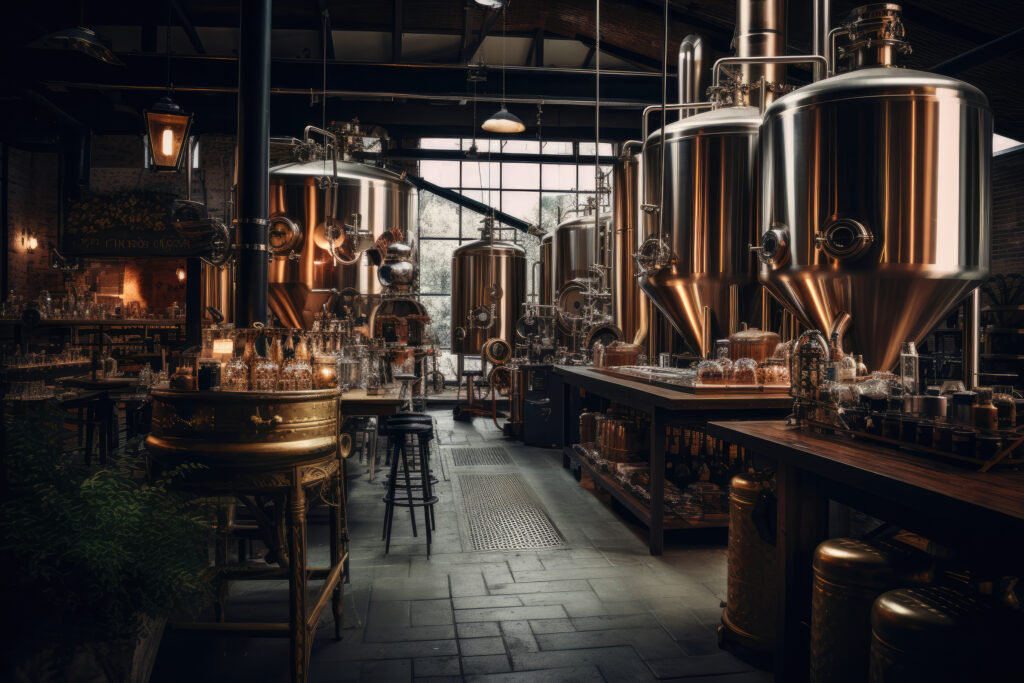
Picture of Distillery tanks in a distilllery

By: Cheryl Gray

Whether it’s craft brew, spirits or hard cider, the right tank can make all the difference in taste. Cutting corners when choosing tank products can inevitably result in quality control issues that can spell disaster for any craft beverage maker. The resulting losses can be time, materials, labor and perhaps worst of all, an entire product batch.

For nearly 20 years, SmaK Plastics has made it its business to provide craft beverage makers with best-in-class tank products, including those from its Flextank product line. Flextank serves clients throughout the United States and in Canada, Mexico, the Czech Republic, Croatia, Hungary, Slovenia, Serbia, Slovakia, Romania, Greece, Cyprus, Australia, Chile, Brazil, Peru, Argentina, France and Austria.

  Headquartered in Vancouver, Washington, SmaK Plastics touts the Flextank roster of tanks as affordable and nearly identical to more costly stainless-steel tanks and oak barrels. Flextank vessels began selling in the United States in 2006. The brand considers itself a market leader in what it describes as new-age wine and beverage making. Flextank products have been used, the company says, to produce award-winning wines, ciders and meads. All its tanks are manufactured and assembled in Vancouver for global distribution in outlets that include Sydney, Australia; Cape Town, South Africa; Santiago, Chile and Bordeaux, France. Flextank products are manufactured with high-quality resins that the company says are approved by the U.S. Food and Drug Administration and the European Food Safety Authority.

  Kristi Cummings, the marketing director for SmaKPlastics, describes some of Flextank’s most popular products and the reasons behind the brand’s success, including an oxygen transfer rate roughly the size of a grain of table salt.

  “With a 9 mg/liter/year oxygen transfer rate, our Heavyweight Flextanks are used by craft beverage makers throughout the world to create award-winning ciders, spirits, meads, kombuchas, wines and other craft beverages.”  

  “Our Flextank Stacker Tanks are among our most popular with craft beverage makers for their capacity, easy access and maneuverability. Unlike heavy stainless-steel tanks, Flextank Stacker Tanks are comparably quite affordable and can be easily moved around your workspace with a pallet jack. Our Stackers, like many of our other tanks, also come standard with our Dexter lid, which provides an airtight seal and easy access to your beverage when you need it. Add-ons like pouring and sampling valves are also available, as well as FlexStaves from a world-leading French stave manufacturer for adding notes of oak to your beverage.”

  As to customer service, Cummings explains what makes Flextank stand out from its competition.

“Flextanks are designed and rotomolded in the USA to be extremely durable. You can craft your beverages with some peace of mind knowing that all Flextanks purchased directly through us or an authorized Flextank dealer come with a lifetime tank guarantee. For busy business owners we make our tank and accessory prices transparent and ordering simple.”

  One Flextank customer is Salt Creek Cider House, an orchard and cidery in the Willamette Valley region of Oregon. This second-generation hard cider company, founded by Carter and Lindy Rickett, was recently voted “Best Cidery” in the Willamette Valley. The cidery relies upon the Flextank Apollo line of products, so named because it resembles the history-making Apollo Space Capsule. Cidery co-founder Lindy Rickert points to the efficiency of the Apollo as one reason that her company, which began with a single Flextank Apollo, has added additional Apollo products to its operations.

  Another popular Flextank option is the versatile Dexter product line. All Dexter Tanks are cylindrical and are equipped with a 19-inch diameter clamp lid for easy cleaning and access. Customers can choose from the standard maturation weight or more heavyweight options. 

  The 80-gallon Dexter by Flextank Tank is the product choice for Runcible Cider, another award-winning cidery based in Mosier, Oregon, along the Lewis and Clark National Historic Trail. According to cidery co-founder Kelly McCune, the Dexter Tank is versatile enough to accommodate the production of hard cider without fear of picking up so-called off flavors. The Dexter has an optional racking pallet with a contoured center “lug” option. This allows for convenient transport and storage of the tank with easy access. 

  For those who prefer stainless steel options, Quality Tank Solutions has, as its name implies, a number of choices when it comes to tank products. The Wisconsin-based company was founded in 2012. It specializes in multiple liquid applications for various industries, including breweries, food and beverage and pharmaceuticals. Quality Tank Solutions works with companies throughout North America and prides itself on what it describes as exceptional customer service, pre- and post-sale.

  Josh Sukys is a the multimedia design specialist for the company and describes what sets Quality Tank Solutions apart. “We specialize in agitation, whether keeping liquids in suspension or providing a scrape surface, we cover it all. All of our products are custom-designed, making the opportunity to get exactly what you are in need of our priority. QTS is also 3A & ASME (R & U Stamp) certified, which adds to the capabilities on what we can provide. But don’t stop there; our customer service is top-notch, covering everything from tank repair to service parts and installations, and if you need a platform to go with, we have that, too.”

  “When working with Quality Tank Solutions, you will have access to the entire team. From conception, design, engineering, manufacturing and installation, Quality Tank Solutions will have you connected to the correct team member every step of the way. Every project is unique, and QTS understands that. Finding out what the equipment will be used for, your process and the required result is all part of the client interaction to be sure expectations are met and exceeded. Once your equipment is installed, QTS offers training and continued technical support, along with a full two-year warranty. Consider Quality Tank Solutions a long-term partner.”

  When it comes to outfitting brewhouses with the right stainless steel tank equipment, Quality Tank Solutions offers custom-built options. The client-specific systems are manufactured with a focus on the height and space restrictions of the brewery. QTS offers full and complete two- and four-vessel brewhouses ranging in size from 3-1/2BBL to 100BBL. Standard construction options include manual to fully automated systems, as well as steam or direct fire systems. QTS also offers a complete line of brewhouse equipment, such as boilers, chillers, grain handlers, walk-in coolers, keg washers, bottling lines and other equipment.

  The QTS fully stainless-steel mash tank offers standard construction features that include a flanged and dished top head, NORD gear drive, turbine agitation, glass top manway, tank light, removable CIP assembly, side wall baffles, steam jackets, shallow cone bottom and 3-A standards. Available options are a combination mash/lauter tun, a hydrator and a knife gate.

  QTS offers stand-alone whirlpool tanks and a double-duty brew kettle/whirlpool tank. Either choice is sized specifically to the brewery’s system capacity. Standard construction features include most of the features of a mash tank plus a shallow cone bottom, vortex breaker and a trub guard.

  Fermentation tanks manufactured by QTS are designed for maximum yields, which the company says results in a greater return on investment. The tanks use the precision and function of what the company describes as Omega laser-welded heat transfer surface jackets. These allow for increased flow and quicker crash times. In addition to some of the standard construction features of other   QTS tank products, a QTS fermentation tank also includes a tori conical bottom cone, an insulated vessel, a heat transfer surface jacket, a top/bottom/side entry manway, a removable CIP assembly with a whirly spray device, a racking arm and other accessories. 

  QTS manufactures brite tanks with standard features that include visual sight gauge assembly, side entry manway, side entry manway and the Omega laser welded heat transfer surface jackets designed for ample flow and fast cooling. The company’s lager tanks are horizontal and marketed as highly efficient because they contain more surface area coverage. Standard construction features include flanged and dished heads, heat transfer surface jacket, quarter-inch thick formed saddle with adjustable feet, oval swing-in manway, removable CIP assembly with whirly spray device, stacked tank design and visual sight gauge assembly. Available options include a stacked tank design and visual sight gauge assembly.

  QTS offers hot and cold liquor tanks that are designed to accommodate the size of virtually any brewhouse and are built to customer specifications. In addition to some of the other standard features of QTS products, these tanks include a round cross-arm manway, flanged and dished or flat pitched bottom, overflow and additional options such as 304 or 316L stainless steel, visual sight gauges and immersion heaters.

  Clearly, there are a number of options that craft beverage makers need to consider when choosing tank products. Whether just starting out or expanding a growing operation, expert companies are within reach to help clients make the right choices.

New(ish) TTB Guidance on Transfer of Beer Between Breweries

Warehouse showing beer and beer bottle storage.

By: Brian D. Kaider, Esq., KaiderLaw

There are many reasons why beer might be transferred from one brewery to another.  Some common examples include; beer transferred between two locations of the same brewer, beer contract brewed by one brewery for another, and beer to be blended as part of a collaboration.  How these transfers are handled and, more importantly, how taxes are applied varies according to the circumstances.

Breweries of Common Ownership

  Since at least 1954, federal law has allowed the transfer of beer, without payment of tax (i.e., “in bond”) between breweries of common ownership.  Title 26 of the U.S. Code §5414, as written in 1954 simply stated “[b]eer may be removed from one brewery to another brewery belonging to the same brewer, without payment of tax, and may be mingled with the beer of the second brewery, subject to such conditions, including payment of tax, and in such containers, as the Secretary or his delegate by regulations shall prescribe.”

  Some terminology here may be helpful.  When the President signs a law passed by Congress, the provisions of the law are broken up into subjects and listed in the U.S. Code (U.S.C.).  For example, laws relating to federal taxes are listed in Title 26 of the U.S.C. (the “Internal Revenue Code”) and those taxes that apply to alcoholic products are listed in Title 26, Subtitle E, Chapter 51.  But, it is up to the applicable government agency in charge of enforcing the law to determine how to put the law into practice.  So, it creates “implementing regulations” that are categorized and listed in the Code of Federal Regulations (“C.F.R.”).  In this case, C.F.R. Title 27, Chapter I, Subchapter A, Part 25, Subpart L, sections 25.181-186 were created by the TTB to deal with the transfer of beer to another brewery of the same ownership.

  In 1958, Congress amended 26 U.S.C. §5414 to further allow transfer in bond between breweries owned by different corporations, if either (A) one corporation owns a controlling interest in the other, or (B) the controlling interest in both corporations is owned by the same “person,” which may be a third corporate entity.  Breweries in one of these arrangements are said to be in a “controlled group.”  As most small breweries are aware, in 2017, the Craft Beer Modernization Act (“CBMA”) provided for a reduced tax rate of $3.50 per barrel on the first 60,000 barrels per year, a level the vast majority of U.S. breweries will never exceed.  This reduced tax rate applies to the first 60,000 barrels of beer removed for consumption by members of a controlled group, collectively.  So, if there are two members of the controlled group, each of which produces 35,000 barrels of beer that are removed for consumption in a given year, the last 10,000 of those barrels will be subjected to the higher tax rate of $16.00 per barrel.

Contract Brewing

  Until 2017, beer could only be transferred in bond between breweries under common ownership or control, as described above.  The CBMA, however, added section (a)(3) to 26 U.S.C. §5414, which authorizes the transfer in bond between breweries of different ownership, provided that the transferor divests itself of all interest in the transferred beer and the transferee accepts responsibility for the payment of tax.  Thus, a brewery that contract brews a beer for another brewery can transfer that beer in bond to the contracting brewery.  The tax that will apply to that beer when removed for consumption, however, is not so clear-cut.

  The reduced tax rate of $3.50 per barrel applies only to beer produced by the brewery paying the tax.  So, if Brewery A pays Brewery B to manufacture “Hypothetic Ale,” and Brewery B brews the beer, bottles it, labels it, and sends it back to Brewery A, in bond, when Brewery A removes that beer for consumption, it will have to pay the full $18.00/barrel tax rate.  The question, then, is what activity by the receiving brewery counts as “production?”

  When Congress first passed the CBMA, it was initially set to expire after two years.  So, rather than go through the lengthy process to issue implementing regulations for this temporary law, the TTB instead issued Procedure 2018-1, which explained how it would address the changes in the law.  In 2020, Congress passed the Taxpayer Certainty and Disaster Tax Relief Act, which among other things made the CBMA changes permanent.  As it works through the process of drafting and approving implementing regulations, TTB on July 13, 2023 issued Procedure 2023-1, which contains the guidance of 2018-1 with some minor updates.

  According to Procedure 2023-1, a brewery receiving beer in bulk that only carbonates the beer or transfers it into consumer packaging is only making de minimus changes to the beer and is not eligible for the reduced tax rate.  A beer is considered to be “produced” if it is brewed by fermentation or “produced by the addition of water or other liquids during any stage of production.”  Thus, if a brewery receives bulk beer concentrate and adds water to it before packaging, they will be considered the producing brewery and will be eligible for the $3.50 tax rate. 

  The TTB guidance does not indicate how much water must be added in order to be considered production.  Here, reasonableness should be the guiding principle.  Receiving a ten barrel batch of bulk beer and adding a gallon of water would certainly not be viewed as “producing” the beer.  If, on the other hand, the transferred beer is sufficiently concentrated to enable it to be shipped in one container instead of two, adding an equal amount of water upon receipt would likely be viewed as production. If in doubt, contacting the TTB or a knowledgeable attorney in advance to get guidance on a specific situation is a good approach.

Blending/Collaboration

  Collaboration beers are becoming more common and can be a great way for new breweries to gain market recognition by collaborating with a more established brewery.  In some cases, the two breweries design a recipe together and then one brewery does all of the actual production.  In other cases, each brewery may produce a beer and then the two beers are blended together into a single product. 

  According to Procedure 2023-1, however, the TTB does not consider “blending” to be production for the purpose of taking the lower tax rate.  That does not mean, however, that the entire blended product is subject to the higher tax rate.  Rather, if a brewery blends a beer of its own production with a beer produced by another brewery not of the same ownership (or control group), it may take the $3.50/barrel tax rate on the portion of beer it produced, but must pay the $18.00 rate on the portion produced by the other brewery.  Of course, if the other brewery’s beer is delivered as a concentrate to which water is added in addition to the blending, then the beer would be considered to be produced by the receiving brewery and the lower tax rate would apply to the entire batch.

Records

  Whether breweries are commonly owned, part of a controlled group, or completely independent, when transferring beer in bond, proper records must be maintained by both the sender and the recipient. 

  The shipping brewer should prepare an invoice that includes: a statement that the beer is transferred in bond, the name and address of the shipping brewer, the date of shipment, name and address of receiving brewer, the number and size of cases and/or kegs and total barrels or the size and type of bulk container and total barrels. The original invoice should be sent to the receiving brewer with a copy kept by the shipping brewer. 

  Beer may be reconsigned to another brewery or returned to the shipping brewery while in transit.  In such cases, either a new invoice should be created and all copies of the original voided or the original invoice can be marked with “Reconsigned to:” followed by the name and address of the brewery to which the beer is reconsigned.  When the shipment is received, the receiving brewery must verify the information on the invoice, note any discrepancies, and maintain the invoice in the brewery records.  The brewery to which the beer is reconsigned or returned is responsible for tax on any beer lost in transit.  However, if the loss is not greater than two percent of the quantity shipped, the receiving brewer is not required to file a report of loss or a claim for allowance of the loss if there are no circumstances indicating that any portion of the beer lost was stolen or otherwise diverted to an unlawful purpose.

  The information on the invoice, including any discrepancies, should be used by both the shipper and receiver in their Brewery Report of Operations (TTB F 5130.9) or Quarterly Brewery Report of Operations (TTB F 5130.26).  Whether the entities are commonly owned, part of a control group, or separate entities, the shipper notes the beer transferred in bond on line 19 of F 5130.9 or line 11 of 5130.26.  The receiving brewer notes the received beer on line 5 of 5130.9 or line 3 of F 5130.26.  When the receiving brewery removes the beer for consumption, it should be reported on line 14 of 5130.9 or line 10 of 5130.26.

Conclusion

  Any brewery that is contemplating transferring beer to another brewery, regardless of ownership, would be well-advised to thoroughly review TTB Procedure 2023-1.  Further, these issues should be considered when expanding to a second location or entering into a contract brewing or collaboration arrangement.  Creating the appropriate corporate structure for common ownership or a controlled group for the expanded business may prevent application of a higher tax rate.  Similarly, ensuring that both parties to a collaboration do enough work on the finished product to be considered a “producer” for the resulting beer may prevent a portion of the product from being assessed at the full tax rate.  As always, consultation with an experienced attorney on these issues is a best practice.

  Brian Kaider is the principal of KaiderLaw, a law firm with extensive experience in the craft beverage industry. He has represented clients from the smallest of start-up breweries to Fortune 500 corporations in the navigation of licensing and regulatory requirements, drafting and negotiating contracts, prosecuting trademark and patent applications, and complex commercial litigation.

Build Your Business Fast and Get it Right.

brewing and distilling machines

By: Kris Bohm of Distillery Now Consulting

Building a business fast and getting it right is hard to do. Many breweries and distilleries start with a far-flung idea that often takes months or years to initiate the process of bringing the idea to life. The thousands of steps needed to bring a big idea to life will take you down a path that is not obvious and certainly not direct. Going from concept to operation is a massive challenge, but with the right help and guidance it can be done quickly. There are many ways to fast track building a new business. Many of these fast methods are fraught with traps and mistakes that are expensive. The sure-fire way to build a business fast and to do it right is to work with those who have done it before. Let’s take a look at some of the biggest learning lessons from building multiple distilleries i’ve seen and help set you on the path to building your business fast and getting it right.

  Talk to any business owner of a brewery or distillery, and I guarantee you that the owner will have some stories about how they did not do some things right the first time. Whether the equipment they bought was too small, or the location was not ideal, there are always lessons to be learned from a first time start up business. One lesson that is particularly painful and hard to fix is poor location selection to start the business. Many challenges such as location selection and selecting the perfect equipment for that location can have long term problems that only an individual with direct experience can foresee. Another factor that is often forgotten in a new business is planning for growth. These are just a few factors critical to starting right and starting quickly. Let’s go over some real world examples of these situations and share some lessons learned the hard way.

  Selecting the optimal location can make a massive difference in the speed your business can get up and running. Finding a building that is zoned correctly is a huge step forward in starting the business. In many instances a business is planned to be started in a building that is not zoned for manufacturing aka light industrial use. To get a building rezoned or to get a zoning exemption can take months if not years and can be a costly endeavor. Seeking out a building that is zoned correctly to start with will help avoid this problem entirely. At first glance, hunting for the correctly zoned property can be so specific that it can feel like a hindrance to starting the business, but taking the extra time needed to find the right property with the correct zoning can save an immense amount of time to start up. In one instance it took a distillery an entire year to get a property and building rezoned and in this case the zoning had to be approved before construction was allowed to start.

  A major cost in building a distillery or brewery is bringing all the proper utilities to the building. The cost of adding sprinklers can be astronomical. Bringing fire water for a hydrant and or sprinklers to a building then installing fire sprinklers is not only costly, but can add months to the timeline of a construction project. The other primary utilities that are needed for a business to function are another factor that is important to consider. Manufacturing equipment often has large electrical demands for motors and requires 3 phase power. Seeking a building that has enough electricity to service the business is another factor that will help to fast track the construction and reduce construction cost. The 3 other critical utilities are sewer, water and gas. All 3 of these utilities have critical use in the business and when possible, finding a building with properly sized utilities in place can save hundreds of thousands of dollars on construction. Buildings that were previously used for manufacturing are often the best option that can potentially have all utilities needed. We recently helped a distillery open up in which the previous building tenant was a water bottling plant. This building already had all necessary utilities in place and floor drains. As a result this distillery was built out extremely quickly. The construction cost of this distillery was also quite low as there was minimal construction related to utilities.

  One challenge many businesses face as they start to grow is the room to grow. It is essential in selecting a location to seek a place with room to grow. Room to grow can mean many different things. Opportunity to grow can be as simple as a location with an empty lot or adjacent buildings that could be added to the operation. When a business outgrows the space it operates in, daily operations can become painful to manage. It can be hard to plan for growth when so much time and energy is being given to just getting started. Considering long term growth during location selection can be so valuable when it comes time to grow.

  When the ideal building is found to build your business, the location is often less than ideal in consideration to foot traffic into a tasting room. Oftentimes the perfect building is tucked far away into an industrial neighborhood that no one would ever stumble upon. This can be challenging for the business as a tasting room or cocktail lounge is often an important revenue center. As foot traffic is non-existent in most industrial neighborhoods, bringing visitors to an onsite tasting room can be difficult. One creative solution that solves this problem is the satellite tasting room. In some states an offsite tasting room is allowed with a distillers permit. A satellite tasting room is often a small tasting room or cocktail lounge that is located in a downtown or Main St setting. A downtown location like this is a great way to introduce people to your brand. A downtown location is also often an impossible place to build a manufacturing business. The satellite tasting room creates the opportunity to expand your business in a tourist area or location with strong foot traffic, to support the manufacturing operation with revenue.

  With such an extensive list of qualifications for the ideal location, it can seem a bit like chasing a unicorn to find the perfect building. It is unlikely you will find a building that checks every single box on my list. A location can certainly be found that checks most of the boxes if you hunt hard enough. For every key feature you find in a potential building these things can save you months of build time and large amounts of money. Finding the ideal space will take lots of diligent hunting. Further it takes the resolve to say no to a space if it is less than ideal. Saying no can be hard, as many spaces can be tempting to say yes and take the steps forward to start construction. It is actually quite common that the first or even second potential location selected for a business does not work out. In some cases I’ve seen several potential locations not end up working for a location.This is not to say that you must have all of these utilities in place for a location to work, but if the building does have it all you will be up and running really fast.

  When starting a manufacturing business, the right location can sometimes mean the difference between success and failure. Take the time to find the right place before you take the big leap to build the business. If you are unsure whether or not a location is right, then hire an experienced consultant or professional to help you consider your options. That professional could save you from making a costly mistake. Building it fast and getting it right can be done but must be done with care.

Proactive, Protective Measures to Avoid Liquor Liability

2 people negotiating showing hands

By: David DeLorenzo

There is a plethora of things business owners in the hospitality industry need to oversee and manage. Bars and restaurants that serve alcohol have the added challenge of serving their customers while also avoiding the liabilities associated with a guest’s alcohol consumption — and the choices they make upon leaving an establishment.

  One of the biggest dangers bar and restaurant owners should steer far clear of is becoming part of a lawsuit related to drunk driving. It cannot be overstated that establishments serving alcohol need to be extremely diligent about their protocols and also vigilant about their insurance policies. They should ensure they not only have proper coverage to protect their business and staff in the event of an alcohol-related lawsuit, they should also stay on top of the ever-changing liquor laws. This is for the safety and protection of all parties. 

  First and foremost, bar and restaurant owners should have good insurance. They also need to be aware of what their policies cover — and what they don’t. Though understanding the ins and outs of insurance may not seem like something that a hospitality business owner has time for, it is vital to the success of their business. Ideally, a bar or restaurant owner should work with an insurance agency that specializes in their industry and is well versed in the laws that impact it. They should also work with an agent who keeps current on the ever-changing laws that pertain to things like liquor policies. Keep in mind unexpected changes such as the ability to sell cocktails and other alcoholic beverages to go during COVID as well as marijuana usage and weapons exclusions, too, which are impacting today’s businesses in new ways.

  It’s always recommended business owners have their policies reviewed at least once a year. This way, they can be notified of changes or new exclusions or endorsements and take stock of whether they need to modify or add to their current policies to better protect themselves. This is also a good time to make note of any changes to the company that need to be reflected and protected in their policies. The “better safe than sorry” adage is not too cliché for this scenario. Just one incident can put a company out of business if they are not properly covered. Just as with auto insurance, some people may not understand they didn’t have the right coverage until an accident — and then it’s too late. This is where an agent that specializes in the hospitality industry can best guide and protect the business, staff and customers alike.

  Beyond air-tight insurance coverage, there are many things bar and restaurant owners can take into their own hands to ensure the safety and protection of staff and customers. Bar and restaurant owners should ensure they have the current certificates for serving alcohol in their state.

  Education is crucial. Employees must understand how liquor law works, how they can notice intoxication and know what steps that need to be taken in order to avoid overserving of alcohol.

This begins with safety training for all staff as well as training staff on how to properly identify an intoxicated person before they even enter the bar. Is it also vital that staff understands how to detect whether a customer is becoming intoxicated during their service.

  It is illegal for an establishment to allow an intoxicated person onto their premises — so safety begins at the door. It is important that a bar have door security to do ID checks to ensure first that guests are indeed of age and also that they are not intoxicated before they even step inside. In addition to door security, bars may want to invest in security personnel for their exterior or parking lot areas as well.

  Upon entry, it is also essential that staff understands how much is too much when it comes to serving their patrons. Training staff on the obvious symptoms of intoxication can help prevent a lawsuit. Signs to watch for can include slurring speech, becoming loud, the pace of their drinking, red eyes or flushed face. It is also important to note that it is illegal to serve an intoxicated person whether or not they are driving.

  Obviously no bar or restaurant owner wants to turn away customers or have to cut them off during their service. However, these measures need to be seen as non-negotiable safety protocols for staff and customers. It could be a matter of life or death if an intoxicated person decides to leave, get in their car and drive away. They are then not only putting their own lives in danger but putting others’ lives at risk.

  Another strategy bar and restaurant owners can employ to help protect themselves is the use of surveillance cameras in and around their property. This can be a lifesaver. Video surveillance can provide timestamped evidence of an incident, such as a fall in the kitchen or a server-customer interaction that can help prove vital in a court of law. Surveillance cameras are a wise investment and are there for safety and protection of all parties.

  It’s also crucial to think about specials bars and restaurants are offering. While happy hour drink specials are a great way to bring in much-needed customers to help boost sales, this can be a risky move — especially reverse happy hour specials that are offered at the end of the night or right before the restaurant is closing. It’s also a good idea to avoid “last call.” These measures can be construed in a lawsuit as encouraging patrons to order more drinks before alcohol will no longer be served or to order more alcoholic beverages because they are being offered at a discounted price.

  It is also key to stay up to date on liquor laws. Knowledge of any changes should be a red alert to check with the company’s insurance agent to see how that might impact current coverage. Staying in communication with their insurance agent can also help bar and restaurant owners ensure they are properly covered as laws and policies change.

  I understand that is a lot to keep up with, especially while trying to operate a bar or restaurant in today’s unstable climate. That is why I created my Connector and Protector Hospitality Series on YouTube. It features videos and interviews with experts on topics such as liquor liability and more to help guide bar and restaurant owners. It is a goal of mine to help my clients and everyone in the hospitality industry be successful — and safe.

  The bottom line is that no one wants an accident to happen to their customers or their staff. Putting simple protocols in place to avoid an incident may seem tedious. However, they can be lifesaving and could save a business if it is hit with a liquor liability lawsuit. Taking proactive and protective measures is for the benefit of all.

  Out of his passion to serve the restaurant and hospitality industry, David DeLorenzo created the Bar and Restaurant Insurance niche division of his father’s company The Ambassador Group, which he purchased in 2009. For more than 20 years, he has been dedicated to helping protect and connect the hospitality industry in Arizona. For more information visit barandrestaurantinsurance.com

Build Sustainable Seasonal Marketing Strategies

4 assorted flowers

By: Hanifa Anne Sekandi

T’is the season to build a sustainable marketing strategy. The beauty of the beverage industry, any brand always has an opportunity to cut through the market. Do not count your brand out or assume that the big brands always finish first. What both old and new brands can learn is the importance of sustainable marketing strategies. A sustainable marketing strategy that runs congruent with the seasons. Mother Nature knows best when thinking about how to create marketing strategies that will captivate your audience. Before you begin devising your marketing plan, hopefully, you will have a clear understanding of why your brand is appealing and who your brand is made for. As you know you cannot be all things to everyone. Once you have these two essential business ideals and a brand blueprint set. Marketing strategies become clear and focused.

What is Your Focus?

  Understandably your focus is driving sales. The beverage industry is a business of making money. Although, it is driven by expert beverage artisans, history, and culture. On the world stage, the return on investments is at the forefront. Set this end goal aside for a moment and shift gears to your marketing plans. This endeavor requires direction and targeted focus. For example, Starbucks has created a great sustainable seasonal marketing strategy. They understand that there are certain times during the year that they can boost sales. How do they do this? They understand the behavior of their consumer. They focus on meeting their needs while realizing that the seasons drive buying decisions. 

  As the fall season approaches all pumpkin things will sell exceptionally well. Not only is the pumpkin in season, but it is also symbolic of a new seasonal shift. With this change, desires and behaviors change. As a beverage brand, it is important to understand the behavior of your target audience. Yearly marketing plans that focus on key variables prove to be effective. What symbols, colors, and themes draw meaning to your audience? Do they enjoy the outdoors? Where and how do they spend their time during the fall months, winter, and spring? Analyze your sales data to discern where your beverage has a high sales volume. What region, state, or town? What is the terrain and weather pattern?

  Simplify, do not overshoot your strategy — focused strategies garner long-term favorable results. It might seem like you are aiming small, but these numbers are a good framework for how to build your seasonal marketing strategies. The ripple effect will be that people who may not live in your targeted regions, and who relate to your brand messaging will be drawn to your brand. Although Starbucks may have higher sales and popularity in certain places worldwide, its targeted seasonal marketing will attract like-minded consumers in Scotland for example; fans of their product and branding. Although they may not be the star brand in this region since they will compete with local brands, they are still able to see increased sales during the holidays and seasonal shifts.

How to Build a Sustainable Seasonal Strategy

  Familiarity. Use recognizable seasonal branding that is familiar to your brand. Variations in design are admissible but familiar colors and brand mark should be implemented in targeted seasonal campaigns. Remember, people need to easily spot your brand. Your pumpkin spice lager or apple spiced rum should not be a surprise addition to consumers every year due to brand inconsistencies. What you can change is your copy. New slogans paired with familiar branding are a wonderful way to reimagine what is old and make it new. If you build a sustainable seasonal marketing strategy concisely you will not have to spend time during every new holiday or season trying to figure out how to boost sales in these competitive sales cycles. Why? Loyal consumers are attracted to consistency. Loyal consumers look forward to that cool fall branding you made last year because they know it is a limited edition exclusive to a certain time of year. 

  You might be thinking that there is always room for improvement. Surely, something new each season and year is needed to increase sales. Of course. Rather than reinvent what works, expand on it. Add marketing strategies that complement an existing marketing campaign that has yielded momentous results. The branding you used for your fall beer product line juxtaposed in a fresh setting. Last year you opted for campfire imagery and this year you may consider a tailgate theme. Fall and footfall are faithful companions. Or you can think bigger and add an outdoor projector screening a football game to a backyard setting along with a campfire, and a cooler full of pumpkin or apple lager. A familiar place where friends and family convene. In this scenario, the product remains familiar. But the marketing strategy is enhanced. Your consumers will know how to find this beer when they walk into the store. You can create impactful marketing campaigns without having to do an entire rebrand. 

Why is Seasonal Marketing Evergreen?

  What is evergreen marketing? It means that your marketing assets can be repurposed or reused with minimal changes year after year. The Tim Hortons ‘roll-up-the-rim’ marketing campaign is a notable example of this. Building strong evergreen assets should never be overlooked. Unless you just want your fifteen minutes of fame. It is okay to have a viral moment if your brand has sustainable supporting marketing material that is relevant for years to come. Always think about what is next if you plan to chase trends. When McDonald’s started putting the Happy Meal in paper bags consumers were not lovin’ it! People like the red box with golden arches. This is a sustainable evergreen marketing strategy that has proven to be timeless. Is there something unique about the items in the box, no but this box became an evergreen gold standard marketing asset. Referencing big chain brands is the easiest way to highlight why consistency and familiarity in seasonal branding and long-term marketing strategies are essential. 

  In a world where people are inundated with the next best and greatest. It is natural to default to what they can trust. Have you ever watched a classic movie every Christmas? Sure, there are other great new Christmas movies, but nothing beats Home Alone. How can your brand be the Home Alone in the beverage industry during the holidays? Further, new seasons are a perfect time for a new brand to enter the market. It is also a exciting time to introduce a new beverage. Consumers are already leaning towards seasonal buys. A good marketing strategist will do their research to understand what their target audience purchases during this time. Is it a warm cider or a pumpkin spice latte? Do they enjoy flannel clothing and long fall hikes? Put yourself in their shoes and understand how they find meaning. Give them what they are looking for.