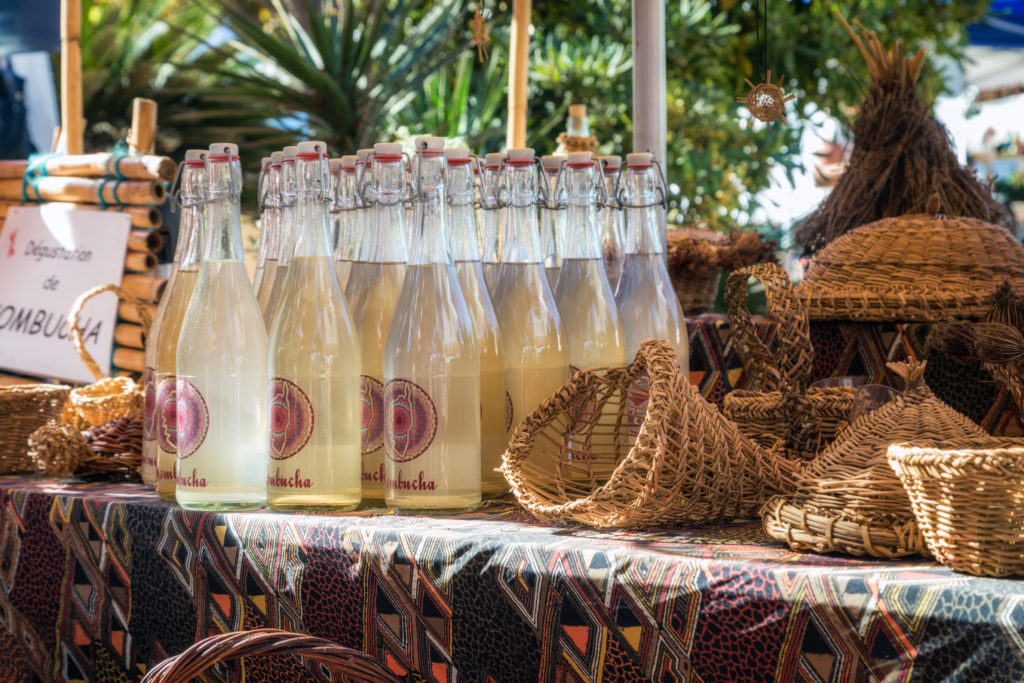
Kombucha with a Kick

By: Nan McCreary

Artisanal cheese for sale at artisan market in Ile rousse

Hard Kombucha is one of the latest drinks to make a splash in the “better-for-you” alcoholic beverage market. But what is hard kombucha, you ask? Wait, what is kombucha?

  Kombucha traces its roots to China’s Qin Dynasty (221 BC), where it was known as the “The Tea of Immortality” for its medicinal properties. The drink is made by mixing sweetened black or green tea with a symbiotic culture of bacteria and yeast called SCOBY and allowing it to ferment. The result is a tart and sour, lightly-carbonated drink that’s naturally gluten-free, low in sugar and chocked full of probiotics. With health-conscious millennials driving today’s beverage industry, it’s no wonder that kombucha is experiencing a revival, and is one of the fastest-growing beverages on the market today.

  Kombucha first went mainstream in the U.S. in 1995 when GT Dave, the man behind GT’s Kombucha, established the first and largest kombucha brand in the industry. Promotion for the drink touted the health benefits of both tea and probiotics, and sales immediately exploded in supermarkets throughout the country.

With an ABV of less than 0.5%, kombucha could be sold legally as an alcohol-free beverage. In 2010, however, a Department of Agriculture inspector discovered a kombucha at a Maine Whole Foods that contained alcohol levels well above 0.5%. It was pulled off the shelves nationwide, and producers were left with three options: keep their kombuchas under 0.5% and follow strict labeling laws, sell them in the beer section at their current ABV, or create an intentionally higher ABV beverage. For those who chose the latter — a “hard” kombucha — the crisis presented a golden opportunity. The low-alcohol beverage with a healthy dose of probiotics caught on quickly, and in just a few short years, became the hot new kid on the beverage-industry block. According to Nielsen, sales of hard kombucha spiked 247% in the 52 weeks leading up to April 20, 2019.

  One of the first to create high-alcohol kombucha was Dr. Hops, based in San Francisco. “I was working in Berkley with the fitness and yoga community, and craft beer was exploding and doing amazing things,” said CEO and founder Joshua Rood. “Non-alcoholic kombucha was also growing rapidly. I’ve always been a food and beverage guy. When I saw this happening, I realized you could make a high-alcohol kombucha that would be authentic to both categories, offering the benefits from the health properties of straight kombucha, and the flavor, complexity and pleasure of a really good craft beer.”

  With only one hard kombucha on the market at the time—Unity Vibration in Ypsilanti, Michigan—Rood approached a brewer who was making both beer and kombucha and asked him to make a prototype that offered the best of both beverage worlds. “The prototype was awesome,” he said.  “At the same time, my wife had an adorable rabbit named Dr. Hops, and I thought, ‘what a perfect name for a health-conscious kombucha that’s all hopped up.’ So that’s why we named our product Dr. Hops.”

  While Rood was developing his product in 2016, another hard kombucha hit the market: Boochcraft, California’s first high-alcohol kombucha, and today’s market leader in sales.

  To make hard kombucha, producers start with a mixture of sugar, tea and water. For his base, Rood selects the highest organic quality and fair trade tea he can obtain. Next, he adds SCOBY—a combination of bacteria and yeast that he’s developed in-house—and adds it to the tea mixture. The concoction ferments for a week, allowing the SCOBY to work and make kombucha what it is: a probiotic, sour and flavorful drink. To raise the alcohol level beyond the 0.5% from the initial fermentation, Rood adds a Belgian Ale yeast that creates a slight beer quality and lets that mixture ferment for another week. This step raises the alcohol level to 0.7 to 1%.  Finally, after the second fermentation is complete, Rood adds hops, fruit, herbs or spices and “lets it rest” to let the flavors develop. 

“This is a very mellow waiting period,” Rood told Beverage Master Magazine. “We gently stir the mixture and let the particulate matter sink to the bottom. Then we add a bit of sugar, which gives the kombucha a touch of sweetness, and finally, we package it.”

  Dr. Hops makes four standard products: the IPK, similar to a juicy IPA; the Lop, a tart, refreshing pomegranate chai with prominent grapefruit notes; the Jackalope, with prominent ginger, lime and mint flavors; and the Blinky, with hints of basil and lemongrass. All are dry-hopped with hops sourced from the Pacific Northwest. Sugars vary from 4-6%, and ABV runs from 5-9%. Flavors come from fresh, organic fruits rather than flavoring compounds.

  In terms of legal classification, hard kombucha is typically classified as a beer rather than a wine product. The Dr. Hops production facility is similar to a brewery, with stainless steel tanks and temperature, pressure and oxygen controls. To produce optimum results, brewers have to be very meticulous, Rood explained. “The process goes through many different phases, and each phase has the potential to create benefits as well as off-flavors. It’s really an art. We have to check fermentation constantly, as it’s a living process and not an exact formula, although we’re getting pretty good at it.”

  Ultimately, Rood’s goal is to create a product that is “good for your belly” and “good for your buzz.”  Hard kombuchas have less sugar than anything in the alcohol world, he said, except for pure vodka. “As Americans, sugar is one of the worst things we consume, so we keep ours as low as possible.”

  Rood also uses a kombucha strain that’s rich with alcohol-resistant lactobacillus, a health-enhancing probiotic. Because Dr. Hops’ products are unfiltered and unpasteurized (heating from pasteurization destroys enzymes, organics and flavors), the probiotics stay in the beverage, helping the body process not just food, but also alcohol. Another health benefit: Dr. Hops uses only organic fruits, roots and herbs, which provide additional nutrients.

  “Essentially, we’re trying to eliminate the junk people put in their bodies while drinking alcohol,” Rood said. “When you take all of our ingredients together, you have a beverage that’s remarkably distinct and much healthier.”

  As more and more health-conscious imbibers turn to beer/kombucha blends, Dr. Hops is enjoying great success. Currently, the company produces 1,000 barrels a year, with plans to triple—or even quadruple—production within the next year.  Right now, they package their kombucha in bottles, but Rood intends to switch to cans soon. Dr. Hops is available in liquor stores and independent food stores and markets in Northern California and is on tap in several bars in the Oakland, California area. Rood’s goal is to increase distribution to the western third of the country and Florida. 

  “Sales have been amazing,” he said.  “It’s something people want, but most don’t know it until they discover it, and then they get very excited about it.”

  Within the past couple of years, many up-and-coming hard kombucha brands have emerged within the growing industry, including Flying Embers, KYLA, JuneShine and Lambrucha. Established kombucha producers are also getting in on the action. Wild Tonic, originally a regular kombucha brand, created two hard kombucha products: one with 5.6% ABV and one with 7.6% ABV. Kombrewcha, one of the country’s pioneering hard kombucha brands, received backing from AB InBev’s investment arm, ZX Ventures, to produce a new line of hard kombuchas.

  It’s not only AB InBev getting in on the action, however. Craft breweries have also extended their product portfolio to include hard kombucha. For example, New Holland Brewing, a Holland, Michigan craft beer brand that’s been around for over 20 years, now produces a seasonal offering that combines the flavors of an IPA with Kombucha. Boston Beer, maker of Samuel Adams, recently launched Tura Hard Kombucha. And Deschutes Brewery in Bend, Oregon collaborated with Humm Kombucha to create Humm Zinger, “a beer that blends together Humm’s tangy grapefruit kombucha with Cascade hops and Pilsner malt for big citrus flavor with a profound dry hop character.”

  Clearly, hard kombucha is hitting the mainstream. After all, what’s not to like? It’s all-natural, gluten-free, organic and vegan, low in sugar and calories yet contains enough alcohol to be fun. As part of the low-alcohol trend, which includes hard seltzers, hard ciders and low-alcohol spirits, hard kombucha has a lot of opportunities to grow. If you think you might be one of those who want it but don’t know it yet, hustle off to your favorite vegan restaurant, grocery or liquor store and check it out.
Assessing the Growth of Cider Apples in the Pacific Northwest

By: Becky Garrison

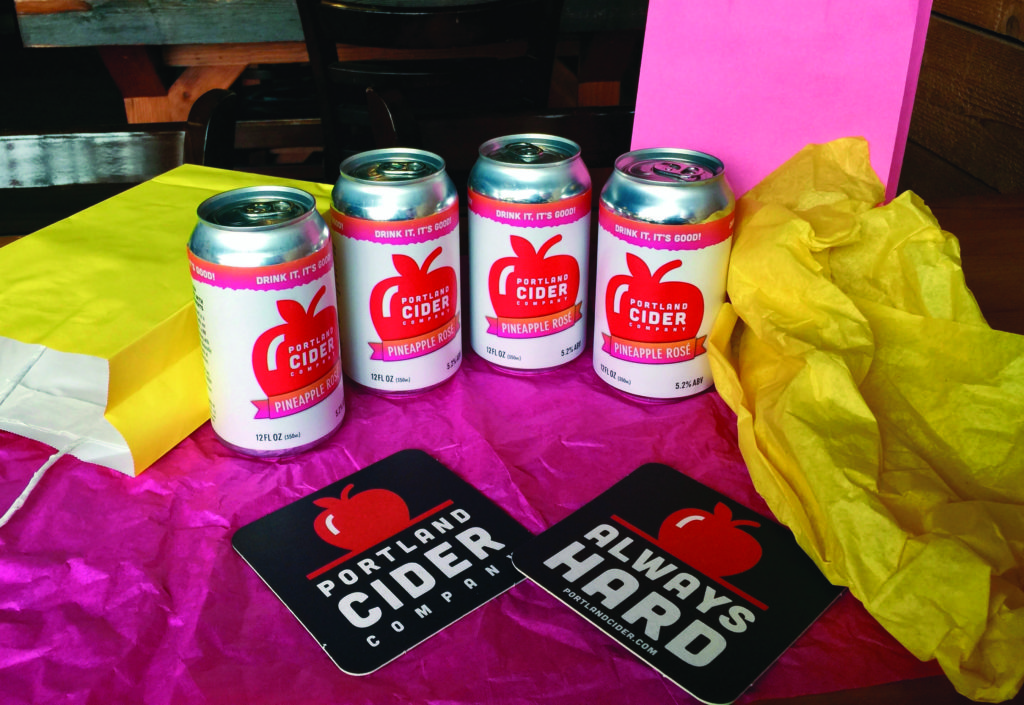
4 cider cans in a table

In 2016, the Northwest Cider Association received a specialty crop grant from the Oregon Department of Agriculture. This grant enabled them to launch a signifi-cant initiative encouraging farmers to plant cider apple trees in the Pacific North-west. The Northwest Cider Association chose to focus these planting efforts in Oregon in two areas: Willamette Valley and Hood River.

  While there has always been a small selection of heirloom cider apples available for small-batch releases, this initiative marks the first time post-prohibition that a sizable number of cider apples will be available to cider makers. Will these ap-ples bear fruit in the burgeoning cider market?

  Currently, there is no available national data on the breakdown of cider made with cider apples versus dessert apples. Michelle McGrath, Executive Director of the United States Association of Cider Makers, attributes this lack of statistics to the fact that the U.S. cider market consists primarily of many very small cideries. As such, their sales are not reflected in any of the scan-based data found in trade reports.

  Even though a majority of ciders available in grocery stores, bars and restaurants are made with dessert apples, a large percentage of the cideries in the U.S. uti-lize cider apples. In McGrath’s estimation, “Fifty percent of our paying members grow their own apples, and 50% of our paying members are using cider apples to make cider.”

  Furthermore, regional brands continue to absorb more of the cider market share, and these brands offer a greater variety of ciders to consumers. McGrath says that in 2012, regional brands represented about 8% of the cider retail market, a number that has risen to 34% today. Also, regional brands of cider sales have grown 16% in the last year, while national brands declined 9%. Because national brands represent more of the total market share, the net result is an overall de-cline of 2% in domestic retail cider sales in 2018. 

  At first glance, this appreciation for small regional craft ciders seems to indicate consumers will be interested in paying a premium for heirloom ciders made with cider apples. Crystie Kisler, co-founder of Finnriver Farm & Cidery, observes how the consumer’s palate has evolved since 2008 when she founded an 80-acre farm situated in Chimacum Valley, Washington.

  “We have appreciated seeing how the sensibilities and palate of folks in the cider-drinking community have evolved over the years,” Kisler says. “We get a lot of interest in our homegrown ‘estate’ ciders—featuring those traditional cider apple varieties with greater complexity—and enjoy seeing people discover the nuances and possibilities in cider fruit.”

  Kisler’s partner at Finnriver, Eric Jorgensen, says that the higher price point of cider made from cider apples does not appear to deter customers who travel to their tasting room. “I’d say that despite their higher price point, when we have them available, they are just as popular as our ciders made from dessert fruit. That preference runs the full range of consumers—we get a very broad spectrum of people coming to visit us.”

  According to Jorgensen, this consumer interest in cider apples can be attributed to several factors: flavor profiles that are nuanced, interesting and complex; gen-eral values around tradition and the rediscovery of these apple varieties; and in-terest in products made with ingredients farmed locally and on a smaller scale.

  From the cidermaker’s perspective, Andrew Byers, Head Cidermaker & Produc-tion Manager at Finnriver, says the advantage of producing cider apples is based in complexity. “Making cider from dessert fruit—be it antique varietals or more modern releases—is making cider from fruit that was conceptualized for a differ-ent purpose, such as eating a fresh apple, or saucing, or baking a pie. Cider fruit has been selected for the qualities they bring to the cider. Body, phenolics, aro-matics—all that cannot be found in a dessert-fruit-based ferment.”

  Byers describes how these apples can transport drinkers to another level. “[Cider apples] waltz you across the room with ease to a place of wonderment where you didn’t know ‘apples could do that.’ [They bring you to] that lovely platform of hav-ing your horizons broadened—a place to realize you just discovered a previously unknown potential. Cider fruit, each year, is an opportunity to waltz with the pub-lic and show them the best we can be.”

  Some logistical challenges are inherent in growing cider apples not necessarily found when producing dessert apples. Tim Larsen, owner and cidermaker at Snowdrift Cider Company in East Wenatchee, Washington, says, “These apples were never cultivated because they grew in an orchard so well, or because they yielded so many tons to an acre. They are grown because of their flavor and aroma. Furthermore, fermentation and aging of cider apples is a fair bit different than working with modern eating apples.” Larsen designed his new operation, Sunred Cider, to manage these challenges for cidermakers and streamline the process between growers and producers.

  Adding to the cost of producing cider fruit is the U.S. law prohibiting farmers from harvesting apples that fall to the ground. Hence, farmers cannot mechanically harvest these apples on a large scale, unlike in the U.K., where apples can be harvested after they’ve fallen off the trees.

  Larsen points to the need for consumer education. In his estimation, “most peo-ple see cider as a sort of holistic Mike’s Hard Lemonade.” He attributes this per-ception to the fact that most large scale cider operations are forced to rely on a very restricted supply of apple juice that, at its best, is pretty uninteresting. They spice up their product, adding flavorings, sweeteners and colors. “This is great if you want something that tastes like alcoholic watermelon juice with hibiscus or some other flavor combination, but it’s not great if you want to experience real cider,” he said.

  Ryal Schallenberger of Northwest Mobile Juicing says that cidermakers try to distance themselves from the apples when they are using bulk juice. “They make comments on their labels that are generic like ‘fresh northwest juice.’ Folks that are using traditional cider apples say so on their labels, for the most part.” This distinction may be apparent to cider connoisseurs; however, this differentiation does not seem to be conveyed to the general public.

  The question, though, is how many consumers crave “real cider” given the popu-larity of ciders made with added pineapple, hops, botanicals or spices? In 2018, apple cider without added fruits, spices or botanicals constituted 63% of national retail sales. Even though over half of all sales in 2018 were ciders made with ap-ples, the trend toward producing non-apple ciders appears to be on the rise. For example, Jeff Parrish, co-owner of Portland Cider Company, notes that consumer demand continues to increase for ciders made with pineapples, pears, and other non-apple fruit.

  In his analysis, Parrish does not view large-scale production of cider apples tak-ing off unless enough cider apples are grown and harvested to bring the cost down to the same price point as craft beer. Simply put, not enough consumers are willing to pay $10 to $12 for a bottle of cider made with premium Pacific Northwest cider apples to justify producing it on a large scale.

  Also, Jorgensen says the general cider distribution market trends towards cans, and thus towards higher production volumes. He’s not aware of anyone with ac-cess to enough “traditional” cider juice to be able to package and sell in large quantities, let alone at a price point comparable to the more contemporary ciders on the market.

  Emily Ritchie, Executive Director at Northwest Cider Association, acknowledges the difficulties faced by craft cideries like the Portland-based Cider Riot. They closed their doors in November 2019 as they found themselves unable to produce their award-winning heirloom ciders while also maintaining a viable cidery and pub. “Right now, it’s harder to keep a business open when you’re just using cider fruit, as your price points are higher,” Ritchie says.

  In assessing the future of cider apples, Parrish points to cider’s long history as a working man’s drink. “It’s never been seen as having a high intrinsic value, and will not be viewed by the mass market as having a high value similar to wine.” In his estimation, history has proven that cider apples will remain a niche market with a loyal following.

  Conversely, Ritchie compares the potential growth of Pacific Northwest cider ap-ples to the growth of the wine industry in Oregon over the last 30 years. Those who planted the first vineyards in Willamette Valley and other AVA’s began from a place where they had no name recognition into producing internationally re-nowned Pinot Noirs and other varietals.

  With the first harvest from these aforementioned cider trees slated for 2020, will cider apples join Pinot Noir grapes as a fruit that defines this region? Time and price point will tell.

“SMART” Brewing: Innovation & New Technology for Craft Breweries

By: Cheryl Gray

man inspecting a machine

Brewers have needed packaging and tools to dispense their products ever since beer was first brewed a millennium ago. Today, innovation and technology that transform a good idea into a great one are driven by industry titans who know how to keep pace with the demands of a highly competitive field, putting craft breweries in a position to stay a step ahead in an increasingly crowded global marketplace.

Print-on-Demand With Abbott Company

  One of those titans is Wisconsin-based Abbott Company, in business for 95 years, specializing in industrial marking and packaging solutions. Tim Stark, Abbott’s president, points to the rise in craft brewing as the catalyst for creating a demand for innovation and new technology aimed at achieving best practices in product identification operations.

  With craft breweries increasing their production capacity and distribution, Stark says there is a correlating trend towards print-on-demand inkjet technology replacing pre-printed boxes and hand-applied labels.

  “Print-on-demand inkjet technology offers many benefits, including a lower cost-per-mark compared to pressure-sensitive labels, as well as more flexibility for managing corrugate stock volumes and case sizes. Our recommended high-resolution inkjet technology, FoxJet ProSeries print heads, has been recently enhanced to print scan-able barcodes on porous cases at higher speeds consistently.”

  Stark says that in automating the printing of product identification on cases, today’s brewers are also looking at improving efficiency by integrating what he calls “scan and select” capabilities into their operation.  

  “This makes product changeovers, and subsequent print message changes effortless and free of human error. A hand scanner is used to scan a barcode from a work order, which selects the correct message to be printed on the case. This is often paired with a barcode vision system which can verify the readability of barcodes before they are palletized and shipped to retailers, allowing a turnkey case coding solution that will scale as breweries continue to grow.”

  Craft breweries are also looking for innovation when it comes to products that solve their primary packaging identification needs, says Stark.

  “We also see a growing desire for high contrast date coding on bottles and cans that are dark in color,” he said. “With a focus on freshness, an increasing number of craft breweries are requesting to use yellow and light blue inks to make the date code and other important product information pop out to consumers. The introduction of the Linx 8900 Plus soft pigment inkjet printer allows brewers to print high contrast codes on their bottles and cans while avoiding the difficulty commonly found with traditional pigmented ink printers. “

Shrink Sleeves With PDC International

  PDC International is another company at the forefront of an industry upon which many craft breweries depend—shrink sleeve labeling. From the moment the business opened in 1968, anticipating customer needs is what the Connecticut-based company has brought to its brewery clients. PDC Founder Anatole Konstantin immigrated to the United States from post-WWII Eastern Europe, building his company out of the den of his home. 

  Through vertical integration and in-house controls, including its own machine shop, PDC is known for quickly solving customers’ production challenges. Neal Konstantin is president of the company his father, Anatole, founded fifty years ago. He says the widespread use of shrink sleeves, a technology allowing a brewery to place its brand name on blank cans rather than having to inventory large quantities of pre-printed cans, saves warehouse space, simplifies logistics and saves money.

  “The recent widespread adoption of shrink labeling by breweries has resulted in machine refinements for labeling [either] full or empty aluminum cans of all sizes,” says Konstantin. “Special product handling ensures that aluminum cans are not dented or marred when processed through the labeler. PDC’s proprietary cutting blades now last millions of cycles between sharpenings, saving downtime and labor and reducing overall costs. We offer the widest range of shrink sleeve label applicators in the industry, ranging from entry-level systems up to 400-500 pm.”

Release the Pressure With

R&S Supply Company

  Don’t be thrown by the Napa Valley location of R&S Supply Company. It also caters to craft breweries, along with wine and other industries in all 50 states and 10 countries around the globe. Founded in 1984, R&S Supply Company is a distributor of products from brands such as Tassalini Valves, Strahman Washdown Products, Definox Valves, Texcel Brewers & Spirits hose assemblies and Dixon Sanitary Pumps & Fittings.

  Company President Paul N. Roberts touts the newest product line that R&S Supply has recently added to its roster. “The newest product line that we have added is Bradley Industrial Products and Keltech Tankless Electric Water Heaters. The Keltech Tankless Water Heaters provide instant hot water anywhere in a production facility when mounted on our cart.”

  Roberts points to the Italian-manufactured line of Tassalini Sanitary Valves as one of his company’s top innovative products. Industry insiders know that the name Tassalini has been around since 1922 when it first produced products for the aeronautics industry. R& S Supply Company is Tassalini’s largest U.S. distributor, Roberts says, stocking all original manufacture replacement seals and repair kits, along with an entire line of Tassalini Valves for every need.

“We stock the complete line including butterfly valves, actuators, check valves, ball valves, tank vents, sight glasses, plug valves and all the accessories and repair parts.”

Pour One Out With Xpressfill Systems

  A relative newcomer to the industry of packaging and tools, XpressFill Systems LLC is led by owner Randy Kingsbury, a mechanical engineer with more than 30 years of experience. Based in San Luis Obispo, California, XpressFill Systems is a global player in the development of affordable, efficient filling equipment for the brewing industry, with customers in the United States as well as Europe, Australia, South America and Asia.  

  “Our equipment is small—tabletop—making it easy to position in smaller brewery operations. It is simple to operate and maintain, requiring only one or two operators to efficiently maintain the quantity and quality of the beverage,” Kingsbury says.

  XpressFill introduced its first filler for brewers in 2014, a tabletop counter pressure filler for bottles with a pair of fill spouts. This product, Kingsbury says, was designed to launch its fill sequence with a carbon dioxide purge, then seal and fill the bottle to a level sensor that automatically stops the fill so the bottle can be removed and capped. XpressFill edged its technology forward, developing its four-spout counter pressure bottle filler, capable of filling 12-ounce bottles at a rate of 400 per hour.  In 2018 the company introduced counter-pressure fillers for cans.  

  “The XF4500C has two fill spouts and is capable of filling 300 12-ounce cans per hour. To further satisfy the demand for filling cans, the XF2200 open fill unit was developed. This provided a faster, less expensive alternative, capable of filling 360 12-ounce cans per hour with two spouts, while still providing quality fills,” says Kingsbury.

  More innovation and technology is in store with the development of XpressFill’s new two-spout filler, the XF280W. “Current quality control of fill volumes is accomplished by craft brewers weighing their filled cans, which is an additional step following the filling,” Kingsbury says. “We set out to explore the possibility of providing a user-friendly and cost-effective filler that would measure the weight of dispensed beer to save the additional weight verification step.”

Expand With iStill

  For craft breweries exploring the world of distilling, Netherlands-based iStill offers an automated, robotized distillery unit that promises a simple setup with only a water hose and electrical plug needed to begin.

  “Due to our scientific approach to distilling, we have been able to create an easy to operate, versatile machine that takes the magic out of distilling great spirits, and makes whiskey, vodka, gin and rum production an easy add-on to the already existing brewery,” says Edwin van Eijk, CEO of iStill.

  “The iStills come in sizes ranging from 26 to 1300 gallons. Each and every machine can make every distilled product. If the craft brewer does not want to re-invest in expanding mashing or fermenting capacity, the iStills can mash and ferment as well. Everything takes place in the same unit.”

  iStills offers a broad range of services, Eijk says, to assist its more than 700 clients worldwide, including iStill University, which educates and trains approximately 200 distillers annually in North America, Europe, Asia and Australia. 

  Innovation and technology are ever-evolving as leaders in the packaging and tools industry find new ways not only to push themselves but also, push craft breweries into thinking smarter about ways to make their products move quickly in the marketplace.

Important Tank Supplies & Accessories for Your Brewery or Distillery

By: Alyssa L. Ochs

tanks wrapped over

High-quality and reliable tanks are one of the most essential parts of any brewery or distillery. However, there are many components involved in keeping tanks in good condition and well-monitored throughout the beverage-making process. Experienced brewers and distillers use various tank supplies to keep their tanks working well for many years into the future and to produce excellent craft beverages.

Here is an overview of some of the most important tank supplies and accessories to stock up on and use regularly in a brewery or distillery.

Basic Tank Needs

  Wraps are one of the most important tank-related products that breweries and distilleries should invest in because they provide fluid temperature control for tanks. Wraps also reduce condensation and allow fluids to circulate with a cooling jacket on for thermal control. Glycol wraps help control the fermentation process and are also referred to as glycol jackets. These products are put on the bottoms and sides of tanks to maintain beverage temperatures, regardless of the beverages’ fill levels. This is especially important on packaging days of the year. Overall, breweries and distilleries typically look for wraps made with lightweight and flexible fabric that’s easy to apply and manipulate as needed.

  Insulation is useful for craft beverage tanks because both hot and cold temperatures are required from these tanks. Common insulation materials are fiberglass and stone wool. Insulation helps to counteract high humidity in a brewery or distillery and also prevent burn and freezing so that ice does not form on the pipes. Since insulation helps resist corrosion, keep mold away and save energy, it is also a way for breweries and distilleries to become more efficient and sustainable. For example, Synavax™ multipurpose coatings use a liquid wrap insulation to coat the equipment and cover exposed valves to prevent energy loss. Just keep in mind that staff members must to be trained thoroughly on insulation safety, especially when working around hot pipes.

  Meters are another crucial piece of equipment used alongside tanks in the brewing and distilling processes. Liquid pressure and vacuum gauges come in both analog and digital formats, with digital versions typically being more expensive. Common sizes are ¼ inch to 1.5 inches, and stainless steel is the most common meter material used in the food and beverage industry. Meters often use two pressure transmitters to measure the beverage level – one for the head pressure and the other for the total pressure. It is that differential that’s really important number to steadily monitor. Magnetic flow meters often range from ½ inch to six inches and provide readings to minimize losses in the beverage-making process. Meanwhile, temperature sensors monitor a beverage’s temperature so that you can quickly adjust temperatures that become too high or low. Regardless of the chosen product, it’s always important to have hygienic process fittings for meter sensors.

  Tank Stands, a less technical but equally important product that goes hand-in-hand with tanks. Stands are usually made from stainless steel and can accommodate 100, 200, 300, 500, or more liters for the right fit with your tanks. Stainless steel pipe stands for brite tanks are available to fit 1.5-inch and two-inch sizes. Some stands accommodate just one large tank, while others fit several tanks and are ideal for small batches. Some smaller tanks have wheels to make them transportable in case mobility is convenient for your operations.

Top Tank Supply Products

  Dean Thompson, the brand manager for Flextank USA, told Beverage Master Magazine that his company’s most popular tank products among breweries and distilleries are its line of SS sanitary fittings, fermentation locks and oak adjuncts. This company manufactures and assembles all of its vessels in Vancouver, Washington and distributes them worldwide.

  Among the most-used products throughout the beverage industry is Flextank’s AK1T – Combo 6-Bolt Flange Accessory Kit in the 1.5-inch size that includes VF1, BV3 and SV1T. This kit includes a complete drain valve installation and a Tassilini sample valve, and it fits all Eco and Dexter Maturation and heavyweight tanks, plus the Apollo Fermentor. Other popular products are Flextank’s butterfly valves and FL1 Fermentation Lock.1 for use on Eco Tanks and Dexter Lids purchased prior May 31, 2014. Meanwhile, the company’s FC060-50-70-80 FlexChill is an exterior wrap chilling system used with glycol chillers and designed for cylindrical tanks in two standard sizes.

  “Our oak staves are French and American oak and available in different toast levels and sizes for different tank sizes,” Thompson said. “These are made with directions to add up the staves needed for use. An example is if you need 80 gallons, you can add the staves from the 50-gallon tank and then add the 30-gallon tank, and now you have what you need for the 80-gallon tank.”

  Miyuki Clauer of ATAGO U.S.A., Inc. told Beverage Master Magazine that ATAGO’s most common product line used for craft beverage tank monitoring is its In-Line Refractometer PRM Series. Based in Bellevue, Washington, ATAGO U.S.A. is a leading manufacturer of refractometers, polarimeters, salt meters, acidity meters, pH meters and saccharimeters.

  “The PRM series offers a digital display section with a seven-segmented LED that displays the temperature and measurements,” Clauer said. “Using output methods, such as RS-232 or 4-20mA, the data can be transmitted to a PLC system for system automation. It offers lab-grade accuracy across the full range of refractive index, Brix or user-defined concentration scale. The PRM series is equipped with an alarm output function that transmits a signal when it detects values exceeding preset high- and low-limit values.”

  Clauer also explained how these inline units use COP (clean-out-of-place) and CIP (clean-in-place) methods for easy cleaning. This is always a valuable feature for busy breweries and distilleries.

  “The detection section occupies a small footprint, taking up very little space and offering an installation option to be directly mounted to the tanks or piping systems,” Clauer said. “The unit can be easily removed without requiring previously acquired skills to be easily removed and installed for COP. The prism section is completely flat and can be easily cleaned once removed. For CIP, users can install an optional accessory and let the ultrasonic cleaner prevent utterly unavoidable sample build-up around the refractometer’s prism surface. Another option is the prism wiper, which attaches directly facing the detection section of an inline refractometer installed in the piping system to manually wipe buildup off the prism surface.”

Other Tank Accessories to Consider

  In addition to wraps, insulation, meters and stands, there are many other tank products that can come in handy during the brewing and distilling process. For example, your beverage operations may benefit from carbonation stones, CIP spray balls and hydrators. Racking arms, valves, sight glasses, basic thermometers and through wall fittings are among the many other tank supplies that experienced beverage producers use.

Choosing the Best Tank Products 

  Although there are many brands, types and styles of tank supplies and accessories to choose from, not all of them are necessarily right for your beverage company. This is why it’s a good idea to get to know industry leaders who make these types of products so you learn about what will best suit your needs.

  With regard to insulating beverage tanks, Thompson of Flextank USA said that the best strategy is “either a temperature-controlled room using our FlexChill system or using standard insulation materials common in hot water tanks.”

Thompson’s advice to breweries and distilleries is a reminder that starting with Flextank for fermentation of grains and sugars can significantly lower start-up or expansion costs.

  “These tanks come in variable permeation rates so they can serve a double-duty and can age spirits, beer and cider without the cost of barrels,” Thompson said. “If an oak profile is desired, inexpensive oak staves are available in a variety of toasts and species that can complement the end product.”

  When shopping for tank supplies for your brewery or distillery, Clauer of ATAGO U.S.A. says that the most important things to look for in a tank meter are the specification of the measurement range, temperature compensation capabilities and after-care services.

  “ATAGO offers in-house service in the U.S., and we offer loaner units while we have customers’ instruments,” Clauer said. “With NIST certification, it offers information security standards and guidelines to ensure that the instrument is working accordingly.”

  Clauer also told Beverage Master Magazine that when searching for pieces of craft beverage equipment, such as tank meters, it is important to have a comprehensive overview of what’s needed and what options are available.

  “Purchasing an instrument is one part, but also knowing the spare parts and how accessible it is to these parts are important, as well as any technical service turnarounds,” Clauer said. “Having a manufacturer that can offer customer service that walks with you every step of the journey of craft beverage manufacturing is important. ATAGO is dedicated to meet our customers’ need with a motto of ‘You ask, we create.’ We offer a portable CO2 meter, refractometer, pH meter, and conductivity meter, as well as the inline refractometer.”

Finishing and Aging Options Evolve with Booming Secondary Barrel Market

By: Gerald Dlubala

barrels outside a facility

Those barrels hanging out in the distilleries, whether new, used or refurbished, are just getting started. Oak barrels have a full and varied life, complete with occasional travel between distilleries, breweries, wineries and back again, sometimes internationally.

  Just within the Kentucky commonwealth, there is an inventory of over eight million barrels of Bourbon and other spirits in various stages of the aging process. It’s the highest inventory in 40 years and represents almost a two-barrel per person ratio. That’s a lot of barrels coming onto the market, which coincides with a booming secondary barrel market.

Impacting Flavors By Following The Seasons

  One company helping those previously used barrels live their best life is Moe’s Barrels, with locations in Galt, Lodi and Fairfield, California. COO Dean “Deano” Wilson is a winemaker and self-proclaimed foodie, so he found it natural to follow his passion by selling previously used wine and whiskey barrels for secondary, flavor impacting purposes.

  “We source our barrels from both the big and small producers,” said Wilson. “The boutique producers are our preferred source for quality used barrels simply because they tend to take care of them a little better. We buy our barrels in lots, with 99% of them coming in already cleaned and sanitized. But we’ll look at, inspect and grade them, giving them a wine or beer grade. If they don’t qualify for that, we can use them as furniture or décor grade. A trend that has grown recently is to sell the parts of used barrels to the artistic community, selling the individual staves, barrelheads or barrel rings for creative endeavors.”

  Wilson told Beverage Master Magazine that his formula for success is to try and follow the season for selling a certain type of barrels. 

  “We get a lot of first and second use barrels at harvest time, which is very good for cross-utilization. White wine barrels are excellent for reuse with wine, Belgian style beers, Cognacs and more. The barrels we get immediately following the crush are great matches for repeated wine and bourbon use.”

  Wilson gets his used barrels delivered with blue painter’s tape over the bunghole. The tape covers the hole for sanitary reasons but still allows the barrel to breathe. If they sit around too long with the bung in, there’s a chance for mold growth. If the barrels are left with the openings uncovered, they could dry out and start to split. Moe’s does the rest, performing sanitation, rehydration, steam cleaning and hot water rinsing.

  “Communication is key for customers looking to purchase used barrels,” said Wilson. “The buyer needs to be comfortable in the relationship with the supplier. First and foremost, look for quality, but be comfortable enough to ask for what you need. Know what flavor profiles you’re looking to build. Use your nose and trust your smell when inspecting the barrels that you are buying. Some staining and minimal hairline cracks are fine, but larger, deeper cracks around the bunghole can be a sign of a problem, and it’s always best to stay away from any hardened purple stains. Check for holes or damage that could be related to borer beetles. We invite all buyers into our warehouse, where you can completely inspect the barrels you’re looking to purchase. Inspect them from head to head, inside and outside, noting the year on the cooperage. Know the barrel’s origin, exactly what it was used for and how many times it’s been used. A quality supplier will know and willingly share this information about the barrels they’re selling. Cleanliness and smell are your two biggest assets when looking at used barrels, so always follow your nose.”

  Moe’s Barrels keeps all of its inventory inside a warehouse and available for buyer inspection.

  “We want to recycle these barrels and give them another life in the business, whether it’s for additional distilling and brewing, for use as furniture and décor or ultimately selling the parts to the artistic community. It’s a way towards sustainability.”

Kentucky Bourbon Barrel: The Name Says It All

  What better place to source local Bourbon and whiskey barrels than in Kentucky, the birthplace of Bourbon and home to the renowned Kentucky Bourbon Trail. Noah Steingracher is the man to talk to for North American and international craft sales at Kentucky Bourbon Barrel, a full service used barrel cooperage, offering used Bourbon and exotic spirit barrels.

  Being right in the heart of the Bourbon Trail in Louisville, Kentucky, Kentucky Bourbon Barrel primarily sells Bourbon barrels sourced locally from all of the familiar names. When Steingracher joined the company, he brought his international sourcing experience with him, so exotic and international barrels are now in play as well. He has sourced used barrels from spirits distributors, breweries, meaderies and wineries for use in finishing and aging a potential customer’s product.

  “We do it all,” said Steingracher. “We sell the used barrels from barrel to stave, depending on every customer’s unique needs. We have contracts with reputable and well-known distilleries to empty and ship their used barrels directly to us. We inspect them using our stringent guidelines for acceptable and unacceptable issues, including the size of any distinguishable cracks. If needed, our experienced team of coopers repair the barrels and make them fit to fill. We fill the used barrel market for customers that may not have the time, expertise or source to fill it on their own, and our experience and reputation are such that we have customers worldwide. I’ve shipped to islands that I’ve had to find on Google Maps. I’ve delivered barrels to the base of the Himalayas. There’s nowhere we won’t deliver.”

  Steingracher told Beverage Master Magazine that the used barrel market is affected by the same seasonal changes that affect all brewers and distillers, as well as how the barrel will be used.

  “A used barrel can function as either a vessel or an ingredient,” said Steingracher. “As a vessel, used barrels are just the holder for the product. For example, if a brewer wants to offer chocolate, porter or coffee stout, a used bourbon barrel fits the need and will provide the expected stone fruit and vanilla notes. But if you want to put out the best coffee stout, you should use a rye barrel so that the unique flavor from the barrel imparts a distinguishable, peppery infused difference. The right barrel will be a noticeable and valued ingredient in your formula.”

  Steingracher noted that brewers and distillers sometimes become too easily attached to the brand stamped on the barrel rather than going with barrels that fit their actual needs, if for no other reason than to associate their brand with that of a particular distillery. 

  “A mindset of only looking towards a brand name rather than filling your flavor profile defeats the purpose of striving for reliability and availability of your product offerings. Craft distillers and brewers can always run into a situation of not being able to find that particular distiller’s used barrel for the next batch. Frankly, they usually don’t even have the marketing rights to use that particular distiller’s name in their marketing. Jim Beam can release up to ten thousand barrels a week, with Buffalo Trace releasing around six thousand a month, and then others like Pappy are obviously extremely limited.”

  “Relationships matter when discussing that reliability and availability,” said Steingracher. “You need to know the type, origin, and age of the barrel you’re getting. With all the variants and combination spirits being distilled these days, what specific type of Bourbon was the barrel last used for? Was a char put on it? What level? Was it toasted? Repaired? How many years has it been used? Barrels can last a hundred years or more if used and maintained properly. The oldest is probably in Scotland, but I’ve personally seen some from aged before World War II. We do buy some back from the distillers that we know care for them the right way, and having access to our cooperage allows us to be able to make the repairs necessary to keep them in circulation. You can certainly come through and check on barrels yourself, but with our regular buyers, they know that the barrels we send them are fit to fill.”

  The flavor and use options for used barrels are indefinite. With many craft distillers and brewers now openly sharing their barrels between multiple brewing cycles, with proper use and care, barrels can last indefinitely. It’s what you can do with them after extensive uses and fillings that become limited.

  The Barrel Mill’s Infusion Spiral Technology Offers More Flavor Options While Decreasing Aging Time

  Options for those barrels, whether new or extensively used, have gotten much greater due to Infusion Spiral technology from The Barrel Mill, a central Minnesota-based cooperage that specializes in premium new oak barrels.

  Len Napalitano is an infusion spiral expert with The Barrel Mill and told Beverage Master Magazine that their infusion spirals are perfect for creating unique flavor profiles and helping distillers get their product to market faster.

  “Sometimes, you won’t find the right barrels for the flavor profile that you want to build for your customers,” said Napalitano. “With each fill, a wooden barrel loses part of its flavor offering and balance, and after three fills, barrels can be neutral regarding any noticeable flavor profile. These barrels are still obviously good for use, and now they can benefit from infusion spirals to regain that lost flavor profile.

You can achieve new oak flavor without the new oak barrel, which can be in short supply at times. Even when used with a new oak barrel, infusion spirals help get your product to market quicker. Our spirals are cut from premium oak, maximizing end-grain exposure for full extraction in weeks instead of months, saving the distiller money in labor, cost and time. The spirals are formed from barrel stave wood, cut through, then put into a convection oven to get their desired toast or char by way of our proprietary formula.”

  Jeremy Wochnick, Sales Professional for The Barrel Mill, said “The spirals range from a light toast to a #3 char depending what the distillers want, and are available in not only the standard, premium oak, but also in French oak and more exotic species like sugar maple, cypress, cedar and more for experimental and unique small-batch flavor profiles. Barrel quality results are obtained using any type of barrel, carboy or stainless tank. The spirals have proven to be successful in spirits, beers and wines as well as hard ciders and nonalcoholic drinks like ginger ale and regular ciders. Infusion spirals can be used to add a flavor profile to anything. We also have packs with blend options featuring different toast levels. The spirals can be used once, and are inserted into your barrel through the bunghole by way of netting or some sort of daisy chain for making retrieval easy.”

  And those infusion spirals, after being retrieved from their time in the barrel? Well, it turns out that they’re a pretty good addition to your outdoor barbecue.

The Best Canning Systems & Machines for Modern Breweries

By: Alyssa L. Ochs

Bottling Canning Machine at Brewery
Eugene, OR, USA – July 17, 2014: Can and bottle filling machine on an assembly line at Oakshire Brewing.

Canning has become an increasingly popular way to package craft beer, and more breweries than ever before are either exclusively moving to cans or incorporating cans alongside their traditional bottle offerings. Many brewers prefer canning over bottling because of the increased protection from light and oxygen, cost, portability, recyclability and freshness. However, a brewery needs the right type of canning system in its space to make this form of production profitable and efficient.

  With the input of top industry experts at SKA Fabricating, XpressFill Systems and OneVision Corporation, here’s what breweries should know before investing in a new canning system for the first time or upgrading a current machine.

Canning Products Available to Breweries

  Smaller and newer craft breweries may start off with manual canning systems that have a two-head filler and that can fill about 10 cans per minute because of these systems’ affordability. An upgrade from this is a micro-automated canning system with a three-head filler and capacity for 25 cans per minute with multiple can size options. Meanwhile, automated canning systems may have up to 10 head fillers and be able to fill more than 70 cans per minute. To operate a canning line, a brewery may also need to purchase blank or printed cans, can ends and lids, PakTech can carriers, shrink sleeves and corrugated case trays.

  One canning machine company based in San Luis Obispo, California, XpressFill, manufacturers affordable table-top machines that are used by craft breweries to fill both cans and bottles. Rod Silver, the marketing coordinator at XpressFill, told Beverage Master Magazine that his company has experienced a significant increase in can fillers from its brewery customers this year.

  “Our counter pressure fillers fill the cans in a pressurized environment to maximize the CO2 in solution,” Silver said. “Our open fill units have become increasingly more popular due to the lower cost and faster fill rate. Controlling filling conditions are critical in achieving optimum fills using either system. Both units purge the can with CO2 prior to the fill cycle.”

  Another relevant company that breweries will want to learn about is Ska Fabricating, which is based in Durango, Colorado and has over 700 customers worldwide. Matt Vincent, a partner in Durango’s largest and most award-winning craft beer brewery, told Beverage Master about Ska’s primary and most popular product called the Can-i-Bus Can Depalletizer. It is paired with either a water twist rinser or ionized air rinse and is an industry-leading depalletizer and rinser combo that covers the speed range of 30 CPM up to 400+ CPM. 

  “It allows for the opportunity to grow as your production grows, due to the wide range of speeds that it can handle,” Vincent said. “It also is a necessary part of a canning line because it eliminates the need for hand-loading cans onto a filling line, allowing operators to focus on quality by eliminating menial tasks.”

  Vincent also said that Ska Fabricating offers an extensive line of conveyance solutions, date coders, handle applicators, can and bottle drying equipment and machinery integration to assist in the post-fill needs of the brewery.

  Meanwhile, Neil Morris of OneVision Corporation in Westerville, Ohio told Beverage Master Magazine how OneVision “manufactures and markets inspection systems that empower beverage canners and food canners produce quality double seams.” This company’s expertise includes double seam evaluations, inspection systems and training and support at system installation, as well as electronic and phone support after installation to prevent seam leaks and keep products fresh.

  Ben Anacker, who manages sales and services for OneVision in the western U.S. and Canada and who is an expert in can manufacturing, said that OneVision arguably provides the most cost-effective craft brew system and support to empower brewers to have confidence in their canned products.

  “Evaluating double seam overlap and tightness is imperative to comprehensive analysis of seam integrity,” Anacker said. “The OneVision SeamMate® Inspection System, in combination with the Mini Drive Seam Stripper System, is unparalleled in performing the destructive seam dissection to allow close examination of these attributes.”

Important Features of Canning Machines

  Overall, canning systems feature a complex set of machines that share some similarities but are also very different in many ways. These differences lie in their speed, efficiency, size and other capabilities, such as low DO pickup, 15-20 ppb, dual cam driven seamers, nitro with a widget or no widget and monitors. Considerations to keep in mind are oxygen and light penetration, seamers, reliability, the ability to upgrade later and integration with your current system.

  Silver of XpressFill said that the most important features to consider are “cost, fill consistency, oxygen uptake, user-friendly, reliability, ease of cleaning and sanitizing and support by the manufacturer (both pre-sale and after).”

  Vincent of Ska Fabricating said that first and foremost, the most important factors for making a canning machine decision are identifying the proper speed line that works well with your budget, batch size, labor pool and desired level of automation. He said that the second priority is to make sure you understand the differences in the fillers and what level of quality you can expect from them. 

  “In the end, you get what you pay for,” Vincent said. “Rotary fillers tend to provide a higher level of fill quality than inline fillers, but they are typically four to five times the cost. 

  “All businesses evaluate the cost-competitive options when procuring capital assets to support their business,” said Anacker of OneVision Corporation. “For the craft brewery industry, there are many options for these canning investments. Sustainability versus initial investment cost is widely overlooked and should be evaluated more closely.”

Questions to Ask Before Buying a New Canning System

  There are many questions to ask before buying a new canning machine, either for the first time as a new brewery or to upgrade existing equipment. Here are some initial questions to start with:

•    Is the machine the right size for your needs?

•    Will you use printed cans or labels?

•    Are pneumatic seamers your best option?

•    How easy is it to clean the machine?

•    What other accessories are needed to operate the machine?

•    What are the financing options?

  Silver of XpressFill said that while many craft breweries are shifting to cans instead of bottles because of customer demand, switching production from bottles to cans is a significant undertaking that should not be taken lightly.

  “Canning lines and mobile canning could be prohibitively expensive depending on the initial scope of your production,” Silver said. “Table top units, like the XpressFill fillers, can be a cost-effective initial effort to meet the initial demand. Questions should be asked regarding the production capacity of the equipment, ability to upgrade, sell-back policies and warranty information to ensure a prudent investment.”

  Vincent of Ska Fabricating said that the most important questions to ask are about the machine’s cost, level of support offered, how many people it takes to operate the line efficiently and what level of dissolved oxygen the filler can maintain while filling.

  Anacker of OneVision Corporation recommends looking into the track record of the supplier company as well as the actual system being considered. He said to ask about if the system can be upgraded to match future growth and to check references of actual users with at least three years of experience using the system. How a “micro-canning” system compares to larger commercial canning systems and whether the system has the same fundamental function and repeatability to have confidence in long-term production capability and integrity are other considerations that Anacker recommends.

Expert Advice About Canning Machines & Lines

  With all of this information in mind, you may decide that now is the right time to start looking at new canning machine options, or it may be best to hold off for a while until you have fully assessed your needs. However, it seems that canned craft beer is here to stay and will only continue to increase in popularity in the future.

  Vincent of Ska Fabricating recommends that breweries do their homework in researching canning line equipment and identify reputable vendors that will provide the levels of customer service and project management that your brewery needs.

  “Budget for the suppliers to do the installations and training for their machinery,” Vincent said. “Many mistakes are made and inefficiencies are created without proper installation and training on the machinery. We have seen many customers that try to do the installations on their own and it ends up creating more problems in the long run, resulting in down time and/or machinery that doesn’t operate as well as intended.” 

  In terms of advice for craft breweries, Anacker of OneVision Corporation said,” Contract or employ resources with canning experience to help make procurement choices, develop production layout, oversee the production to get this business phase started well and develop other resources for sustainability.”

  Silver of XpressFill recommends finding other breweries that have worked with the particular machine and manufacturer that you are considering and asking them about the machine’s reliability and overall satisfaction with the canning equipment.

  “Also, search online for reviews of the equipment,” Silver said. “Real world experience is the best insight into what can be expected with purchasing and operating a new canning system.” 

Brew More Pay Less: A six pack of tax tips for breweries

By: Brandon Scripps, Senior Audit Manager, Sensiba San Filippo.

Lavender, bacon, maple syrup, chipotle. A decade ago the only thing these flavors would have in common is a row in a jelly bean box. Today, the combination of innovative flavors and unique business character has led to the success of the ever-growing craft beer industry.

With creative, and often obscure, flavor profiles flooding the market, beer consumers are rejoiced by the plethora of options at the taps and down liquor store aisles. In fact, nearly 65% of beer lovers say that they prefer craft breweries due to the volume of variety. Where there used to be only several major beer companies monopolizing the market, there are now 5005 breweries in the US, 99% of which are small, independent craft breweries.

With an ever-growing demand for more and more unique varieties, it’s no mystery why breweries are popping up all over the nation. Whether established or just getting off the ground, it’s important for brewers to know what options there are in terms of tax benefits. Like any business, producing and retaining enough of your profit is critical to sustainability, and beer is no different. Here is a list of tax tips that will help you maximize your wealth and keep those taps flowing.

Domestic Production Activities

Deduction (DPAD)

Since brewing is the process of transforming raw ingredients into a final product, breweries are inherently considered manufacturers. The Domestic Production Activities Deduction (DPAD) is a deduction available to U.S. manufacturers and can amount to as much as 9% of net Qualified Production Activities Income (QPAI). To be eligible, the brewery must pay W-2 wages and must be producing a profit. The deduction applies only to manufactured products at the brewery, and therefore resale and merchandise sales do not qualify. To avoid later complication and questions from the IRS, a well-organized accounting system is recommended to distinctly separate qualified DPAD related expenses and revenue from non-manufactured activities.

R&D

Think that research and development only happens at tech companies? Think again. Breweries are constantly innovating the brewing process, developing new or improved product formulas and testing out new procedures — all of which are qualifying R&D activities. The tax credit can be applied to expenses associated with any R&D activities, including wages, supplies and services used during the process. The qualification process is tricky and requires a four part eligibility test. For this reason, it’s recommended that you have extremely organized and accurate documentation on the costs associated with the R&D activities. Qualifying activities include anything developed or improved, such as bottling processes, preservative chemicals, filtration methods, flavor or aroma profiles, or other advances in methodology or procedure.

To make things better, congress recently passed new legislation that enables small businesses to apply their R&D credit to offset payroll taxes. Like many start-ups, breweries often struggle to make and sustain a profit their first few years in business. While not profitable, the odds are they still have payroll to maintain. This legislation allows small businesses and breweries to put those R&D credits toward those payroll taxes rather than income taxes to realize an immediate cash benefit.

Charitable Donations

While charitable giving is a great way to boost employee morale and help others along the way, it’s also an exceptional way to save some cash throughout the year. Contrary to popular belief, charitable giving can mean donating physical items rather than just straight cash. Like other businesses that have an inventory supply, breweries often have an excess of inventory or out of season beer throughout the year. Let’s say your brewery makes a delightful winter ale, but come springtime, consumers no longer crave those comforting notes of nutmeg and cinnamon. By donating this excess beer to a qualified charitable non-profit for a fundraising event, you could receive a tax deduction directly correlating to its market value. The beer must of course be in consumable condition, and must be donated to a registered 501(c)(3) to qualify. Be sure to keep documentation of the donation as well as a signed form from the charity to receive the tax benefit.

FICA Tip Credit

For brewpubs, customer tips are a critical part of employee compensation. The FICA tip credit gives brewpubs the chance to claim a credit on their federal taxes, including social security and Medicare. Note that this credit is only applicable to tips that put the employee in excess of the national minimum wage ($5.15 per hour). Employers are responsible for 7.65% of FICA payroll taxes, making this credit a huge asset when properly utilized. A simple year-end payroll report will showcase all of the necessary information to qualify for this credit.

Section 179 Deduction and

Bonus Depreciation

Having good equipment is an essential part of a successful brewery. Section 179 of the IRS tax code gives businesses the opportunity to deduct the full purchase price of qualifying equipment and software purchased or financed during the tax year. In an effort to encourage business growth and investing, this deduction is one of the few that really helps small businesses grow their operation. While businesses used to write off a portion of the purchase each year as a part of depreciation, this deduction allows businesses to write off the entire purchase price for the year they buy it (up to $500,000 in 2016). This covers everything from software, corporate vehicles and machinery.

Bonus depreciation is also a great way to quickly recover the cost of capital assets. Essentially, bonus depreciation allows breweries to purchase equipment (thus pumping up the economy) and expense a portion of the asset immediately in return. Bonus depreciation allows for an immediate deduction of up to 50% of the cost of the assets, above and beyond the Section 179 deduction claimed. As part of the extension, the amount available for immediate deduction will be 50% in 2016 and 2017, 40% in 2018 and 30 percent in 2019. It’s important to note that bonus depreciation is not applicable for used equipment or other assets — in which case it’s best to take the Section 179 deduction on those assets when qualified.

California Sales Tax Exemption on

Manufacturing Equipment

Since brewing naturally requires a large amount of production equipment, most brewing equipment will qualify for California’s manufacturing sales tax exemption. The exemption allows a 4.1875% sales tax rate reduction on qualified production purchases. Claiming the reduced rate is simple and well worth the benefit. When making a qualified purchase or lease, simply provide a Partial Exemption Certificate for Manufacturing Equipment to the seller. Although the exemption began in July of 2014, it’s not too late to get a refund for the sales tax exemption that could have applied to prior qualifying purchases. Consult with your tax advisor to see about getting a refund for any past overpaid sales tax.

Whether it’s a bold new flavor, a more economic bottling procedure, or a new facility to expand your operation capacity, be sure to take advantage of the many tax incentives offered to breweries.

If you want to learn more about how your brewery can start saving cash, contact our craft beer and wine specialist, Brandon Scripps, at 408.286.7780 or at bscripps@ssfllp.com