Vegan-Friendly Beer

A Growing Trend To Watch This Year

By: Natasha Dhayagude, CEO, Chinova Bioworks

beer and pizza on the side

In an industry as competitive and ever-changing in terms of new products and trends, the ingredients for developing beer are constantly evolving. One trend to watch is the plant-based movement. Whether consumers are vegan or not, many consumers are paying more attention to what is on the ingredient label before they consume their favorite foods and beverages.

  Examine most beer labels carefully and currently, you will find that many beer brands are using animal-based compounds to process alcoholic beverages. Some animal-based compounds that are widely used throughout the production process of beer and alcoholic beverages are pepsin, a foaming agent obtained from stomach enzymes of pigs; chitin, derived from lobster and crab shells; and carmine, which is found in the crushed scales of cochineal insects. Another commonly used compound is isinglass, which is a kind of gelatin obtained from fish swim bladder. These compounds are often used in the alcohol production and filtering process to make drinks appear clearer and brighter. Clearing is an aesthetic concern and stability issue; it does not only look better, but it is more stable than cloudy beer.

But what if you Live a Vegan Lifestyle? Can You Still Enjoy beer?

  Because the vegan lifestyle is grounded in plant-based products, beer manufacturers must ensure the animal add-ons are completely taken off the list during alcohol production. With new technology, leading beer makers, including Budweiser, Coors, Corona and Heineken, have already begun shifting its processing to incorporate vegan-based ingredients instead of animal-derived ones.

  Vegan brewing is a growing trend, as more consumers are looking towards environmentally sustainable, plant-based options when purchasing food and beverages. While the market for vegan, gluten-free and low-calorie beers is still somewhat small, this industry is set to begin expanding as future generations become increasingly aware about the ingredients in their food and beverages. The growing trend of vegan brewing stems from millennials who are making more conscious decisions about what they consume, even when it comes to alcoholic beverages. Vegan beverages require a series of preparation and ingredients to meet the expectations of vegan consumers. Veganism has inspired the alcoholic beverage industry to incorporate plant-based and animal cruelty-free products. For many, being vegan has gone farther than just a trend; it is a lifestyle that many live by.

  Chinova Bioworks launched a major research initiative with College Communautaire du Nouveau Brunwick’s (CCNB) INNOV centre, supported by the New Brunswick Innovation Foundation’s Voucher Fund in 2021 to develop a new fining agent for vegan-friendly beer. Fining agents are used in breweries to clarify and brighten beer. The term “fining” is used to describe the forced clarification process. It increases the brightness of the finished beer by removing suspended yeast and haze-forming proteins and polyphenols. A beer with elevated levels of haze tends to deteriorate rapidly. This process also shortens aging times by removing the excess flavor-destabilizing components from the finished beer.

  For years, CCNB’s Grand Falls campus has developed technologies around brewing and distilling. Now, our company, Chinova Bioworks, has provided CCNB with a viable product and is putting its clean-label expertise to leverage the vast depth of brewing expertise at CCNB’s campus. Through this research, Chinova Bioworks will develop a new application for its proprietary white button mushroom fiber, Chiber, as a rapid fining agent for breweries. White button mushrooms contain many health benefits. Aside from the white button mushroom improving the quality of a product, it also has a notable amount of vitamin D minerals infused within the mushroom itself.

  Chinova’s mushroom extract is also a natural solution to reducing food waste and assisting in the production of vegan-friendly alcoholic beverages. Chiber is a cost effective, sustainable and vegan-friendly solution for the brewing industry. Before being used by breweries, Chiber has also been used for plant-based meat, dairy alternatives, sauces and condiments. It is a pure fiber extracted sourced from the stems of white button mushrooms that help improve quality, freshness and shelf-life and does not contain any allergenic materials from the mushroom, which results in increased consumer satisfaction and reduced food waste. Testing is also conducted to confirm the absence of regulated allergens. Chiber is odorless and tasteless; it does not alter the taste, color or consistency of beverages.

  Early results have shown that Chiber works eight times faster at settling yeast post-fermentation and can leave residual antimicrobial benefits to the beer, which makes it stay fresh longer. Chiber is a one-for-one replacement for artificial preservatives that provides the same protection from microbial spoilage, while being a natural and clean label ingredient. Chiber holds many certifications including: vegan, kosher, halal, organic compliant, non-GMO, declared allergen-free, paleo, keto-friendly, low FODMAP, gluten-free, Whole 30, and it has no sodium contribution.

  This research initiative comes at a time when many breweries are working to shift to vegan-friendly beverages to keep up with consumer demand for more sustainable products. Chinova Bioworks’ technology would provide brewers a vegan alternative to animal-based, isinglass fining agents and synthetic polyvinylpolypyrrolidone (PVPP) that has long been used in the beverage industry as a processing aid. Because many people are searching for vegan and plant-based options in every aspect of their lifestyle, Chinova Bioworks is committed to providing sustainable solutions through our white button mushroom fiber. Our goal is to help manufacturers produce clean-label ingredients and reduce food waste. Alcoholic beverages, beers in particular, are filled with animal-derived and synthetic ingredients, so we believe Chiber can make an impact for beer brands looking to expand their offerings to consumers. With this research, producers in the beverage industry will be able to consider the opportunity to incorporate vegan-friendly and sustainable products into their own beverages using clean ingredients. This research initiative will pave the way toward more vegan-friendly and sustainable beer and alcoholic beverages.

  In 2021, Chinova Bioworks worked on the research portion of the vegan beer initiative and with early adopters for market testing, while actively seeking innovative companies to take part in this initiative. Once this research initiative phase is completed, we expect that Chiber for alcoholic beverages will become available during the first half of 2022. The future for beverage companies is exciting and new technologies like Chiber may help many expand beverage offerings to a wider range of consumers looking for a good brew.

 Natasha Dhayagude

  Natasha Dhayagude, CEO and co-founder of Chinova Bioworks, a food technology company founded in 2016 to develop natural, clean-label preservatives extracted from mushrooms for the food and beverage industry. Chinova is headquartered in New Brunswick, Canada, and 90% of her team is made up of women practicing in STEM fields. Dhayaguede was named Startup Canada’s Young Entrepreneur of the Year in 2017 and Startup Canada’s Woman Entrepreneur of the Year in 2019 for her role in co-founding Chinova. Since then, she has raised $4.5 million in capital investment from major food-technology venture capitalists and has formed strategic partnerships with major multinational producers in the food-technology industry. Dhayagude earned her Bachelor of Science degree in biochemistry from the University of New Brunswick.

 For more on Chinova Bioworks, visit https://www.chinovabioworks.com

Unpacking Findings From the Craft Spirits Data Project

By: Becky Garrison

craft spirits tray

While Jason Parker, co-founder and President of Copperworks Distilling Company, reported an 80% drop in revenue in 2020 due to Covid-19 closures and restrictions, in 2021, Copperworks actually expanded their operations. After the furniture store directly next to their Seattle water-front property closed, they plan to lease this establishment with plans to turn this facility into a cocktail bar and event space.

  In January 2022, Copperworks signed a lease to build in the former Nine Yards Brewing facility in Kenmore, Washington. They raised $2 million for this expansion, which will allow them to distill ten times more spirits since their partner breweries, Pike Brewing Company, Elysian Brewing and Fremont Brewing, cannot produce enough product to meet the growing demand.

  Copperworks’ ability to grow during this global pandemic was emblematic of other craft distiller-ies, evidenced by the 2021 Craft Spirits Data Project report. The report was presented on De-cember 7, 2021, by the American Craft Spirits Association and Park Street Companies at the Annual Craft Spirits Economic Briefing during ACSA’s Annual Distillers’ Convention & Vendor Trade Show in Louisville, Kentucky.

  Since its inception in 2016, the Project has been a research initiative designed to quantify the number, size and impact of craft spirits producers in the U.S. Among the industry groups who participated in this project include the Alcohol and Tobacco Tax and Trade Bureau and the Na-tional Alcohol Beverage Control Association.

Assessing the Growth of Craft Distilleries

  Despite the global pandemic, the U.S. craft spirits category as a whole did grow in both volume and value in 2020, albeit at a slower rate than in previous years. Park Street CEO Harry Kohlmann attributed the slower growth rate to the early period of the pandemic when on-premise sales were shut down in a significant portion of states and consumers were “pantry loading” the brands that were available at off-premise locations. Pre-pandemic, craft spirits brands often prioritized onpremise to brand build, so it stands to reason this period was detrimental to the category.

  However, as Copperworks’ story illuminated, craft spirits companies are nimble and innovative. Kohlmann noted that the majority of them were able to transition to a market strategy that relied more on e-commerce and off-premise sales. Also, Kohlmann pointed to a 2020 trend that partial-ly made up for the drop in sales early in the pandemic regarding consumer buying habits. “Consumers went from purchasing big staple brands early on in the pandemic to more premium ex-pensive products like craft spirits when the pandemic panic subsided.”

Craft Distillers by Size

  In compiling this report, the Project team utilized data from surveys, regulatory agencies, nation-al and regional industry data sources, survey data, interviews and team assessments. The report defined a craft distillery as a “licensed U.S. distilled spirits producers that removed 750,000 proof gallons (or 394,317 9-liter cases) or less from bond, market themselves as craft, are not openly controlled by a large supplier, and have no proven violation of the ACSA Code of Ethics.”

  The survey delineated between small, medium and large craft distillers by a range of gallons and 9L cases removed from bond annually. A large craft distiller produces 100,001 to 750,00 gallons (52,577-394-317 9L cases), a medium craft distiller produces 10,001-100,000 gallons (5,259-52,576 9L cases), and a small craft distiller produces 1-10,000 gallons (1-5,258 9L cases).

  Small producers make up 90.1% of all U.S. craft producers though they are responsible for just 10.3% of annual case sales. While larger producers only make up 1.6% of the total number of craft producers, they are responsible for 56.6% of cases sold.

  As of August 2021, the number of active craft distillers in the U.S. grew by 1.1% over 2020 to 2,290. To put this growth into perspective, Park Street charted the growth in distillery numbers from 2015 to 2020. During this time, large craft distillers grew from 23 in 2015 to 37 in 2020, a 61% increase.

  Also, the number of medium craft distillers more than doubled from 73 in 2015 to 188 in 2020, while small craft distillers nearly doubled from 1,067 to 2,054.

Sales of Distilled Spirits

  The survey compared results from 2020 sales compared to sales in 2015. These statistics were not broken down by ecommerce versus brick and mortar sales. Nor did this Project address the impact of grassroots marketing strategies employed by some distillers during Covid-19, such as pairing with restaurants and bars to offer cocktail-to-go kits or forming collaborative local alcohol delivery services.

  The number of cases produced by medium craft distillers has grown from 1.3 million 9L cases to over 3.9 million 9L cases. On average, the number of cases produced by a medium-size craft distillery rose from 18,000 9L cases to 21,000 9L cases. Small distilleries grew from 597,000 9L cases to over 2 million 9L cases, with the average number of cases increasing from 559 9L to 663 9L cases.

  Overall, the U.S. craft spirits market volume reached over 12 million 9L cases in retail sales in 2020, at an annual growth rate of 7.3%. In value terms, the market reached $6.7 billion in sales, with an annual growth rate of 9.8%. U.S. craft spirits market share of total U.S. spirits reached 4.7% in volume and 7.1% by value in 2020, up from 2.2% in volume and 3% in value in 2015 and 4.6% in volume and 6.9% in value in 2019.

  In terms of distribution, large producers are often nationally distributed, medium producers are usually distributed regionally, and small craft distillers tend to be only available locally. In 2021,  46% of the total U.S. craft business occurred in the craft distiller’s home state. This local distribution accounted for 59.6% of sales by medium producers. For large producers, out-of-state business sales remain key, accounting for 70.9% of the total business.

  While direct sales at the distillery are key for all craft distillers, they are particularly important for small craft producers, with over 47% of their total business coming from this sales channel. Along those lines, less than 8% of the total business for small craft distilleries comes from outside their home state, though this number appears to be growing slowly.

  Exports add 0.9% to the overall volume for U.S. craft distillers, with medium craft distillers reporting 0.2% sales from exports. These exports declined by 32.9% from 104,000 cases in 2020.

Employment In Craft Distilleries

  According to this survey, COVID-19 had a heavy impact on the U.S. craft industry. Between 2018 and 2020, the average number of full-time employees decreased by 24%. In 2019, total employment surpassed 30,000 but was reduced by nearly 50% in 2020 to under 17,000. While this data points to a significant drop by any standards, Kohlmann noted that the industry still maintained volume growth at a 7.3% rate, reaching 12 million cases produced with fewer employees.

Ranking of Distilleries by State

  In breaking down the number of craft distilleries by region, the West and South contain the highest percentage of distilleries at 30% and 29.3%, respectively, followed by the Midwest with 20.7% and the Northeast at 20%.

  The top five states that produce the most craft spirits are, in order, California (190), New York (180), Washington (135), Texas (135), and Pennsylvania (117). In this ranking, Pennsylvania passed Colorado, which has historically been in the top five. These five states make up 33% of the U.S. craft distilleries. The next five states––Colorado (107), Michigan (88), North Carolina (80), Oregon (77) and Ohio (73)–– comprise an additional 18.6% of the market, with the remaining states representing 48.4% of the market.

Impact of Legislation on the Industry

  The Craft Beverage Modernization and Tax Reform Act reduced the Federal Excise Tax on dis-tilled spirits from $13.50 to $2.70 per proof gallon for the first 100,000 proof gallons removed from bond annually. As a result of this decision, the U.S. craft spirits industry invested $759 million in their businesses, rising from $698 million in 2019. According to the Project, the top moti-vation for investing was expanding to meet consumer demand and increase visitor space.

  As a small craft distiller who opened during the pandemic, Stephen Hopkins, owner and distiller at Aimsir Distilling in Portland, Oregon, pointed to how state law can aid small craft distillers for whom tasting sales remain critical. “Oregon recently updated its law to reduce the taxes on tasting room sales which has really helped our business survive the pandemic.”

  Also, he noted the need to streamline the process of moving products to different states. “The overhead of moving to another state is very high and often hard for small producers to overcome. Even regional states being more cooperative would help small producers as well as the consumers.”

The Right Equipment for Your Brewery Startup

By: Gerald Dlubala

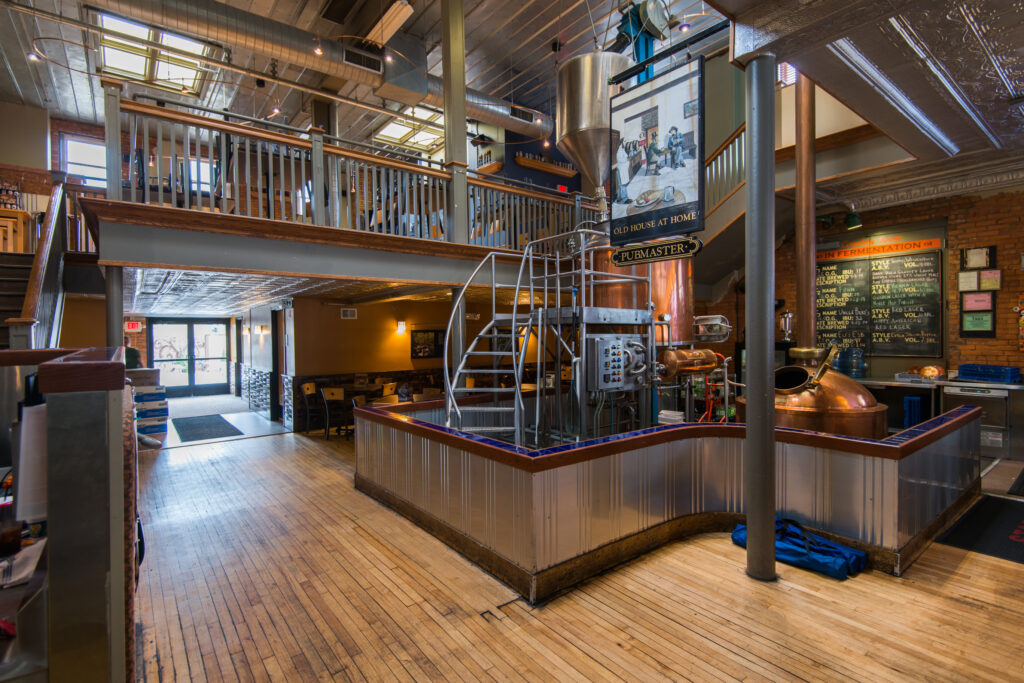
cozy brewing facility

You’ve likely had a vision of the perfect brewing location in your mind for quite some time, and finally, you’ve found it. After all of the location hunting, permit wrangling and liquor license drama, it’s time to get the essential equipment installed and get to brewing. But how do you know what equipment is necessary? And how does that translate to your brewing goals?

  “Well, that depends,” says Chris Jennings, technical writer for Glacier Tanks LLC, a retailer of stainless-steel beer tanks, mash tuns, brew kettles, pumps and parts. Jennings is well-versed in the brewery startup process, having been part of multiple startups and currently opening his brewery.

  “You know, with a brewery, location is always going to be important,” said Jennings. “But as a potential owner, you need to take into account the inherent demands of your operation to understand your needs. For example, if you want a small little local brewpub, a smaller footprint to house smaller production equipment is fine. But, do you want to stay local? Are you looking to produce a regional brew? Do you see yourself as a regional production brewery? Are your goals to become nationally distributed? Your answers reveal your goals and ultimately factor into your basic equipment needs.

  “A common path for brewery startups is to fit the brewing operation into an established and secured location, especially with the popularity of historic buildings,” said Jennings. “It’s perfectly okay if you don’t have a location set, but if you do, then you already know the building’s options and available utility choices. You’re going to have to get permits for everything, especially in historic locations, which will make you fully aware of your on-site choices. Does your location have three-phase electric, 40-amp circuits, and 220-electric? What fuel source is available for the boilers? Are we looking at electric heating options, direct fire options (natural gas or propane), or steam, which, by the way, is the most efficient option and should always be the first choice if available? And please, always involve your preferred equipment supplier as early in the process as you can, even when considering specific buildings and locations if possible. We can help with building a potential brewery layout with AutoCAD software, and then custom fabricate an entire brewhouse based on the available footprint and specifications if needed.”

  Jennings told Beverage Master Magazine that the bottom line for brewery startups is to save time, money and heartache by getting equipment to make your daily work life more manageable. During the brewery startup process, it’s imperative to associate yourself with informed people who can offer guidance and experienced purchasing information. The essential equipment to consider for brewery startups include the mash tun, a hot water source or hot liquor tank, depending on the production size, a boil kettle, heat exchanger and fermenter. Matching these essential items to your brewery’s goal-driven production needs within the allotted space goes a long way in ensuring a quality startup.

  “Other things can technically wait,” said Jennings. “But when considering equipment, I always suggest that anything else you can add to the actual production process immediately makes your brewing life more manageable. Any production process needs equipment. It’s just the way it is, so the more equipment you can have available upfront, the easier and more manageable your daily brewing life will be. Of course, I’m talking about anything and everything else, including a brite tank, filter, glycol system, applicable pumps, valves or other minor equipment. As a brewmaster, you want to focus on brewing your beer rather than losing quality time to menial or time-consuming tasks that the proper equipment or tooling can handle.

Size, space, and the Limits of Customization

  “Custom tanks like those we offer at Glacier Tanks are awesome,” said Jennings. “But even though our tanks and brewing equipment can be customized, there are not infinite options. Brewing is a science, and science determines the effectiveness, performance and size of the brewing equipment needed, including tanks.”

  But Jennings said there’s more to consider when matching projected production numbers to equipment. For example, adding additional fermenters doesn’t necessarily increase your production capability. If your boil kettle is a five-barrel capacity and you add a 20 barrel fermenter, you’ll need four brew sessions to fill it. So yes, you’ll have more beer, but you have to account for the extra time spent brewing. Adding two 10 barrel fermenters or four five-barrel fermenters may be more economical and efficient. Rather than looking at an 18- to 20-hour brew day to use a single 20 barrel fermenter efficiently, smaller capacity options allow more time between brew sessions while providing greater batch control and increased possibilities for brewing variety.

  Glacier Tanks offer stainless steel certified tanks that can adapt to any extraction process a brewer considers, including kombucha, soda, non-alcoholic products and even winemaking. The company keeps experienced brewers on staff to ensure that their systems remain industry-specific, including their turnkey brew systems that can be a two or three-vessel system, ranging from three barrels to 15 barrels requiring a 14’ x 16’ space.

  “Space is always at a premium for brewing operations, so when projecting a layout, it’s important to take every square foot into account,” said Jennings. “As for equipment, science says that the larger everything is, the larger everything needs to be. If you’re considering a three-barrel boil kettle, you’re looking at a piece of equipment just over seven feet tall and about three and a half feet wide. A three-barrel fermenter is 6’4” and three feet wide. A 10 barrel kettle will be 8’ 6” tall and 4’ 9” wide. A 10 barrel fermenter will take up 8’ 5” by 4’ 2”. A 20 barrel kettle requires a 15’ x 15’ space. Fermenters can range up to a 20’ x 8’ area required for a 100 barrel option.

  “What a brewer needs for a startup depends on the production goals. If your production is greater than five barrels, you should have an HLT just from a water conservation standpoint. To calculate the production capacity of any system, multiply the size of the system in barrels by how often a week you want to brew. Take that weekly amount and multiply by the number of weeks a year (50 is standard) you intend to brew to get your annual production number. You can also work backward to set your brewery production goals and scale the equipment and system to the necessary workload. Divide your annual production goals by the weeks you will brew to arrive at a weekly production number. The number of brew cycles needed per week then depends on the capacity of the system you install.”

The Never-ending Evolution of Brewing Technology

  While it’s true that brewing technology is constantly evolving based on needs, Jennings said that technology generally changes because of the potential of greater efficiency or measurable cost savings. One example is in the area of water conservation. “The brewing process wastes a lot of water, so there is always interest in any new technology that decreases, limits or stops wastewater and saves money. Glacier Tanks has incorporated a spud valve based on old German technology that allows a brewer to off-gas produced CO2 at a predetermined PSI setting during the fermentation process. As fermentation ramps down, the amount of CO2 released naturally lessens, allowing the brewer to capture more of their own produced CO2 to keep in the solution. It’s more efficient and can reduce the cost of purchasing CO2 after releasing all of your own. Higher efficiency plus cost savings drives successful changes.”

  “Sizing your system is the important first step in starting your brewery,” said Jennings. “Brewery equipment is scalable and should be scaled to your brewhouse so you won’t have to upgrade too rapidly. Even though saving money is important for a new brewer, penny-pinching or skimping on initial equipment purchases upfront can lead to supply and demand issues, income and product loss, and increased waste. Rather than wasting money on things you might need, spend the money on quality equipment you need. Also, don’t consider expansion only for the sake of growth. Fixing a problem due to bad planning is very expensive. Instead, make sure that the market is there and you’re prepared to expand your workday.”

When Even the Basics are too Much: Small Batch Equipment for Limited Spaces

  Quality equipment is essential, especially if you’re a small batch brewer with limited space. No one knows this better than Adam Sommer, Head Brewer and owner of Evergreen Farm Brewing in Metamora, Illinois.

  Sommer used his detail-oriented background as an electrician and mathematics enthusiast to start a small-batch, ground-to-growler brewery on a farm that’s been in his family since at least the mid-1800s. However, by choosing the old farm as his brewery location, his available brewing space was limited by the dimensions of the original farm buildings. That meant fitting a complete brewing system into a 15’ x 15’ space, and after researching his options, he found an all-in-one brewing system option from BREWHA Equipment Company. Their turnkey system allows the entire process of mashing, boiling and fermenting to occur in the same portable, conical fermenter, saving both space and time for a small-scale brewer.

  “Space was definitely an issue, but being out here in the country, we operate out of an existing well, so wastewater is an important issue as well,” said Sommer. “With the BREWHA unit, we only use two gallons of water per gallon of beer compared to four gallons that are normally needed.”

  Sommer told Beverage Master Magazine that he has been brewing beer for less than a year but estimates his production to be about 50 barrels for his first year. He plans to expand by renovating more original buildings and combining those with new structures that will feature the same aesthetics and appeal as the original structures. Sommer also has a couple of one-barrel fermenters for experimental brews and for producing different beer styles. Additionally, he uses two jacketed water chillers with a third in the works that provide a steady range of temperatures throughout the fermentation process.

  “And it’s easy to overlook at first, but you can’t forget about the small but equally important equipment and supplies that you need to serve your customers properly,” said Sommer. “We keep a supply of growlers and howlers so our patrons can take and enjoy our products at home or share with others. The amount that you’re going to need is just kind of guesswork at first, but the important thing is to have a relationship with a supplier to get your orders delivered when you need them.”

  When asked about advice for startup craft brewers, Sommer echoes the thoughts of Jennings. “Don’t skimp upfront. Instead, buy the best option to handle the capacity you need. That will allow you to make a quality product at a good price point for all involved. At the onset, the BREWHA brewing system was what I needed to get started. The price was right, and the system met my goals, needs and specifications.”

  Sommer’s ultimate goals for Evergreen Farm Brewing include becoming a destination brewery featuring event spaces with Airbnb rental options.

For more information, go to www.evergreenfarmbrewing.com

Packaging With a Purpose

How the Right Packaging Can Protect, Promote & Preserve Your Craft Beer

By: Cheryl Gray

beer manufacturing facility

Putting a distinctive face on a craft beer product means giving it a good chance to shine in the marketplace spotlight. However, that’s only part of the role of packaging. It should also protect craft beer from outside contamination while preserving its flavor integrity.

Equipment

  Enter the expertise of companies that shape the multiple roles of packaging for breweries. Among them is SKA Fabricating of Durango, Colorado. Founded in 2012, SKA Fabricating is the result of a demand for a can depalletizer designed by Matt Vincent, one of three partners in Durango’s award-winning SKA Brewery. SKA Fabricating now employs more than 70 people and manufactures and sells depalletizers, conveyors and packaging line equipment to businesses worldwide.

  Ska Fabricating has more than 1,000 clients in 23 countries, providing them with depalletizers and other custom packaging line equipment. Beyond the craft beer industry, the company also provides packaging line equipment to producers of food and beverages such as coffee, tea, water, kombucha, soda and orange juice. Non-beverage industries include aerosol, paint cans and spice jars.

  The size and capacity of systems built by SKA Fabricating fit virtually any brewery packaging line need. They range from a 20’ x 20’ square at 20 containers a minute to a 60’ x 60’ square running 250 CPM and above. The company is big on automated packaging line systems, touting them as more economical since automation requires less manpower. However, SKA Fabricating provides manual systems for clients who prefer them, such as start-up breweries on a tight budget. Those manual systems are available for half-height use and do require more personnel. As breweries grow and want to advance to automatic packaging systems, SKA Fabricating can help with the transition. 

Filling

  Another part of packaging is filling the cans and bottles that craft brewers use as containers for their products. XpressFill offers multiple fillers for the craft brewing industries. Rod Silver spearheads marketing and sales for the company.

  “XpressFill’s filling equipment is suitable for breweries that are not ready to invest in a full-blown production line. Our artisan brewers can realize significant savings in their efforts to grow their markets before making such a significant investment.”

  Since XpressFill offers fillers specifically with start-ups and smaller craft brewers in mind, the company promotes its products as the gateway to an opportunity for artisan brewers to run efficient, cost-saving packaging production lines. The company cites its products as top industry choices when it comes to being affordable, compact, user friendly and easy to maintain.

  Silver added that customer support is an important key to client satisfaction and that XpressFill has products for production brewing lines, large and small. He described how brewery clients are already benefitting from the range of products that his company has on the market, all designed to optimize productivity.

  “We offer counter-pressure fillers for both bottles and cans. We also offer an open filler that will fill both bottles and cans,” Silver said. “The XF4500C is a counter pressure system for cans capable of filling 200 12 ounce cans per hour. The XF2200 (two-spout) and XF4400 (four-spout) are open fill systems for cans capable of filling 300 to 600 cans per hour. The XF2200 and XF4400 can also be adapted to open fill bottles. The XF2500 (two-spout) and XF4500 (four-spout) are counter pressure systems for bottles capable of filling 200 to 400 12 ounce bottles per hour.”

  Silver laid out the pros and cons of manual versus automated production lines. “The most obvious distinction is production capacity and cost. The XpressFill systems are affordable for start-up breweries, ranging from $2,500 to $6,500. Automated systems are, at a minimum order of magnitudes, more expensive. Often, brewpubs will provide cans or bottles to be sold at the pub in limited quantities. Brewers getting started in retailing their brews will want to start in a deliberate manner to test the market. Larger breweries will also use our fillers for small batch or specialized runs that do not require start-up of larger production facilities or mobile operators.”

  Silver described how XpressFill works to protect the integrity of the beer inside any container. “All of our fillers have a pre-fill CO2 purge cycle to minimize the oxygen in the container prior to the fill cycle. Our can-fillers also have a post-fill top-off function to ensure an adequate layer of foam on which to place the lid. The counter pressure systems require a minimal air compressor to operate the pneumatic actuators. Our fillers operate at 110 volts, although they can be provided at 220 volts for our international customers.”

  Ease of use is also important. Silver said that his company prides itself on the simple operation of its products.“XpressFill can-fillers can easily be operated by a single user. Weighing under 40 pounds, they are intended to be used on a tabletop for portability. A few test runs are required to dial in the settings and bring the equipment to temperature for best results. Our fillers will purge and fill the cans, and a separate seamer is required. To maximize the production and efficiency, many of our customers use a second operator for the seaming function.”

  Silver said that XpressFill products have state-of-the-art safety features, compliant with industry-standard safety measures, including all applicable electrical and mechanical requirements. All materials in the flow path are food grade and meet the standards set by the National Sanitation Foundation.

  Fillmore Packaging Solutions is another company focused on small craft brewers. Its history highlights how owner Tony Saballa, a craft brewer in his own right, founded the company because he couldn’t find products on the market catering to the needs of small breweries like his.

  Based in St. Louis, Missouri, Fillmore Packaging Solutions provides its clients with options for automated can filling machines that utilize an automatic shutoff feature. This prevents cans from overfilling, a costly and time-consuming production line mishap. The product’s four-head can-filler is designed to fit into small spaces and accommodate small budgets. The product features double pre-evacuation counter-pressure filling, designed as an effective method of reducing dissolved oxygen during beer packaging. It can fill 12 to 16 cans per minute. Standard features on the product include under lid gassing, automatic lid placement and seaming. Additional features such as tank and CO2  pressure sensing and temperature monitoring with onscreen readout help to enhance the product’s ease of use. 

  The firm has also created two- and four-head filler machines for bottles. The machines operate on 110v/220v and compressed air. Fill rates for the two-head machine range from six to eight bottles per minute. The four-head machine fills at a rate of 12 to 16 bottles per minute. Features for both include automatic filling and self-leveling to correct fill height. The four-head model has a feature that pushes bottles onto the production line’s packing table. The models are operator-controlled from start to stop, loading and unloading bottles and loading crowns onto crown heads for capping. Fillmore also created a keg washing machine featuring a 25-gallon detergent reservoir with heater and a 25-gallon sanitizer reservoir.

Labeling

  When it comes to the aesthetics of packaging craft beer, labeling is the star. Colorado-based Lightning Labels has provided clients with custom-designed labeling for nearly twenty years. The company uses HP Indigo digital printing technology, which combines the best features of traditional offset printing with digital techniques. This hybrid delivers top-notch quality whether the client’s order is large or small. 

  Lightning Labels prides itself on the vibrancy of its color palettes, produced in high-resolution and designed to be water-resistant. Labels can be affixed to bottles, cans, growlers and kegs in a wide range of finishes, using high gloss, matte or textured paper. There are separate front and back label options, or clients may opt for one large wrap-around. Lightning Labels touts that its print quality allows listing custom beer ingredients in a crisp, readable font. Bottle labels are available in paper,  vinyl and eco-friendly options as well as more durable alternatives. As the name implies, Lightning Labels touts a quick turnaround on product orders.

  Blue Label Packaging Company specializes in labels for beer cans. Headquartered in Lancaster, Ohio, the company also uses HP Indigo printing, offering its customers an array of materials and substrates, such as foil, film and paper cut and stack labels. Product finishes and decorative techniques aimed at creating high impact include hot foil stamping, die-cutting and embossing. 

  Cost, creativity, and careful planning matter when it comes to packaging for craft breweries. The combination results in products that distinguish themselves on store shelves and meet the benchmarks of industry standards and food safety requirements.

Pumps, Motors and Drives in the Distillery

By: Alyssa Ochs

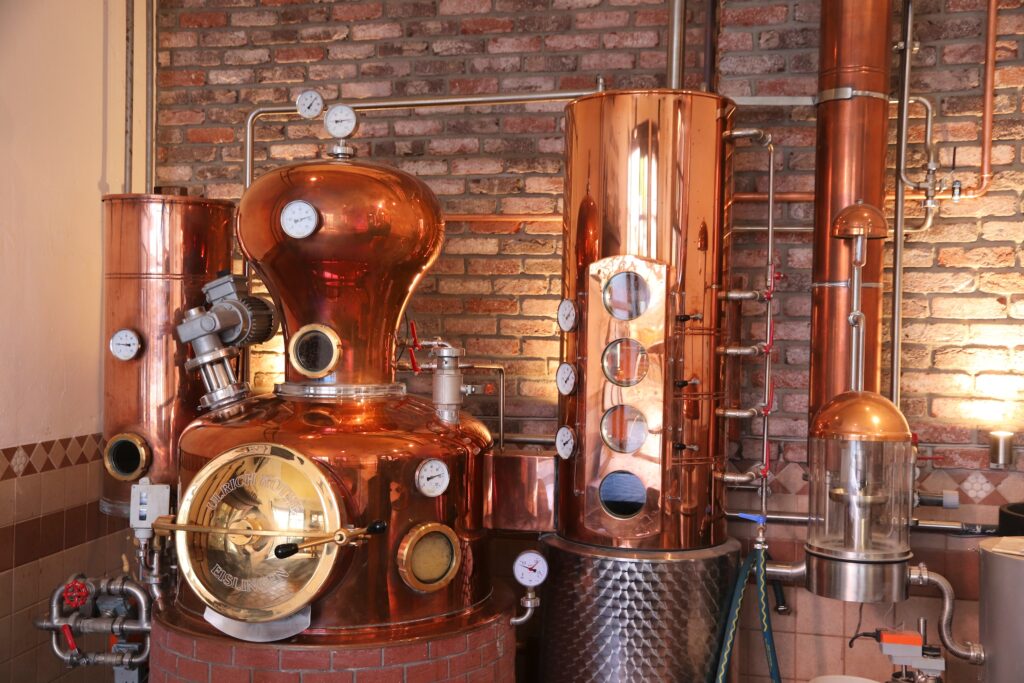
distillery equipment set

There are various kinds of specialized machinery used in modern craft distilleries to produce the high-quality spirits we know and love. Among these are pumps, motors and drives, which are worth learning more about to choose the best options for your distilling needs. To kick off the new year, here are some best practices and tips for ensuring that these pieces of machinery are functional and effective for their intended distilling purposes.

Distillery Uses for Pumps, Motors and Drives

  Pumps perform many unique functions in a distillery, including bringing in water, mashing, wort recirculation and fermentation transfer. Distillers also use pumps during distillation, for filtration, to fill barrels for aging and fill bottles when the finished product is ready.

  Motors drive the pump and grinding mills using electricity. Motors serve various purposes in distilleries, including pumping cool water, charging, discharging the still, agitating tanks and transferring distillate and spirits. Explosion-proof motors are critical in a distillery as a safety precaution while handling high-proof liquids and vapors. Some motors used to make craft spirits are not explosion-proof, but the key to using them safely is strategic placement on the property.

  Drives are part of the mechanical device that brings about its dynamic movement and are a great way to streamline the bottling process.

  All of these moving parts contribute to the automation process that modern distilleries use to increase efficiency, improve safety and work around labor shortages.

Pump Recommendations and Tips

  Among the many types of pumps available, centrifugal and positive displacement pumps are common in distilleries. Distillers also use flexible impeller pumps and double diaphragm air pumps with grounding tags.

  Air-driven double diaphragm pumps work well in flammable distillery areas and are versatile and self-priming. Meanwhile, electrically-driven double diaphragm pumps tend to be more cost-effective because they do not require compressed or pneumatic air. Electrically-drive peristaltic hose pumps can discard botanical waste by pushing liquid through a rubber hose and ensuring the desired flavors and fragrances remain in the spirit.

  Typically constructed with stainless-steel and hygienic materials, air-operated diaphragms pumps can handle multiple fluid types and applications, and they can be trolley-mounted for greater versatility. Hygienic pumps comply with food and beverage safety requirements, while pumps with low flow rates can transfer spirits from tanks to barrels for maturation. However, it is important to have the capability to adjust the flow rate for different cask sizes to prevent spillage and product loss.

  Glenn Mulligan at FLUX Pumps Corporation in Kennesaw, Georgia, told Beverage Master Magazine that FLUX drum and container pumps are ideally suited for distilleries of all sizes.

  “The pumps are lightweight and portable for ease of operation in many areas of the plant,” Mulligan said. “Whether you are pumping concentrates, additives or sanitizing products or ingredients like honey, FLUX has a solution. Food-grade pump options and motors suitable for use in classified atmospheres, such as explosion-proof products, pose no problems for the equipment.”

  FLUX Pumps Corporation has been producing pump technology for over 70 years, starting with the invention of the first electric drum pump. Beyond its well-known drum pumps, FLUX’s product line includes eccentric worm-drive pumps, centrifugal immersion pumps, air-operated diaphragm pumps, flow meters, mixers and complete system solutions. The company also carries a comprehensive range of accessories to suit the needs of various industries and applications.

  Overall, distilleries need pumps that provide efficient transfer of their products over a wide range of head and viscosity conditions. Multiple seal options are also useful, as leaky seals are common. Other things to look for in a new distillery pump include clog-free check valves, durable integral mounting, corrosion-resistant materials and easy installation with quick disconnect ports.

  Jon Johnson from Carlsen and Associates told Beverage Master Magazine that using pumps in a distillery is tricky, and the only type of pump he would sell to a distillery is an air diaphragm pump. Johnson has been in the industry for over 30 years and understands that distilleries must abide by rules that vary between each city, county, state and fire department.

  Based in Healdsburg, California, Carlsen & Associates is primarily a wine equipment supplier that offers positive displacement pumps, centrifugal pumps and air pumps, along with various related tools and fittings.

  “If you use an explosion-proof, Division 2 pump––which means that all rotating devices are non-sparking and have a cast-iron frame on the motor––you can put the motor and pump in there, but you have to put the control on the outside of the building and can’t run the speed control into the room because that is still illegal,” Johnson said. “You also need to have three backups if the air pressure drops.”

  He said that air diaphragm pumps could be safely used to pump high-proof and mash anywhere in the distillery and an explosive environment. Some distilleries use positive displacement pumps, but this is only safe if not in an explosion environment.

  “Make sure the products are grounded and that elastomers in the pump are compatible with whatever you are pumping and cleaning it with,” Johnson said.

  Carlsen and Associates sells Yamada-brand diaphragm air pumps, and Johnson said that the NDP-25 and the NDP-40 pumps are the most popular options. An NDP-25 pump costs approximately $3,200, while an NDP-40 model is closer to $5,000. The main difference between the two is volume.

Recommendations and Tips for Motors and Drives

  Experienced distilleries prefer energy-efficient, hygienic and explosion-protected motors, as well as those with effective brakes and built-in encoders. Different types of pumps use different motors to power them, but distillers should seek out certified motors that are explosion-proof and have multi-phase power, as some motors only fit certain transmissions.

  Air motor pumps are small pumps used to ensure safety and prevent explosions. Air motor power costs considerably more than a direct drive electric motor; however, upgrading motors can dramatically improve safety and comply with standards.

  Variable frequency drives can provide power at low speeds and have options for efficient designs, normal and heavy-duty operation, safety functions and cooling systems. Distilleries use electric variable frequency drivers as motor controllers that vary the voltage and frequency of power. This is how the electric motor is driven within an RPM range instead of a binary on or off. Drives can be programmed to minimize hydraulic shock and provide great accuracy while maximizing the properties of heat exchangers.

Considerations

  When choosing new pieces of equipment, factors to keep in mind include having access to readily available parts and quality people who can install and repair the equipment when needed. Mobile machinery and multi-functional pumps can help save valuable square footage in small distillery operations.

  Distilleries benefit from having pump-related products built from materials that conform to FDA and 3A requirements and can be quickly taken apart, cleaned and put back together. Mulligan said that this is why FLUX pumps are perfect for pumping different liquids while preventing cross-contamination. He also said that there is a common misconception that drum pumps are pieces of “throw-away” equipment.

  “While this may hold true for the lesser-quality brands, FLUX is committed to providing the best pump on the market with the lowest overall cost of ownership,” Mulligan said. “Every part for all of our pumps and motors are sold as individual components, which can result in repairs costing as little as just a few dollars. FLUX has customers that have been using pumps for over 20 years–some by just completing only the bare minimum for maintenance.”

  Mulligan also said choosing the best pump should be easy because many drum pumps on the market will solve the customer needs, but with varying degrees of customer satisfaction.

  “Selecting equipment from a manufacturer that is long-lasting, with the ability to be repaired when necessary, will result in a pump life that can be counted in decades,” Mulligan said. “Quality equipment results in less downtime and more production, ultimately adding to the bottom line. We can show you how the break-even point for the return on investment comes in just a few months, with thousands of dollars saved over the lifetime of the pump.”

Blending In

By: Tod Stewart

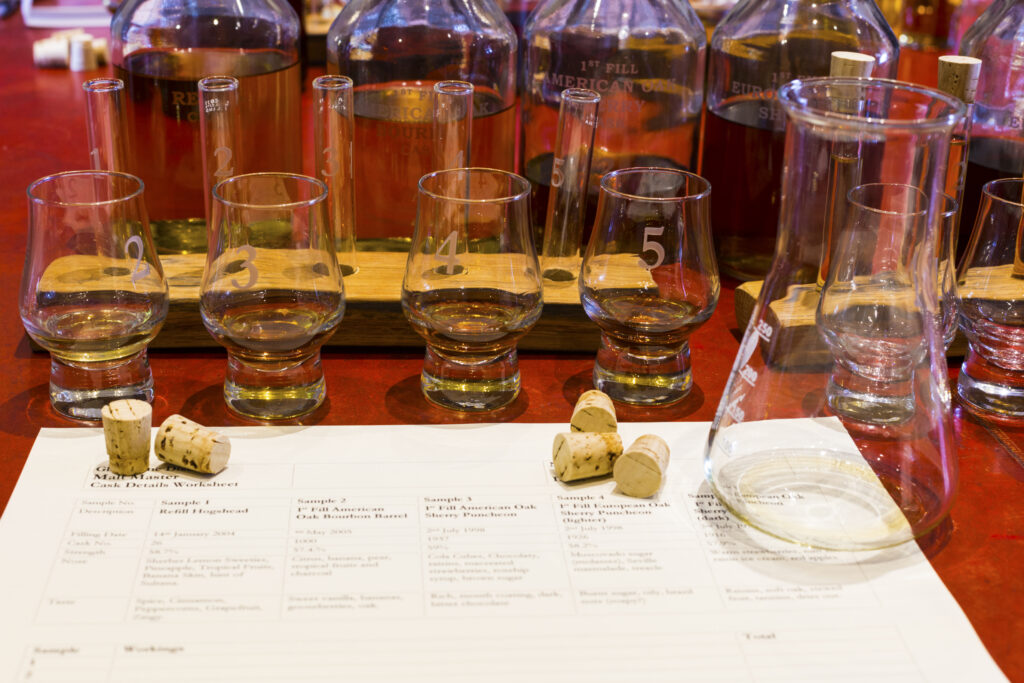
distilling instruments in the table

It’s been said that spirit distilling is a science, and spirit blending is an art. As I am neither a scientist nor an art-ist, I prefer to simply enjoy the end result of the distiller’s science and blender’s art.

  That being said, in the interest of science (possibly art), I’ve subjected myself to the organoleptically humbling “blending exercise” on several occasions, trying to duplicate house styles with the Metaxa Master Blender in sunny Greece; with the Mount Gay Rum Master Blender in sunny Barbados; with the Appleton Estate Master Blender in sunny (sort of) Jamaica; and with the Brand Ambassador for the Famous Grouse Blended Scotch Whisky in the bowels of a definitely un-sunny bar in Toronto. I’m sure there were more. Most have been men-tally blocked, as the mind can only tolerate a finite number of crushing failures.

  So, acquiescing to the reality that I would never enter the sacred realm of Master Blender, I chose instead to live vicariously through the lives of those who have, in an effort to understand more about the art and science of blending.

  Enter Cécile Roudaut, Master Blender for St-Rémy, the French distiller of one of the world’s most popular brandies. To her mind, distilling and blending are equal parts art and science, but the approach to each differs slightly.

  “For me, both distillation and blending are arts, but they are expressed differently,” she said. “I think that the art of distillation requires a lot of know-how but also intuition, and depending on what you want to achieve…inspiration.” When it comes specifically to blending, Roudaut said that “the olfactory notes are a bit like music notes, they must be harmonious and not discordant. Blending is the art of harmony of notes; there is a part of intellectual, of artistic property.”

  To me, the art/science/frustration of spirit blending is twofold. First, it aims to create a sort of liquid gestalt, where the blend turns out to be something magically different than its component parts. Secondly, it seeks to do this consistently, day in day out. Most spirits are, in fact, blends. Whether you’re blending whisk(e)y, brandy, rum or tequila, you’ll be shooting for a common goal, though you may go about it somewhat differently.

  “The common objective [in blending] is to obtain a product that conforms to a standard,” said Karina Sanchez, Global Brand Ambassador for the tequila producer Casa Sauza. “For a specific [type of] spirit, the blending process has unique details related to customs and legal constraints, production and warehousing processes, ap-proval criteria and so on.”

  These blends are typically closely guarded secret recipes, sometimes passed down from hand to hand. Could someone who’s not a part of the covenant of the Master Blender/Knights Templar/Masonic Orders in general ever be able to duplicate a successful blend? Maybe it isn’t possible. Maybe trying to replicate a blend is a mug’s game.

  So I asked a few Master Blenders this: Is trying to replicate a blend a mug’s game? To which they replied: “Yeah, pretty much.” See, even if you had all the exact component liquids and mixed them in the exact propor-tions, you still wouldn’t get the correct mix down in a blend-off competition that might last an hour.

  Here’s a possible reason why.

  Spirit blenders have been likened to marriage counselors in many instances, or at least in one instance I know of for sure. In the book Goodness Nose, Richard Patterson, Master Blender for Whyte & MacKay scotch, revealed this about whisky blending: “Not all of the whiskies will immediately fall in love with each other. Indeed, some may be totally incompatible. The boisterous, younger malts may simply flirt, only to go their separate ways. The chosen whiskies must be given time to court, time to sort out their differences and to make the necessary compromises before a perfect partnership is achieved.” Obviously, all this cohabitating, marrying and getting-to-know-each-other isn’t really doable during a blending exercise that may only last a half-hour or less. Before that stage, the professional blender’s task is not only to select the spirits that will best work together to create a final product but also to ensure that there is sufficient stock of the components on hand to recreate this product in the volume required regularly.

  “I believe that blending is about controlling all phases of the rum-making process,” said Nelson Hernandez, Master Blender at Diplomático rum. Hernandez explained that crafting what he calls the  “Diplomático style” calls for a combination of elements and processes, including the final blending of distillates extracted from three distinct stills.

  “We have a continuous distillation system we call Barbet. It was designed in 1959 exclusively for our distillery, with a very particular internal shape that allows us to obtain a light but very aromatic distillate. Another unique system we have was imported from Canada. It is called a Batch Kettle, and we adapted it to get a semi-complex distillate. Finally, we have a discontinuous copper system, which was used in Scotland until 1959 to produce malt whisky. These distinct distillation systems allow us to obtain three completely unique and exclusive distillates, which we then age for different durations and blend them to achieve our specific expressions.”

  Be it rum, whisky, brandy or tequila, once the blender is satisfied with the profile of the new blend — or the proximity to the “standard” is so close that no differences can be detected — the blend is ready to be replicated on a commercial scale. However, given the advances in modern science and technology, I wondered how im-portant the human senses are in the finalizing process, especially when it comes to duplicating a pre-existing blend. Surely in the world of gas spectrometers and the like, this task would be best handled by machines. Or so I thought.

  “The Whisky Mastery Team at The Macallan are a truly unique group of individuals whose abilities to blend single malt whisky have put them at the forefront of the industry,” said Cameron Millar, The Macallan Brand Ambassador. “The human element of whisky making is largely down to the use of a whisky maker’s nose or olfactory sense. This team of whisky makers will nose each and every cask selected for use by The Macallan, providing a quality check that no machine or technology could ever replicate.”

  In fact, of the half dozen or so Master Blenders, Cellar Masters, and Brand Ambassadors I spoke to, all were unanimous in asserting that while technology can offer assistance, it is ultimately human senses that dictate the final blend. “So far, there is no modern technology that has managed to replace the talent of men and women Cellar Masters,” confirmed Anne Sarteaux, Cellar Master for French brandy producer De Valcourt. “Of course, there are analyses that ensure the organoleptic components serving as support for the daily work, but only the human palate identifies the subtlety of the Eaux-de-vie which make up the final blend.”

  Hernandez concluded that, from a strictly human perspective, a Master Blender has to have an exceptionally good memory for aromas and flavors. Probably a bit of an understatement.

  Once the ultimate blend has been settled on, it’s time for the Master Blender to unleash it on a thirsty world. This basically involves recreating the blend by the barrel rather than by the beaker. But it’s not quite as simple as a straight swapping of millilitres for casks.

  “To start, each blend is elaborated in our laboratories with graduated test tubes,” Sarteaux said. “Then we select the available blends that we regularly test. We then develop the blend on a larger scale, always testing the or-ganoleptic quality. Each selection is then tasted. Lastly, we test our brands blind with an independent and expert consultant.”

  Constantine Raptis heads up perhaps one of the most intricate blending regimes. As Metaxa Master, Raptis blends spirits, wines, and a special aromatic component together to create the signature spirit of Greece.

  “I create Metaxa by bringing together aged distillates, Muscat wines from the Aegean islands and a secret bou-quet of May roses and Mediterranean herbs,” Raptis said. “Every blend is created following the same philoso-phy. The first step is to collect, evaluate and record all the information (years of aging, origin, organoleptic characteristics) of every cask where distillates are left to age. Then, based on my experience and — sometimes small-scale tests — I decide which cask will be used for the specific blend. The content of the casks is emptied in a tank and stirred. The new blend is then tested, and if needed, I may add some specific distillate to achieve the final character of the blend that I am looking for. Usually, my blends are 20,000 or 70,000 litres, depending on the Metaxa style that I want to create.”

  Consistent flavor is what a blender aims for, but just as different casks bring different nuances in flavour and taste, color consistency also has to be considered and typically adjusted. Raptis said, “Every blend is created with distillates of different aging that may have certain variations in their appearance. Therefore, every final blend may present slight colour variations that are adjusted by the addition of natural caramel colour. This step is important so as to maintain stable all the other organoleptic qualities of the blends.” Note that the addition of natural caramel color is standard practice in the blended spirits industry and has no impact on the final taste of a brown spirit.

  Sometimes, for blenders to offer something truly unique, a break with traditional practices (and mindset) is re-quired. Canada’s Alberta Distillers Ltd. releases an annual, limited edition Alberta Premium Cask Strength Rye Whisky. In blending the final product, a bit of “coloring outside the lines” is necessary.

  “To create our award-winning Cask Strength Rye whisky, Alberta Distillers Ltd. breaks from the traditional blending technique that other Canadian distillers are known for and selects only pot stilled liquid that is aged in new white oak barrels,” said George Teichroeb, the distillery’s General Manager. “Once matured and drained directly from these barrels, nothing is added to the whisky. Additionally, we use both pallet and rack style warehouses during maturation. This, coupled with the unique weather we experience here at the foothills of the Rocky Mountains, offer distinctive nuances to this coveted whisky.”

  Like the end product itself, the art and science of spirit blending are complex. But whether they are mingling whisky, rum, tequila, brandy or exotic elixirs like Metaxa, the aim of the blender is the same — consistency and uniqueness in aroma, flavor and color. The Master Blenders and Cellar Masters use both talent and time to en-sure that, as a spirit aficionado, you can be confident that the second bottle you buy will be every bit as enjoya-ble as the first one.

If It’s Premium & Luxury, We’re Drinking It

By: Hanifa Sekandi

bartender mixing alcohol

Maybe we have been home too long? Could it be sheer curiosity leading us to develop a sophisticated spirits palate? It is true that when your life is busy, you tend to give very little thought to what goes into the cocktail you are drinking. You may know you like gin, bourbon, whiskey or tequila but, unless you are a spirits connoisseur, the quality of liquor you drink may evade you. Now that you have graduated from junior bartender to an award-winning at-home mixologist, drinking just anything does not cut it. You want premium and luxury spirits that are high quality and arouse the palate. You desire a tequila on the rocks that is as smooth to sip as it is when poured for a single shot. Your bar cart is the a la carte experience that your neighbors dream of; they sure do envy it in the community group chat. It is time to expand your horizons to premium and luxury spirits from around the world.

  You may not be able to travel to a far-off land, but you can feel its energy, the ingredients, the rich soils, and the minerals that make up the alcohol in each bottle. Alas, you can feel the African rhythm, the tranquility of India, the heat of Mexico when you savor one of their premium spirits. It is the road less traveled that leads one to incredible experiences. During this time, our hearts and minds come alive and begin to dream again. Until then, the road will be through the liquid poured and made with pure heart by people who want you to discover their lands and what makes them unique.

The Heat of Mexico: Tequila

  It is not that people were not drinking tequila in years past; they certainly were. As with all things great, it takes time for people to appreciate what has always been good. Tequila traces its beginning to Jalisco, Mexico. Travelers to this sunny destination learn very quickly that tequila is one of the essential elements of experiencing Mexican culture. Yes, there is more to Mexican culture than this ancient craft spirit, but there is no denying its pulsating effects. There is the ad-age that you may have heard, “tequila makes babies,” meaning that it goes down so smooth and keeps the party going, you most likely will not remember what happened the night before. With each sip, the heat rises, the party becomes passionate and livelier. What has changed? Why has tequila gained popularity in recent years? What seems like a newfound love for tequila is due to education. Premium tequila brands are going a step further by partnering with brand ambassa-dors, bartenders with in-depth knowledge about tequila and a deep understanding of how tequila is made and what makes a brand luxury.

  For some, tequila is a waist-friendly, craft-spirit-alternative that sips well. It is the alcohol of choice when mixed with low-caloric pre-made drinks. This trend might have been ushered in with popular diet-savvy cocktails, like the skinny margarita, since pared-down emphasizes the quality of tequila used.

  Premium tequila contains 100% de agave. Lower-quality tequila, called mixto, consists of other alcohols and less than 51% agave-derived alcohol. It is most likely what you tried years ago at your local bar before they upped their alcohol repertoire due to the patron’s elevation of tastes.

  If tequila is the main event for burgeoning spirit enthusiasts delving into premium alcohol, skip-ping the frills and enjoying it “just as” seems appropriate. A familiar mid-level premium brand is Clase Azul Reposado. Due to the white ceramic bottle with beautiful blue hand-painted details, it is a recognizable brand. Although this mid-range tequila only ages for 8-months in American oak barrels, it boasts a rich flavor profile. It is not unusual to find this bottle perched on the shelves of travelers who have visited Mexico and needed to take a piece of tequila splendor home with them. Another noteworthy premium tequila made with agave from the highlands of Jalisco and aged for five years is Tears of Llorona Extra Añejo Tequila.

  Word travels fast with the premium brands recognizing that tequila education increases aware-ness and demand. Hence the prevalence of tequila tastings has become a common occurrence not just in Mexico but in bars across the globe that showcase premium tequila as the main event.

Feel the African Spirit: Brandy

  South Africa is known for its Winelands but, for those who know, there is something rhythmical-ly beautiful about African-crafted spirits. Each country on this rich continent has homegrown spirits that keep the symphony of well-made liquor loud enough to entice explorers far and wide. It is not surprising that as the premiumization of this sector flourishes, South African spirits are found on the top shelf right next to the best American-made bourbon in town. Although South Africa is known for its brandy, there is a diverse array of spirits that never fail to impress. A standout spirit is a blue-hued botanical gin by Six Dogs that gets its color from a blue pea flower. The magic of this gin is apparent as it changes to a lovely pink when mixed with tonic.

  On the world stage, South African brandy has received prestigious accolades. KWV Centenary Limited Edition Brandy, made in the Paarl region of South Africa, has a premium price tag that will send chills down your spine. Its namesake and distiller is Ko-operatieve Wijnbouwers Vereniging van Zuid Afrika, a distillery that has been making brandy for over 100 years.

  The word brandy derives from the Dutch word ‘brandewijn,’ meaning burnt wine. Brandy’s long legacy dates back to the 17th century with Dutch settlers. This is apparent with the breathtaking gardens and Dutch farmhouses where spirits are still made. South African brandy is described as having a velvety texture with robust citrus and floral notes along with an enchanting aroma. A standout attribute is that distillers maintain traditional brandy-making practices. Although they have pivoted with the times, honoring the tested and true techniques produces a premium amber spirit.

  What brandy distilleries in this country have maintained is crafting beautifully aged batches with copper pot stills as the first stage. They follow this by further aging it in oak barrels. Batches un-dergo this process for at least three years before a brandy with an alcohol content of 38-43% is ready to be bottled.

  South African brandy is composed of Colombar and Chenin blanc grape varietals, fermented to make this chest-warming spirit. For those who love wine but turn their nose up at this deep-colored, rich, alcoholic beverage, the two are close relatives that share the same roots, often liter-ally.

  When sourcing authentic South African premium brandy, keep in mind that the rules are strict for brandy distillers. Therefore the real deal is only made from grapes endemic to the South Afri-can Winelands and distilled, aged, and bottled there.

The Tranquility of Spirits in India: Whiskey

  When most people think of India, they imagine themselves in an ashram meditating and doing yoga. India is a country where people travel to find what is missing within and, for some, to simply find what is yet to be seen. It is a land that is full of beauty and undiscovered treasures. It is not surprising that premium spirits are made in a country rich and diverse with indigenous plants. The climate is ideal for growing and harvesting; therefore, making unique premium whis-key was inevitable. 

  For Hermes Distillery, a premium spirit distillery founded in 2018, producing homegrown pre-mium whiskey was a necessary endeavor. Founder Amit Kore recognized that India could pro-duce top-shelf liquor just like America and Europe. The Rockdove premium label whiskey made by this nouveau distillery bouts all the luxuries that an avid whiskey drinker desires: A rich and deep-colored whiskey, light-bodied and smooth like scotch.

  The 100-year old technique used by Hermes Distillery at their Tomsa plant, the first in India, is from Spain, and it is the same technology used by familiar brands Crown Royal and Johnnie Walker. Moving at a pace that would take most distilleries decades, Hermes is opening the door for Indian-made premium liquor to join prestigious distilleries as a top-shelf selection.

  Drinking premium or luxury is not about social class. It is about quality. A survey conducted by Bacardi found that 75% of the people value cocktails made with high-quality spirits. For those looking to experience more than a night out with any old cocktail, premium spirits allow them to enjoy the moment with ease and appreciation. It is better to stretch your wallet just a little bit to drink the real deal. In the case of tequila, 100% de agave is a must! And wouldn’t you like your botanical gin to contain ingredients sourced from the lush gardens of South Africa? Seeing the meticulous effort that goes into an Indian-made whiskey, you must recognize that there are no shortcuts for luxury. So, as we usher in a new year, let’s take the long road down luxury lane, slowly sipping one premium spirit at a time.

“SHOW ME THE MONEY”

After Friends and Family, Where Do I Get Growth Capital?

By: Quinton Jay

dollar bills flying

Like most entrepreneurs, founders and owners of smaller craft breweries and distilleries often find themselves having to wear many hats. You need to be aware of your internal operations and external logistical factors in your business’s supply chain, as well as understand how to best market and sell your brand’s products.

  Arguably one of the most important hats you will have to wear that is not obvious is the one that reads “finance.” Without having a finger on the pulse of your business’s finances, you’re setting yourself up for inevitable failure. Running out of cash is the number 1 killer of businesses within the first two years.

  When your finances start leaning towards the red, or you know your business requires an additional injection of capital to grow successfully, it can be easy to feel frustrated and discouraged. But this is simply another part of business; you can’t expect to reap the benefits without having to face and overcome the hurdles and challenges you’re bound to encounter.

  If you — like many other small business owners — were able to obtain at least a portion of your original capital through friends, family, or other investors, this may not be a possibility further down the road. This is where that “finance” hat comes into play once more. In order to emerge from uncertainty with a brewery or distillery that is ready to continue growing, you as a founder or owner are required to find alternative means of raising funds, especially if your overarching aim or goal is to land an eventual, profitable exit. But where do you start?

  Here are some ways that you can use as means of obtaining additional growth capital for your small brewery or distillery business when reaching back out to friends and family is no longer an option.

Understand the Realm of Private Equity Investments

  As the Managing Director of Bacchus Consulting Group and its capital management fund, I have more than twenty years of experience managing, consulting for, and investing in more than a handful of small, independently-owned brewery and distillery businesses. I have helped dozens of businesses in the industry understand their options when it comes to raising growth capital through VC investments, the separate stages of fundraising, and the impact that each fundraising option has on those businesses.

Private Equity Funding

  When the time comes to look into raising growth capital for your small brewery or distillery business, the most prominent option you will run into is private equity (PE). To put it simply, PE involves investing in companies using capital that has been sourced from individual or institutional investors, as opposed to investing in companies using capital sourced from public equity markets like the NASDAQ or New York Stock Exchange.

  For the sake of insight, the general thesis of any PE investment is three-fold. A PE investment is made to: firstly, purchase a company (or portion of a company) using significant leverage and a minimal amount of equity; secondly, utilize the industry expertise and synergies of the PE investor(s) in order to maximize the growth and efficiency of the acquisition or investment made, and; thirdly, to sell that acquisition in an approximate period of 3-7 years based on the company’s improved metrics and lowered levels of debt.

  A common misconception with PE funding is that giving away equity in return for capital is “free,” but this could not be further from the truth. Selling equity for capital is simply a means of delaying payment. With PE funding, there’s no true cap on what you can give away in return for the growth capital you want or need. If you believe in your business, you’re better off acquiring debt rather than selling a portion of your equity. When you give away equity, you’re giving away infinite returns in perpetuity.

Alternative Lenders (Non-Bank Financing)

  Some sources of alternative financing include:

●    Merchant Cash Advances (e.g., Quickbooks capital, Shopify capital, AMEX Merchant Finance, etc.);

●    2nd Lien Lenders (similar to a 2nd lien on a home mortgage)  and;

●    Unitraunche Lenders: a hybrid lending model that combines multiple different loans — sometimes from multiple lending parties — into one, with a blended interest rate that tends to average those of the lowest and highest rates of the individual loans lent.

  As their name states, these are each an alternative form of financing available for businesses looking for access to growth capital. However, these forms of financing for businesses tend to be riskier on the part of the lender, hence why they charge more for these sources of growth capital.

Traditional Lenders (Bank Financing)

  Financing for growth capital through bank loans is another available option for small businesses. This avenue tends to come with lower interest rates than most sources of alternative financing but is usually much more difficult to acquire.

  Financing can also be done through debt, rather than its equity, but again: if your small brewery or distillery business is already deep in debt, it may not be the most beneficial option available to you. Although, when acquiring bank debt, or any debt instrument (as opposed to equity via PE financing), there’s always a cap on how much you can pay for the use of those funds received.

Finding the Right Investor for Your Brewery or Distillery Business

  Regardless of which financing option you choose to go with when searching for additional growth capital, the most important factor to keep in mind is to find the specific investor, fund, or lending institution that compliments your business and its goals. If your aim is to grow your brewery or distillery into a business that can be acquired by a larger parent company in a multi-million dollar deal, then PE financing is likely your best option. Similarly, if your business has a higher amount of debt, finding an investor that can provide you with acceptable terms for a second lien may be the avenue you wish to pursue.

  Whatever type of growth capital investment you wish to see for your business, be sure to ask yourself questions regarding the synergies your investor has with your business. Some examples of these might include:

●   Does this investor have good chemistry with me and my core leadership team?

●   Does the investor have a willingness to help and mentor me and my team on how to best successfully grow our business in line with our goals?

●   Does this investor believe in me, my team, and our ideas for our business?

●   Do they have relevant experience and connections we can utilize for additional investment opportunities now and/or in the future?

●   Does this investor have the domain and expertise — along with the capital — necessary to help carry our business forward through periods of growth we want to achieve?

  If your answer to any one of these questions falls into the realm of anything other than “yes,” then chances are high that they are not the right investor to bestow you and your business with growth capital. Additionally, if you or your core team are not ready or willing to accept mentorship from an investor, then don’t waste their time (or yours) trying to receive an injection of capital for growth solely for the sake of having more cash to fuel your business’s runway. Too many businesses — even smaller breweries and distilleries — land themselves in hot water this way. Don’t become one of them.

Showing What Investors Want to See in Your Business

  Before any investor, fund, or firm will agree to make an investment of growth capital in your business, they are going to scrutinize your business from every perceivable angle. Throughout their vetting process, you can (and should) expect any potential investor to analyze no less than the following aspects of your company:

●   Business Model: How does your brewery or distillery make money? What are your key business metrics such as revenue and gross margin, operating profit, and EBITDA? Is your current model scalable or does it need to be reworked if your business wishes to continue growing?

●   The Team: Does your business’s core team (including you) possess the knowledge, skills, and ability to carry the company through periods of growth? If not, which employee(s) need to be let go and replaced? Is the team able to collectively address and resolve issues?

●   Structure and Governance: How is your company structured and led? Is there transparency and accountability across its departments? Does your business have a succession and/or key man insurance plan in place? If so, what does it look like?

●   Exit Plan: Does your company have an exit strategy in place? If not, then why not? If so, what does this plan look like, and is it reasonably sound?

  All of these factors will play a vital role in your business’s ability to land growth capital. From my own experience as an investor/financier, I am looking for specific reasons not to invest in or finance a company; anyone can fall in love with thier own deals and each deal must stand on its own merits. This means that you, as the founder or owner of your business, will need to know both your company and its market viability inside and out if you wish to gain an investment of capital necessary to grow it in a way that meets your goals.

  If you are able to show investors and financiers that you are credible and trustworthy, that your business has shown the capacity to make sales of quality products and grow from its revenue and profits to date, and that it has the potential to continue growing in its existing market or into new markets, then your chances of landing an investment of capital required for growth are much higher.

GETTING CRAFTY: How the Beverage Industry Can Secure Business Funding

By: Raj Tulshan, Founder of Loan Mantra

hand holding dollar sign

According to the Independent Craft Brewers Association, the Craft Brewing Industry was responsible for over 400,000 jobs and contributed $62.1 billion to the U.S. economy last year.  As with other industry segments like restaurants and retail, COVID-19 had a devastating impact on sales.  Craft beer retail sales decreased 22%, to $22.2 billion, and now accounts for just under 24% of the $94 billion U.S. beer market (previously $116 billion)*.

  At the same time, craft brewers and brewpubs may have found themselves left out of the American Rescue Plan, which offered $100 million in grants for eligible organizations during the COVID–19 pandemic. And for those companies that could take advantage of government programs like the  PPP (Paycheck Protection Program), records indicate that more than half of the funding proposed to help smaller shops and owners, actually went to larger corporations.

  When it comes to funding your business, you have many financing options. If you’ve decided that borrowing money from a lender needs to be a part of your funding plan, there are many things you can do to increase your chances of getting the best possible loan, including different kinds of research, some careful planning, or actions you can take. 43% of small businesses applied for a loan last year, and only 48% of those small businesses get their financing needs met.

  Banks lent over $644 billion to small businesses in 2019, but lending slowed in the wake of the pandemic in 2020. With lenders feeling more optimistic in 2021, there will be more options for small businesses looking to rebound. For businesses still struggling after more than a year of unprecedented disruption due to the COVID-19 pandemic and working tirelessly to recover, not all hope is lost. Consider the case of  Trubble Brewing Company.  Trubble Brewing received loans to expand from one location to three in the Ft. Wayne, Indiana area just before the pandemic began in 2019.  From 2019 through today, the company enjoys huge success.  

  To best position you to apply for a loan, there are some steps you can take, from figuring out if you can qualify to prepping all the documents you’ll need. Here are some tips to think about when financing:

  Research loan products: Understanding the type of loan that are available is critical. Applying for a loan, when what is actually needed is a line of credit, will slow down the process and possibly end in a loan denial. Experts from Loan Mantra can help you pinpoint exactly what type of funding is needed and help guide businesses through the application process step-by-step.

  Structure the deal:  Working with an expert can help you structure the loan so that your approval is fast and successful.  For instance, know what specific things associated with the business that a lender will grant you funding for and structure the loan accordingly.  For instance, borrowing money for expansion, real estate, machinery and buildings may be very amenable for a lender.

  Make a name:  Now is not the time to scale back marketing efforts or forget to update the website.  Market your craft brew, register a website domain address and update your online profiles. Get a professional logo.  Be active on social media and online.  Stake your claim in the industry and make the craft beer name stand out.  Register with search engines and on multiple platforms so that banks and other lending institutions can find and get a feel for the company.

  Realize it takes time:  One of the biggest factors in determining whether a loan is approved or not is the length of time a brewery has been in business.  Lenders want to know if a business has stability and the longevity to keep up with the business in the near and long term so that their funds will be re-paid.  In addition, the ability to provide receipts and prove profitability are very important even if a business is fairly new.  The lender is determining if a company has credibility – does a business invoice and collect payments on time, maintain records and conduct its processes in a professional manner.   

  Organize and compile your documents:  Applying for a loan requires financial transparency, so make sure your financial, accounting and tax records are accurate, organized, and updated. You’ll likely be required to submit numerous documents, including three years of business and personal tax returns, a loan application that permits a personal credit report for all owners, business debt schedule (BDS), personal financial statement (PFS), interim financials, AR and AP aging reports, entity documents, and purchase agreements. Organizing and compiling these items ahead of time makes the process much easier and less stressful. The Loan Mantra portal allows you to upload and securely store your financial documents so you’re prepared to apply for funding as you prefer.

  Maintain credit worthiness: Pay your bills on time, have the best credit possible, and know your credit score. Avoid foreclosures, bankruptcies, and late payments. While different lenders have different credit requirements, good credit is important regardless of the loan you’re pursuing. Lenders often require a credit report that can mildly impact your credit, knocking a few points off your credit score each time you pull the information.  Therefore, applying for too many loans simultaneously may undermine your credit score, so start by applying for a loan that you have the best chance for securing. Loan Mantra’s financial technology, BLUE (borrower lender underwriting environment), uses decision-tree logic, meaning it can help you determine the best loan product for your needs. Also, Loan Mantra experts can help you determine the most prudent options for financing–from a conventional loan to MCA–based on your borrowing needs.

  Be prepared:  Now is not the time to scale back marketing efforts or forget to update the website.  Market your craft brew, register a website domain address and update your online profiles. Get a professional logo.  Be active on social media and online.  Stake your claim in the industry and make the craft beer name stand out.  Register with search engines and on multiple platforms so that banks and other lending institutions can find and get a feel for the company.

  Sustain and remain:  What part of the brewery: growing, product, mechanism, process, water usage, energy consumption, etc. is sustainable?  Does the brand resonate with the community and do you know the future goals for sustainability in the areas where the business is located?  This can make a direct impact both now and in the future.

  Keep records safe:  Providing and producing documents for the loan process can be time consuming and frustrating for both borrower and lender alike.  Working with companies that have an online portal to streamline this process to keep this information safe and secure for use anytime can save time, headaches and money.  Fortunately, Loan Mantra offers this service that is free to all business owners.  Simply upload your documents to a secure portal at loanmantra.com.  You don’t even have to be a client or customer to use the service.  

———————————————————————————————————————————–

About the Author

  Neeraj (Raj) Tulshan is the Founder and Managing Member of Loan Mantra, a financial advisory firm with best-in-class and proprietary fintech, BLUE (“Borrower Lender Underwriting Environment”). Loan Mantra, Powered by BLUE, is next-level finance: a one-stop-shop for business borrowers to secure traditional, SBA or MCA financing from trusted lenders in a secure, collaborative and transparent platform.

  After graduating from Ithaca College in Finance, Tulshan began his banking career at Merrill Lynch in New York City. He spent more than a decade in the Currencies, Commodities and Investments Group where he also worked with global asset-backed securities, structured products and principal investments. Here, he also originated and underwrote deals valuated near $25 million and structured Series A and B financing.

  When the market crashed in 2008, Raj saw a significant opportunity to fix the fractured lending ecosystem. Soon thereafter, he sought after and completed an MBA from the Said School at Oxford University and began developing Loan Mantra. His goal was to remove the silos that exist between lender and borrower using secure financial technology. Though Tulshan continues to be iterative with his fintech, meeting current demands of both market and borrower, his professional mission and good- natured approach with clients remain the same. In this, Loan Mantra displays its founder ’s proud partnership between best-in-class fintech and top-marks human experts. Time-and-again, clients turn to Raj because they know he will always pick up the phone and offer unparalleled financial counsel in a remarkably human —even friendly—way.

About Loan Mantra

Loan Mantra

  Loan Mantra is a financial services company designed to serve small and medium businesses with offices in New Jersey, Charleston, SC and New York. At Loan Mantra your success is our success.  This means that our attention, purpose, and intention are all focused on you, our client.  We are your ally to overcome obstacles, bringing peace through uncertain times to achieve your highest goals and aspirations. Your friendly, responsive agent will listen respectfully, and service your account actively through one of three locations in the US.  We speak your language whether it’s English, Spanish, Hindi, Bengal, Hospitality, Laundry or Manicure, let us help you today.

Connect with us at…www.loanmantra.com or 1.855.700.BLUE (2583)

BREWERY AS A BUSINESS: Important Points to Consider

By: Jess Perkins

man writing on paper

As an experienced brewery owner or manager, you will agree that starting a brewery is easy; running one is not. There are many different things to consider and plan for when running a brewery, and many of those things only become immediately apparent once you are running a brewery. This article will discuss the major issues that any brewery needs to consider. They are not all equally important; some may even be seen as trivial, but each case has been a stumbling block for at least one brewery in the past.

Staffing

  Employees of a brewery are so crucial to the success or failure of a brewery. There are several points to consider when hiring employees for your brewery. You will want people who are motivated, responsible, professional, and of course, good at their job.

  It’s important to remember that if you have a small number of employees, you must compromise on at least one of these positions because there aren’t enough people out there with the skills of a great brewer, accountant, salesperson, and bar-tender all rolled into one. It’s not unusual for a brewery to have several business partners who take on different business roles, but this leaves some positions understaffed or unfilled.

  An important point to consider when hiring is that not all employees want to work full-time hours. You need to be able to offer flexible schedules and part-time positions as well as full-time ones. Employee scheduling and planning for business needs/periods throughout the year is a difficult skill and something that requires good time management.

  Employee training is crucial in the brewing business. It is expensive and time-consuming to train new employees, so you want to ensure that the person you hire will be successful. You don’t generally find people willing to work for free, so training costs do fall on the brewery. The more money you invest in your employees, the better they will perform their jobs — it’s as simple as that.

Labor Laws

  It would be wise to familiarize yourself with labor laws in your geographical location, country, and even state/province (if applicable). The U.S., for example, has very different laws in each state, resulting in a complex web of labor laws that can be difficult to navigate through. There are also different laws for different types of employees, e.g., full-time vs. part-time or salaried vs. hourly.

 Breweries that hire non-exempt employees (i.e., those who get overtime pay) should become familiar with the Fair Labor Standards Act (FLSA), which outlines the rules and regulations relative to paying overtime, minimum wage, and child labor.

  Breweries that hire exempt employees (i.e., those who do not get overtime pay) should become familiar with the Internal Revenue Service’s guidelines of what qualifies an employee for “exempt” status. For example, managers may be eligible as exempt under some circumstances, but it is wise to consult with a tax professional if you are unsure.

Pricing

  There are many different ways to price your beer. There is a powerful perception in the craft brewing industry that all breweries sell their product for “too cheap,” and part of the job of a brewery is to educate consumers on what good beer costs. In fact, some brewers go as far as saying that if you can’t afford their beer, you probably can’t afford craft beer.

  There are many factors to consider when deciding on a price for your product, not the least of which is competing in your market. Price too high and no one will buy your beer, price too low and you may lose money or have to discount the beer very frequently to move it off the shelf — another challenge altogether.

  In addition to that, you have to take into account other factors such as overheads costs (keg size, pour size). You should also understand the difference between pricing off-premise and on-premise bottles and cans. At Untappd, there’s a beer pricing guide that is worth a read for future reference.

  Regardless of how you price your beer, it is a fact that the craft brewing industry is a volume or “spread” business. Very few breweries make money, but those that sell beer to enough people make a decent income at a good spread. If you look at the National Brewers Association’s list of the top 50 craft breweries in the U.S., it becomes apparent that volume is king. Very few of these breweries make significant profits, but they are still thriving because the spread between their production costs and retail prices is greater than most other beer manufacturers.

Branding

  Branding is an essential aspect of running a brewery that includes everything from your logo and beer labels to where you sell your beer. It also involves how you market, advertise and promote yourself. An excellent way to think about it is the total image or “face” of your business. Breweries also have to think about consistency in their branding across multiple locations.

  There is a lot of money and effort involved in making sure that all your beers, logos, labels, and promotional materials are consistent from location to location. If you own more than one brewery, it is almost impossible to create a consistent image between them.

  Craft brewing is an industry that has been growing exponentially for several years. While it is a great time to open a brewery, staying relevant and growing your business can be equally challenging. Many challenges have come along with the current craft beer explosion, not the least of which is keeping up with demand. It’s no secret that many breweries find themselves struggling to meet the demand for their product.

Taxes

  Breweries have a general misconception that they don’t have to pay taxes on top of the price increases they charge for their beers when in fact, they do. You can avoid paying taxes somehow, but it is not advisable, and the penalties are severe if you don’t follow proper procedures by filing quarterly estimated tax returns.

  Brewers must also pay close attention to the Alcohol and Tobacco Tax and Trade Bureau (TTB).

  Once a brewery has sold its first keg of beer, it will need to get Brewer’s Notice required for breweries to sell beer. The TTB also requires brewers who produce more than 100,000 barrels per year to file an annual report and pay a fee.

Tax rebates for breweries are rare, but there are some. The primary way breweries can reduce their taxes is through tax credits usually applied to capital expenditures or new equipment. These credits are offered by the federal government yearly, and every brewery should apply for them.

Competition

  Brewery owners should always think about how they can differentiate themselves from other breweries in their local market. The more you know about the competition, the easier it is to compete with them. You will need to consider your price points, your unique selling proposition, and what makes your brewery stand out from others. To do this, you’ll want to collect as much information as you can about your competition. It doesn’t end there. Once you have a large enough customer base, you’ll notice that many of them will want to know how your beer is made, especially if they are true connoisseurs.  

  Brewery owners should also be aware of what their competitors are doing and what the market will bear. You have to know when to compete with other breweries and when you should let them fight amongst themselves while you keep your focus on growing your customer base. Brewery owners who are too aggressive in competing against other breweries may alienate customers and create bad press for their company.

Growth and Expansion

  Growth is vital for breweries, but it shouldn’t be the only focus. You need to think about how you can grow your brand and maintain your current customer base while still maintaining product quality and consistency and avoiding the depletion of raw materials as much as possible. Successful brewery owners know that growth is not always good and that some microbreweries have been forced to close their doors because they grew too fast.

  Brewery owners should think about the total market for craft beer and how it is evolving, not just your little bubble of sales. They need to be aware of what the current trends are and stay ahead of them. As new breweries pop up, you’ll want to ensure that your brand is strong enough to stay relevant in your local craft beer scene. Making sure that you are always ahead of the curve will help your brewery grow and look forward into the future rather than behind at all of the things you used to do

  Brewery owners and managers can’t just rest on their laurels and expect success to keep coming. They have to engage in the marketplace actively and stay ahead of trends or be one step behind them. You also need to try new things that you think will work despite what your competition is doing. Most importantly: never lose sight of your goals and vision and stay consistent with it. No plan will be perfect, but that shouldn’t stop you from trying your best to get there.