It’s Time to Roll Out the Barrel

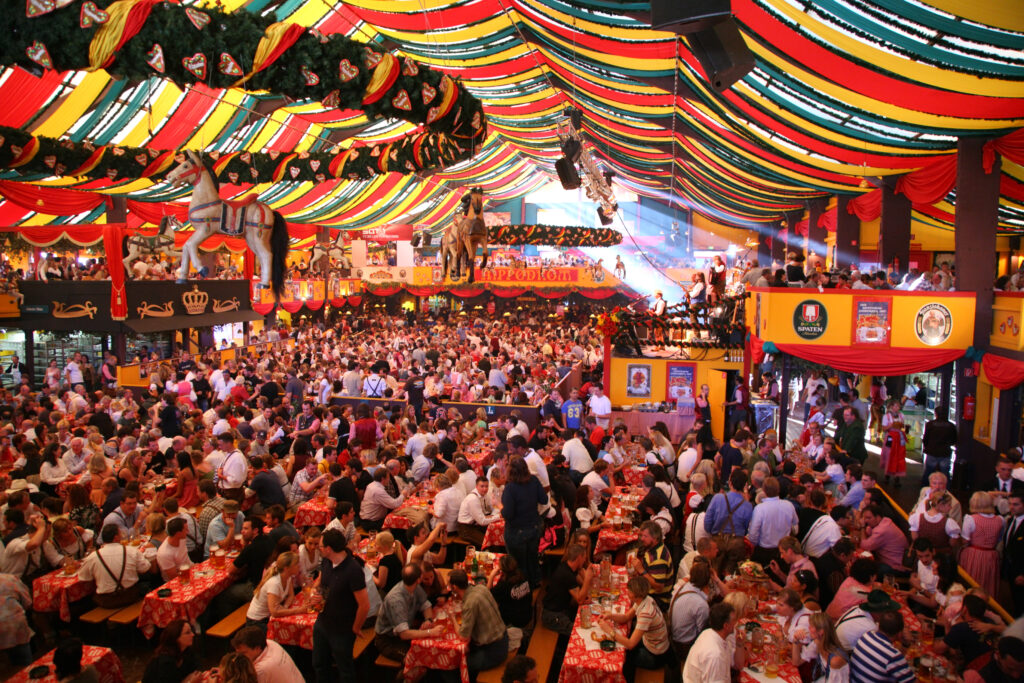
Oktoberfest 2025 group shot

By Melissa Watkins, Loan Mantra

As we prepare to roll out the barrel for Oktoberfest, the world’s most renowned beer festival taking place in Munich, Germany, we invite you to immerse yourself in this grand celebration of Bavarian culture. This annual two-week event showcases an abundance of beer steins, pretzels, lively dancing, traditional attire, beer tents, carnival rides, and fun. Although its name suggests it occurs in October, Oktoberfest kicks off in September. This year’s festival begins on September 20 and continues until October 5, 2025, marking an impressive 190 years of festivities! We will explore the various aspects of Oktoberfest, including its financial impact on the Munich economy and how these valuable lessons can be applied to your beer business.

Oktoberfest History

  The inaugural Oktoberfest took place on October 12, 1810, as part of the wedding festivities for Crown Prince Ludwig (later King Ludwig I) of Bavaria and Princess Therese von Sachsen-Hildburghausen. Residents were invited to enjoy a five-day celebration culminating in a horse race at Theresienwiese or “Therese’s green.” The event’s popularity led to the race being held annually, eventually evolving to include food stalls and beer tents, resulting in the pop-up beer halls made of plywood, complete with interior balconies and bandstands, that visitors enjoy today. These beer halls and tents accommodate over six million guests anticipated at the 2025 Oktoberfest.

  Preparations for this year’s event started June 30. Each Munich brewery constructs temporary structures with seating for around 6,000 people. The breweries also participate in parades featuring beer wagons, floats, and people dressed in folk costumes. The mayor of Munich officially opens the festival by tapping the first keg. Total beer consumption during Oktoberfest exceeds 75,800 hectoliters (approximately 2 million gallons).

Economic Impact of Munich Oktoberfest

  Oktoberfest serves as a significant driver of economic growth, generating €1.25 billion and accounting for up to 2% of the city’s Gross Domestic Product (GDP). Millions of visitors from across the globe greatly contribute to hotel occupancy rates, dining, shopping, and public transportation. Despite rising beer prices and high inflation, 6.7 million guests attended Oktoberfest last year. Each year, 12,000 to 13,000 jobs are created due to the festival, resulting in an annual wage growth of 6.6%.

  The creation of both temporary and permanent job opportunities benefits individuals and bolsters the city’s economy. The influx of workers leads to increased spending in Munich, positively affecting businesses beyond the festival. Local restaurants, transportation services, and accommodation providers all experience heightened activity, contributing to the city’s overall economic vitality.

  The Department of Labor and Economic Opportunity reported that Oktoberfest had a significant economic impact, attracting about 7.2 million visitors who spent €442 million on the festival grounds. Total spending on food, drinks, and rides reached €1.25 billion. Visitors from outside Munich spent €505 million on accommodations, boosting the hotel sector. Beer tents generated €300 million, with setup costs between €1-2 million, and organizers earned a 7.8% profit. The festival produced 7 million liters of beer, resulting in €75.7 million in tax revenues. The hotel and hospitality sectors gained €500 million, while stalls, bars, and rides contributed €140 million to the economy. Souvenir sales, including Lederhosen and Dirndls, added €160 million to individual trade.

Long-Term Economic Impact

  Beyond immediate economic benefits, the festival also generates long-term advantages. Oktoberfest fosters strong brand recognition and nostalgia for Germany, attracting year-round visitors and tourists, leading to revenue that stretches beyond the Oktoberfest season. This allure encourages infrastructure investments and foreign businesses, directly benefiting the German economy, promoting international collaborations, and enhancing the nation’s global presence.

Oktoberfest 2025 group shot

Willkommen (Welcome) to Oktoberfest in the U.S.

  Some of the most popular Oktoberfest celebrations in the U.S. include:

1. Oktoberfest Zinzinnati (Cincinnati, OH), September 18-21, 2025, largest with 800,000 2024 attendees.

2. The Denver Oktoberfest (Denver, CO), September 25-28, 2025, activities: keg bowling to stein hoisting, live music and more.

3. Oktoberfest La Crosse, (La Crosse, WI), September 25-28, 2025, longest running.

4. Big Bear Lake Oktoberfest (Big Bear Lake, CA), September 6- November 8, 2025, celebrating 55 years.

5. Helen Oktoberfest, (Helen, GA), September 25 – November 2, 2025.

6. Mt Angel Oktoberfest, (Mt. Angel, OR), September 11- September 14, 2025.

7. Wurst fest (New Braunfels, TX), November 7- November 16, 2025. Ten-day festival that raises over $20M for nonprofits.

8. Reading Liederkranz Oktoberfest, (Reading, PA), October 1 – October 5, 2025.

9. Schmidt’s Columbus Oktoberfest, (Columbus, OH), September 5-September 7, 2025

10. New Ulm Oktoberfest, (New Ulm, MN), October 3- October 11, 2025.

Bavaria in America

  Here are some of the most delightful Bavarian villages in America:

1.    Leavenworth, Washington: Leavenworth, set by the Cascade Mountains, has evolved from a logging town into a Bavarian-themed destination. Highlights include alpine architecture, beer halls, the Nutcracker Museum, the Christmastown Village of Lights, Oktoberfest, and year-round outdoor activities.

2. Frankenmuth, Michigan: Founded by German immigrants in 1845, Frankenmuth is known as “Michigan’s Little Bavaria.” The town hosts numerous annual festivals, including a Bavarian Easter, World Expo of Beer, and Christmas events. Don’t miss Bronner’s Christmas Wonderland, the world’s largest Christmas store.

3.   Helen, Georgia: Helen is a village in the Blue Ridge Mountains, located about 100 miles northeast of Atlanta, recognized for outdoor recreation options. The town has cobblestone streets and offers wine tasting, mini golf, a water park, and German cuisine. September and October bring visitors for Oktoberfest, while the Christkindlmarkt is held during the holiday season.

4. Fredericksburg, Texas:  Established by German settlers in the mid-1800s, Fredericksburg features architecture such as a replica of a 19th-century German church and has a local wine industry with over 100 wineries and vineyards. Located within reach of Austin and San Antonio for day trips, Fredericksburg holds more than 400 festivals and events annually, including a three-day Oktoberfest and a fall Food & Wine Fest.

5.   Vail, Colorado: Vail blends Swiss and German architecture with notable charm, making it one of the top ski destinations in the United States. Stroll cobblestone streets, enjoy Austrian-Bavarian cuisine and stay in cozy Bavarian-style lodges. 

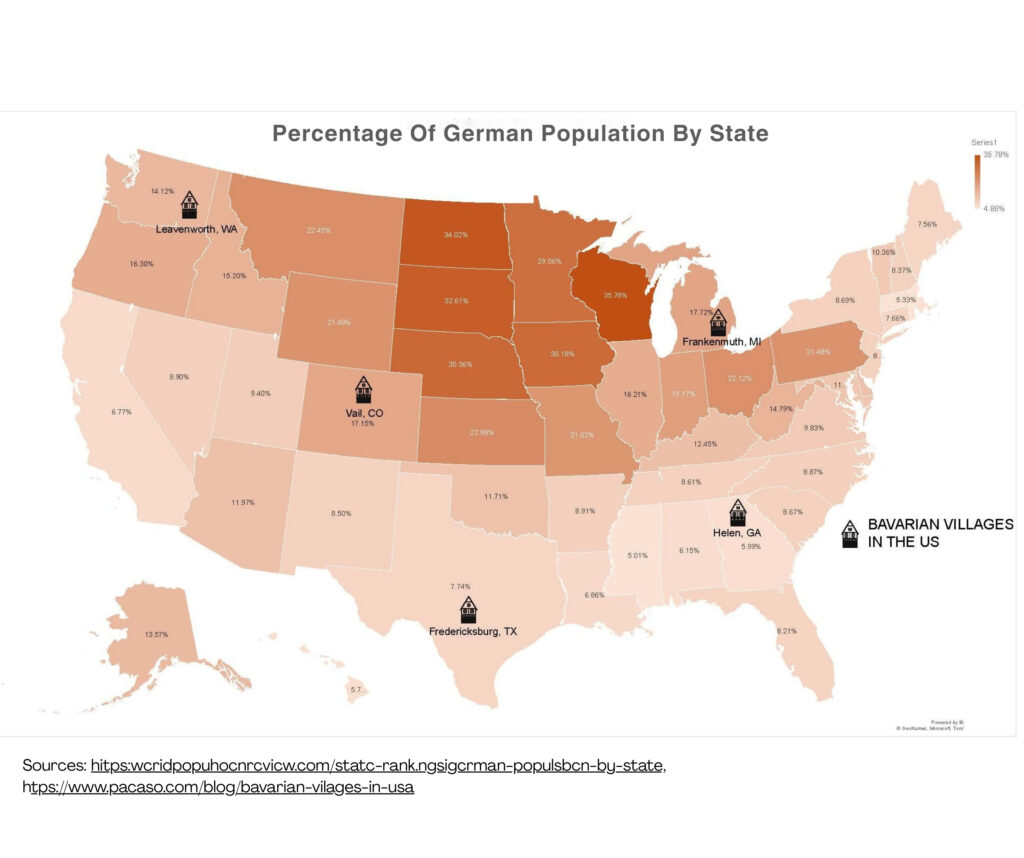
German Heritage in the United States

  It’s fascinating to examine the geographic distribution of populations identifying with German heritage.

map of united states showing percentage of german population by state

  Ready to Roll Out the Barrel? Is your beverage business prepared to leverage Oktoberfest’s popularity and success? Here are some insights and ideas to consider.

Leverage Technology

  E-commerce and social media platforms are crucial for breweries to engage consumers and boost sales. Embrace digital media to fully exploit the Oktoberfest brand and its seasonal appeal. Think about how your business can capitalize on this by:

a.  Utilizing e-commerce platforms

b.  Engaging social media

c.  Implementing innovative digital marketing strategies

  Consider creative approaches, such as partnering with a sister city near Munich or livestreaming from events. Additionally, utilize technological tools like AI and ChatGPT to explore opportunities and gather insights.

Enhance Customer Experiences

  Consumers are eager to invest in premium, high-quality, and unique beer experiences, providing craft brewers an opportunity to distinguish themselves. How can Oktoberfest be optimally utilized to create memorable experiences for patrons? Reflect on whether your craft brewery or distillery could host events such as an Oktoberfest celebration, “A Taste of Bavaria,” or even a live beer tent with Polka dancing. Additionally, consider how to enrich the taproom experience with food pairings, engaging events, and various activities that will captivate and resonate with consumers.

Share Your Story

  Brewers focusing on regional storytelling, ingredient sourcing, and eco-friendly practices are likely to connect with today’s value-driven consumers. What compelling aspects of your unique business journey stand out? Can you collaborate with similar businesses or local events to enhance and promote your craft brew brand? This approach can help narrate your local company’s story. Emphasizing regional storytelling and sustainable practices can truly resonate with consumers seeking meaningful connections.

Diversify and Test

a.   Explore brand diversification and testing to introduce new and improved beverage options. Diversify Product Portfolios: Offer a mix of traditional and non-traditional drinks to cater to a broader range of consumer preferences.

b.   Sales of non-alcoholic beverages, both within and outside of Munich’s Oktoberfest beer tents, surged by 50% compared to the previous year.

c.   This trend aligns with significant shifts in the U.S., where consumer interest in unique flavors, as well as non-alcoholic beers and beverages, is on the rise.

d.   Invest in Non-Alcoholic and Low-Alcohol Options: Dedicate resources to research and develop high-quality, flavorful non-alcoholic and low-alcohol beverages.

  Oktoberfest can be a flagship event to capture and reinvigorate beer sales. By exploring its history, aligning your beer brand with regional and local celebrations, and tapping into Oktoberfest’s brand equity, beverage businesses can capitalize on the festival and position their business for success.

  Raj Tulshan is founder and managing partner of Loan Mantra. For more information visit www.loanmantra.com or connect with Raj at https://www.linkedin.com/in/tulshan/.

Five Bucks & a Bag of Chips

crystal ball and tarot cards

By Mark Colburn

Beer, wine and spirit sales are sagging due to reduced consumption, inconsistent tariffs that threaten many aspects of our industry, wholesaler consolidation and low consumer confidence. Combining these trends means that the battle for shelf and handle space will be frenetic. The fight for the consumer’s share of stomach will be equally challenging. As a craft beer wholesaler marketing director in a major metro, I sat through hundreds of supplier business plan meetings which typically begin in October. These next year plans were filled with new products and clearly absorbed a great deal of executive supplier attention. Herein lies the chink in your competitor’s armor.

  Sitting on the opposite side of the supplier vs. distributor (I was the marketing director for one of the country’s largest craft, beer, cider, wine and spirits wholesalers) conference room table, I wondered how the fourth quarter seemed to be overlooked, or taken for granted by our large, medium and even small suppliers. Perhaps they were satisfied with the long summer’s results I mused during these marathon meetings?

  This particular large supplier was presenting in mid-September hoping to get the “attention jump” on the rest of the supplier roster. As I sat there viewing slide #68 of their PowerPoint presentation I got an idea. Keep in mind my background is in the ad agency business…

  As the one responsible for each month’s rather bulky sales plan (8-10 pages), I started looking for common denominators. It was easy. One of my brand managers even sarcastically coined his monthly supplier incentive as, “five bucks and a bag of chips.” I found that the vast majority of monthly sales incentives were alike – five dollars per Off Premise placement and slightly more for On Premise.

  The volume incentive was equally similar as was the compensation for a new tap handle placement. As a believer in the “zig vs. zag theory” I recognized a unique opportunity for a supplier that wanted to get a bit creative.

  Since it was still September I knew I had time to whip up something and get it agreed to…and funded. I also knew that Halloween had grown into a $12+ billion business. Moreover, anything to do with Halloween was fun. This seemingly obvious point is forgotten by so many businesspeople. Over my 15 years in this distributor position, I experimented with hundreds of fun incentives to assess their selling significance with a highly street smart, unionized and sizeable ON and Off Premise selling team.

  Most succeeded while a few did not. The one I’m about to share with you shattered all volume and distribution expectations and was in my top three of all time. Although this incentive may not be applicable to your situation, the point is to inject creativity and fun into your brand. Where legal, you might even fine tune my incentive into a consumer or employee event that will garner results.

The Sam Adams Haunted House

  By far the smartest executive I have ever met is Jim Koch. I first met him in Boston and later we rode together several times visiting key accounts throughout San Francisco. Mr. Koch had heard about some of my prior incentives, “Gordon Gekko’s Greed is Good,” “The Money Chamber” and “Broccolinchini” and probably thought I was thick as two short planks.

  He could not deny the results, however. After procuring the necessary budget from Boston Beer and my team, I set out to create the most fun incentive ever launched around a Halloween theme. Thus the Sam Adams Haunted House was “built.” How can this help your business? Please read on…

  In my career I’ve found that whenever “Fun” is used as a strategic denominator, the results are exponential. The Sam Adams Haunted House was created as a sales incentive “clutter buster.” The vast majority of supplier-side sales team incentives lacked even the most remote level of fun or creativity. The trend was to simply follow everyone else. The results were naturally proportional.

  To clearly differentiate the Sam Adams brand from the rest of the big, medium and small brand pack I worked with my graphic designer to create a huge haunted house graphic (see pic inset).  This graphic was brought into the Friday morning sales meeting, by yours truly, every Friday in October. If you’ve never been in a large, end-of-week, early morning sales meeting; you’re not missing much.

  These can last several hours as supplier sales reps and managers stumble their way through unrehearsed, monotonous sales presentations. Now that I’ve shared the setting, picture this: The huge sales meeting room (60+ occupants) is now dark (all lights out and curtains pulled). The huge sales team is now watching and listening, wondering what is next. Suddenly a boom box blasts sounds of howling wolves, creaking doors, chains and screaming goblins throughout the cavernous room. I enter wearing a black cloak with the scariest mask you’ve ever seen holding a flashlight under my chin. I let out a screeching howl, “Welcome to the Sam Adams Haunted House!!!” From that second on, Sam Adams owns this major metro sales team.

  To get to the Haunted House, the On and Off Premise sales teams competed weekly by making placements in their accounts. The salespeople with the most placements got a Friday morning trip to the house where they came up to the front of the room to select a scary graphic that I then flipped open (I had pre-trimmed these into little doors and marked dollar values for each that when combined kept us on budget) to reveal their winning cash prize.

  The prizes ranged from $25-$250 so there was significant interest to earn a pick every Friday in October. This kept the incentive top-of-mind throughout the salesperson’s week. To determine who picked each Friday morning I came into the office very early to run VIP reports showing individual sales rep accomplishments. After reviewing the numbers I was able to announce the weekly winners by 7am.

  Although this level of creativity (I admit it is a bit creepy but think of the audience – predominantly males aged 24-39) may not suit your personality or your brand, I must share with you that the sales volume and placement results shattered our wildest expectations.

  The incentive was so popular that I repeated it for three or four years in a row. This incentive DOMINATED all other suppliers during the month of October. Further, it created momentum and top of mind awareness within one of the largest sales teams in the country.

  This momentum carried the Sam Adams brand into the November and December holidays (supported by my “Santa Broccolinchini” incentive) where many brands concede this period opting to gear up for the New Year.

  This fourth quarter incentive tandem provided Boston Beer with sales plan DOMINANCE for 8+ weeks. Further, it put their brand on a substantial downhill roll teeing up their annual business plan meeting where the incentives and their results were the first thing that everyone spoke about in the executive meeting room.

  They really set the “fun tone” and paved the way for the coming year’s strategies and new items.  The Sam Adams Haunted House is provided to you as an example of the synergistic results achieved when creativity is mixed with a large dose of fun. I use the term, “Fun-kifize” (an old Tower of Power tune) in my podcasts and recommend such to you.

  If you don’t participate in wholesaler incentives try adjusting a version to your internal team or even at the consumer level. Perhaps a game could be played to earn trips to the haunted house to generate more consumer interest and traffic in your tap or tasting room?

  Lastly, to dot the “I’s” I learned that Jim Koch was going to pay us a visit in November. I asked his team if I could interview him for 15 minutes and videotape the session. They agreed so I taped Mr. Koch and gave him the names of the biggest achievers from the Halloween incentive. I then edited the tape and played it during one of those long, boring Friday sales meetings.

  The sales team loved hearing a luminary like Jim Koch give specific sales people “Atta boys” for their their outstanding performance. Just another example of adding legs to a creative idea to wring out even more benefit. Remember that people buy AND SELL for people and BRANDS that they like. Be THAT brand.

Happy Halloween!

About the Author

  Mark Colburn has 35 years of experience in the beverage industry working primarily with craft beer and cider brands. He is the host and creator of the pod cast, “The Shinerunner Show” http://www.thebrewingnetwork.com/shinerunner-ep18-dyno-ing-the-marketing-mix/ and author of the book, “Craft Beer Marketing & Distribution – Brace for SKUmeggedon.”

  After earning his master’s degree in marketing, Mark went into the advertising agency business then into brand management. For 15 years he was the marketing director at a large California beer, cider, wine, and spirits wholesaler where he managed a brand team, experiential events, and multiple craft brands. Currently Mark works as a consultant and is available to chat about your brand opportunities at …

shinerunner@comcast.net

https://www.linkedin.com/in/mark-colburn-8332625

Did Home Distilling Get Legalized?

home distilling equipment outside a house on a table

By Kris Bohm, Distillery Now Consulting

Every distiller got their start distilling somewhere even if it was not necessarily legal. Many American distillers did not make their first batch of spirits in compliance with the laws of the United States. If you ask most professional distillers and distillery owners where they got their start, these people are not always open to discussing this topic. The reason for the hushed tones or outright silence when discussing learning distilling is that many distillers made their first batches of distilled spirits illegally. United States laws spell out that it is illegal to distill at home. If you were to hypothetically set up a little 5 gallon still at home and distill a few bottles of moonshine you have committed a criminal activity that warrants a felony in the United States. Because many distillers got their start in this exact way, the topic of the roots for distillers is not a vocal discussion. Hobbyists and professional distillers alike both tend to agree that home distillation should be legal and better regulated, but the battle to change the laws has not been an easy one.

  It is not common knowledge among the public of the antiquated laws regarding home distilling. The TTB, which is the government organization that regulates distilling states the following. Within title 26 of the United States Code, section 5601 sets out the following criminal penalties for producing distilled spirits at home. Offenses under this section are felonies that are punishable for up to 5 years in prison, a fine of up to $10,000, or both, for each offense. Some of these offenses include owning an unregistered still and possessing distilled spirits that have not been paid tax. While it is perfectly legal for an individual to produce their own beer or wine at home without any consequences (nor any taxes due) the production of distilled spirits at home is wholly illegal. It is quite absurd at first glance to understand why some homemade alcohol is legal (beer and wine) and others (distilled spirits) are not. This difference has helped to form the argument and a legal case to change laws related to home distilling.

  There are many books on the topic of home distilling and vendors all over the United States who can and will legally sell distilling equipment and materials for distillation. It is legal to sell distilling equipment of all sizes and the responsibility of the still purchaser to register the equipment with TTB. The Federal Government does not allow home distilling and so small stills fit for a hobby size scale are inherently illegal to own as you cannot register them with the TTB. Home distilling is a perfect platform to perfect the art of science and distilling. In fact, many professional distillers made spirits illegally at home prior to growing their hobby into a commercial distillery. While there are many new craft distilleries emerging, if home distillation was made legal it would likely contribute to more commercial craft distilleries opening their doors. The boom and growth of craft breweries is partially attributed to the legalization of homebrewing which was allowed in 1978.

  In 2024 the ridiculous restrictions regarding home distilling are finally getting their day in court. A home distilling group known as the Hobby Distillers Association (HDA) which represents over 1300 home distillers, is a group based in North Texas. One member of this organization had received a letter from the TTB notifying the individual that the TTB was aware that this individual purchased a small still and the still was not registered with the TTB. The letter further went on to cover the penalties for home distillation which can include jail time and large monetary fines. The individual who received this letter not only felt threatened by the TTB but felt action was needed to protect other hobby distillers. The HDA decided it was time to take action to change the laws that prohibit their hobby and work to protect its members from criminalization. Thus, the Hobby Distillers Association filed a case with the United States Court of North Texas that in essence stated the laws regarding home distilling were unconstitutional for a slew of reasons. The HDA contested that laws prohibiting home distillation did not accomplish the intent of the law to protect tax revenue. As part of this case the goal for the Hobby Distillers was to get the court to rule in their favor so that participating in the hobby of home distilling would no longer put hobby distillers at risk of severe criminal penalties.

  District Judge Mark Pittman who sat on the case found himself ruling in favor of the distillers on a rather interesting angle regarding the law. Pittman found that while the laws regarding distilling are intended to protect federal tax revenue they do not actually accomplish their intent. Because the original intent is not accomplished the laws are an over extension of the power of Congress. While the TTB outright bans the use of distilling equipment at one’s home, there is no space within this ban to regulate taxation. Further, the limited amounts produced in home distillation as demonstrated by the HDA does in no way jeopardize the revenue collected by the government from the taxation of spirits produced by legal commercial distilleries. In the opinion written by Judge Pittman he stated Congress did nothing more than statutorily ferment a crime— without any reference to taxation, exaction, protection of revenue, or sums owed to the government. With humor the judge has in essence ruled in favor of the hobby distillers to carry on with their hobby at home without fear or risk of prosecution.

This ruling is a positive change for home distillers and hobbyists, but it is not certain just yet. There are still bigger changes that need to be made to truly legalize home and hobby distilling. The opinion as put out by the judge does not change the laws. It merely protects the individuals from a law that is unjust. Currently the federal government and TTB still can seek changes to the judge’s ruling. It is important to note that some states have specific laws regarding home distilling. If you are considering practicing home distilling or distilling without a permit, I would recommend you research laws regarding the hobby and learn safe distilling practices as well.

  Written by Kris Bohm of Distillery Now Consulting. When Bohm is not busy distilling he can be found cracking lame dad jokes and riding bikes.

  The Decision regarding this case is Hobby Distillers Association et al. v. Alcohol and Tobacco Tax and Trade Bureau et al., Case No. 4:23-cv-01221, in the U.S. District Court for the Northern District of Texas

  TTB rules on Illegal Distilling can be found here.

https://www.ttb.gov/distilled-spirits/penalties-for-illegal-distilling

Delta Dirt Distillery

Harvey and Donna Williams holding their vodka bottles

By Gerald Dlubala

It’s probably one of the most frustrating and head-scratching yet rewarding and fulfilling things I’ve been involved with,” said Thomas Williams, head distiller at Delta Dirt Distillery, about the journey of getting Delta Dirt Distillery from its days of a “what if” idea to its present-day status as an award-winning, internationally acclaimed distillery in downtown Helena Arkansas.

  Thomas’s parents, Harvey and Donna Williams, are the co-founders of Delta Dirt Distillery. They were high school sweethearts who eventually married and moved their family away due to Harvey’s corporate career as an agricultural engineer. Harvey had always wanted to come back home to the Delta region and start a business that somehow incorporated the family farm. How that would be possible and what that business would look like was still a question mark.

  Harvey and his brother had many conversations around the farm, discussing the growing of vegetables and the latest trends based on information gained from a recent vegetable grower’s conference. The theme of the conference that year was sweet potatoes and the possibilities surrounding their various uses. Some of the conversations turned to using sweet potatoes in the distillation of vodka. Harvey thought that it was a cool and unique idea, something different that not many others considered.

  “That sparked an idea, and he went down the rabbit hole of research upon research and distillery visit after distillery visit,” said Thomas. “Eventually, after a couple of years, my mom let him know that it was time to make a choice, meaning start the distillery or just let it go. So, Delta Dirt was incorporated in 2017, and we were now an official business. We started the journey of purchasing and renovating an old downtown building. Then, it was time to buy the equipment and start formulating our first product, Sweet Blend Vodka.

Four Generations of Farming

  While the Williams family have no direct experience in producing distilled spirits themselves, it does run in their bloodlines. Harvey’s grandfather, “Papa” Joe Williams, was the patriarch who sharecropped the family’s original 86 acres back in the 1800s. His son, U.D. Williams, farmed the same acreage but also made moonshine in a still tucked into the woods on the family farm. With the money he made from cotton and making moonshine, U.D. Williams was able to do something remarkable. In 1949, he purchased the family farm out of sharecropping.

  “The story goes that once he purchased the farm, he quit making moonshine and buried the equipment,” said Thomas. “I’ve heard all of the stories, but we never recovered any of his original moonshine recipes or instructions. I wish we would’ve. It would’ve made my job a little easier if I had a recipe to at least get started. The recipes I use are formulated and made from scratch based on research and a lot of trial-and-error.”

  Although no moonshine recipes were found, a lone remaining jug from U.D. Williams’ moonshining days is proudly displayed at the distillery.

Unique Spirits Lead to Immediate Awards and International Recognition

  Delta Dirt Distillery is a family-run business that grows its produce and grains in the same community and on the same clay-dirt family farm that has been in the Williams family for four generations. Harvey fills the role of CEO, while Donna is the Chief Brand Officer. Thomas is the head distiller, and Donavan handles the duties of Operations Manager. After nearly three years of trial and error, the Williams family released their Sweet Blend Vodka in 2020, distilled from a blend of sweet potatoes and corn grown on their family farm. Awards quickly followed in U.S. and international competitions, including winning double gold in 2022 and platinum honors in 2024 at the San Francisco World Spirits Competition. Sweet Blend Vodka is now considered one of the best distilled vodkas in the world.

  “Most people think that sweet potatoes will bring sweetness to the vodka,” said Thomas. “It does to some extent, but not as much as you would expect. It’s more of an earthiness with just a little hint of sweetness that mixes in all the best ways to produce a very smooth and unique tasting vodka. It’s hard to describe to someone who has never tasted it, but the combination of flavors comes through so beautifully in a spirit that makes it well balanced in something that you’ve never had before.”

•   Sweet Blend Vodka is Delta Dirt Distillery’s flagship spirit, featuring floral and fruity notes that present a complex aroma with a pleasing finish.

•   Tall Cotton Gin is crafted by hand with upfront notes of juniper and hints of floral, orange and coriander. It presents a light, airy mouthfeel upon tasting.

•   Sweet Roots Arkansas Brown is Delta Dirt Distillery’s version of bourbon whiskey. Although they can’t label it as a bourbon because the use of sweet potatoes in the mash disqualifies it from that category, Thomas says that it is produced following all the same practices and guidelines as bourbon whiskey. Sweet Roots Arkansas Brown is distilled from a blend of corn, sweet potatoes, rye, and barley. After aging, consumers will notice hints of caramel and subtle spice, along with the exceptional smoothness that Delta Dirt Distillery’s products have become known for. On the back of the label, Thomas honors the present family legacy with a picture of his parents, Harvey and Donna.

•   Deep Roots Arkansas Brown is a small batch release honoring the family’s past. It is dedicated to “Papa” Joe Williams, the patriarch of the Williams family. Consumers will notice his portrait, authentic signature, and description as “first generation landowner” on the back of every bottle label, ensuring his legacy lives on. Deep Roots Arkansas Brown is distilled, bottled, and released in limited quantities and generally sells out within hours. It ages longer and has a higher proof than the Sweet Roots Arkansas Brown and embodies the Williams family’s profound connection to the land they’ve cultivated for four generations and counting.

Educating Consumers and Supporting Local Community

  “I want our spirits to be an eye-opening experience and opportunity for our consumers,” said Williams, “From a new and distinctively good tasting product to the transparency of where the ingredients came from to make what’s in their glass, down to the actual field where the sweet potatoes were harvested. People always want to know where their food comes from, but that same desire to know isn’t yet present in spirits. We offer that to the consumer, showing them exactly where that alcohol comes from. Additionally, I want them to know how good the spirits in their glass can and should be. You should drink something because it’s really good and you really like it. Then you can fully enjoy it. I want people to drink and enjoy our spirits, thinking to themselves that what they’re having is truly exceptional. They’ll know exactly where it came from, how it’s uniquely different, and that, at the same time, they are supporting a lot of people here in Helena, Arkansas. This area needs some love, so part of our mission is to give back to the community that we’re rooted in, both physically and metaphorically. There aren’t many distilleries around here, so we know we’ll be some people’s first interaction and experience with this sort of spirit, so we try to educate. I love being the educational piece. I love educating visitors about our products and our region. I love answering questions because when someone has questions, that shows interest.”

  At the same time, Thomas says that they are in a somewhat depressed area, so it’s essential to support our local neighbors and give back to the community.

  “We are rooted here both metaphorically and physically,” said Thomas. “We have an opportunity to touch on a lot of different things with what we are doing.”

Named Attraction of The Year and Drawing Tourists from Across the World

  “We were only two years old when we were named Arkansas Tourism’s attraction of the year in 2023,” said Thomas. “That’s a testament to what we’ve created. We continue to build recognition as something unique to our area, but we also attract tourists from around the world. Usually, tourism in Arkansas means the Northwest region, which is the hub of entertainment and nightlife, but tourists are now heading here, to the opposite side of the state, just to visit us.”

  “The distillery features couches and a large three-sided bar, locally made by a craftsman behind our distillery,” said Thomas. “Visitors can see our entire production floor and process through a glass wall that highlights our showpiece, the copper pot still. We’ve doubled production every year since opening. We’ve expanded storage, improved our equipment, and actually have more new machinery on the way. The rich, clay-dirt farm is still in full operation. There are some squash and vegetables still planted, but sweet potatoes occupy most of the acreage space, all going toward the distillery.”

Working With Family Is Rewarding

“Being able to be successful while working with family is always special,” said Williams. “The headaches, at the end of the day, are worth it if you’re doing this with a purpose. If you’re trying to get into it solely to make money, you’re likely to be unsatisfied. Try to remain open to any unique possibilities that come your way, which may not be part of your original life plan, and turn those into something special. In my case, it’s touching that we can come together and do all this tough and time-consuming work together as a family. Every day is an adventure, and I’m really enjoying it.”

  For more information or to visit and tour Delta Dirt Distillery…

Delta Dirt Distillery

430 Cherry Street

Helena, Arkansas 72342

870-662-5709

customerservice@deltadirtdistillery.com

Craft Beverage Brands Demand Flexible Equipment

cans in a canning machine

By: Rebecca Marquez, Director of Custom Research at PMMI

Handling a wide variety of sizes, shapes, and materials at faster speeds requires flexible, automated equipment that provides quick changeovers.

  More than 16,000 craft beverage brands are now competing for attention, space, and sales at U.S. retail outlets, according to 2024 Craft Beer and Spirits: Success Through Packaging, a report from PMMI, The Association for Packaging and Processing Technologies. In addition to the large number of brands available, craft beverage producers have been feeling the pinch of rising input costs — from raw ingredients to packaging materials — and higher distribution costs.

  To support brand and business growth, many craft producers are actively investing in new machinery. Some also have an aggressive growth plan.

  One beer and spirits contract packager cited in the report is trying to determine if its current packaging equipment is strong enough to support an expected doubling in volume in the next year and, with a growing customer base, the possibility of five-fold growth in the next three to five years.

  From a machine standpoint, craft beverage brands are almost unanimous in their opinion that their equipment needs to be adaptable, according to the 2024 report. While complete adaptability, such as filling bottles on a canning line, is functionally impossible, OEMs should carefully consider how versatile they can make their machine offerings. For instance, a canning line capable of filling 16- and 12-oz. cans provides some versatility. Still, one capable of switching to 19.2-oz. sizes and running tall, sleek cans would be more desirable for craft producers.

Machinery Flexibility Reigns Supreme

  Craft producers need the ability to handle a wide variety of sizes, shapes, and materials at faster speeds, and they need more automated equipment features for changeovers, loading, and feeding.

  Multipack formats—including multipacks that contain a variety of products—have remained a popular stock-keeping unit (SKU) option over the past decade. While consumers consistently report liking these formats, they frequently create operational headaches for craft producers because they necessitate alterations in their overall operations.

  Special packaging formats also can create significant production challenges. In addition to label and format variations, specialty product releases are typically limited runs. To help craft producers reduce downtime when switching from standard to specialty product runs, OEMs and suppliers are working to expand features, such as automated label changeovers and automated feeding.

  The logistics of handling mix packs is challenging for small breweries because it is typically performed with manual labor. Consequently, many craft beer producers seek affordable, automated solutions to help them compete with larger breweries.

  For example, some smaller craft brewers need user-friendly push-button equipment and end-to-end solutions to minimize fluid waste. They also require predictive and preventive maintenance software, modular machinery, easier-to-program programmable logic controllers, and simplified, intuitive human-machine interfaces.

  Craft producers also want advanced technology features, such as AI machine learning and improved machine sustainability functionality that uses less energy and reduces material waste.

  Machines as a service, or MaaS, may have a future role to play in the craft beer and spirits industry when it comes to accommodating tight budgets and limited floor space, but very few operations are currently deploying this strategy, according to the 2024 PMMI report.

Beverage Processors Look to the Future

  Technical integration will positively impact beverage packaging and processing operations in the coming years, according to 2025 Beverage Industry Packaging Trends, another report from PMMI. However, inflation, supply chain disruptions, regulatory compliance, and talent acquisition/retention challenges are expected to continue negatively impacting this industry.

  The 2025 report states that company expansions, consumer product demands, and technology advances are the top three reasons beverage companies purchase new machinery. In addition, nearly 90% of the 2025 report’s surveyed companies plan to purchase some type of beverage packaging machinery in the next three years.

  For instance, 58% of the respondents anticipate their investment in beverage packaging machinery will increase by 10% over the next three years. This includes 26% who expect an increase of more than 20%. Some plan to invest in entire production lines to keep up with demand and/or accommodate new product SKUs they’re developing. Others are focused on improving equipment efficiency to reduce bottlenecks and minimize downtime.

  But beverage companies sometimes need more guidance from their suppliers to make the right decisions and keep machinery running. In-person and remote support are important since beverage processors want true partnerships with OEMs that are reliable and consistent for as long as the machine is functioning. In addition, these processors want more support, education, and perspective into what the future holds for new equipment.

  Processors are justified in turning to OEMs for this type of assistance. To meet evolving packaging demands, end users need to optimize machinery use by leveraging digital insights and diagnostics for faster, more efficient production and the reduction of downtime, which directly impacts revenue, making technology-driven troubleshooting a top priority.

  The degree of a machine’s user-friendliness is also a critical factor. In fact, one 2025 survey respondent believes machinery suppliers should automatically assume that somebody without much experience will be running the equipment every day. “The equipment needs to be smarter and more intuitive to the operator and contain built-in tutorials,” he states.

  When it comes to avoiding recalls, sanitation is a major priority in beverage processing. Therefore, processors need machines and parts that are more easily cleaned. Standardized machinery and sanitation templates that work for one facility and can be transferred to others also make sanitation easier, especially for processors with multiple sites.

  Over the next two to three years, expanding consumer demand will drive the need for more diverse beverage products and packaging sizes, leading to an overall increase in all packaged beverage formats. As a result, beverage manufacturers and their co-packers must improve and replace infrastructure now to ensure they remain flexible, efficient, and competitive in an evolving market.

  To learn more about technologies that boost beverage production, attend PACK EXPO Las Vegas, Sept. 29 to Oct. 1, 2025 at the Las Vegas Convention Center. With 2,300 exhibitors and thousands of cutting-edge solutions, attendees can engage in conversations about emerging trends, challenges, and innovations that are shaping the future of the industry.

  At the event, beverage processors can experience hands-on demonstrations of the latest packaging and processing solutions on topics like automation, sustainability, workforce development, and manufacturing efficiency. In addition, more than 100 educational sessions will take place on seven stages/content centers on the show floor, including Sustainability Central, Industry Speaks Stage, Innovation Stages, Processing Innovation Stage, and the Reusable Packaging Learning Center.

  Visit packexpolasvegas.com to learn more and register now to connect with industry leaders, discover state-of-the-art innovations, and gain a competitive edge.

Beyond the Container

Understanding Packaging and Its Subproducts for Modern Breweries

Earthrings showing 3 six pack carrying containers for beer cans

Photo Credit: Earthrings

By: Alyssa L. Ochs

In the modern brewery, packaging is more than just a finishing touch or an afterthought at the final stage of production. Rather, it is a vital part of a brewery’s brand strategy, a way to improve operational efficiency and a mechanism for achieving sustainability goals.

  Innovative packaging technologies help breweries grow and adapt to changing consumer demands. Settling for what used to work in the past to package beer is no longer an option for forward-thinking producers. From wrap-around case packing to shrink sleeve application, side loaders and compact palletizing,  new packaging solutions are redefining what it means to be ready for production and attract a strong consumer base.

  This article explores various aspects of brewery packaging and its subproducts, driven by real-world insights and companies that are setting new standards for aesthetics, efficiency, and sustainability.

Primary Packaging Basics: Core Components for a Strong Foundation

  Simply put, the foundation of all brewery packaging operations is the containers holding the beer. Whether you pour your beer into cans, bottles, or kegs, this is the cornerstone of your primary packaging and the basis for which all subproducts must complement.

  Cans now dominate the craft beer industry because of their logistical advantages, recyclability, and durability. For cans, many breweries have begun to embrace shrink-sleeve application technology with full-wrap, high-impact branding.

  Producers like Mother Earth Brewing (Vista, California and Nampa, Idaho) have used automated cartoners to streamline the process of erecting and packing cases and trays. Modern cartoners allow easy changeovers between 12-ounce and 16-ounce cans and help breweries keep up with growing demands.

  Meanwhile, a sizable number of breweries still favor glass bottles for specialty beers or to celebrate nostalgia and beer-drinking traditions. Packaging bottles requires careful consideration for handling and shipping weight.

  Stainless-steel kegs remain efficient vessels for on-premise distribution, events, and international export. However, PET plastic, one-way kegs are trending as a sustainable and cost-effective alternative to stainless steel because of their lightweight, compact, high-oxygen barrier advantages.

  Closures, whether in the form of cap ends, swing tops, crown caps or keg fittings, are also primary packaging products critical to maintaining freshness and the necessary pressure.

Packaging Subproducts: Behind-the-Scenes, Yet Crucial

  However, there is enormous potential in the best uses of secondary and tertiary packaging materials, also known as subproducts. These materials play essential roles in protecting and presenting beer, as well as in distribution coordination and sustainability.

  For example, combined cardboard and film packaging are hybrid materials that offer excellent visibility and strength to a packaging strategy. Shrink-wrapping helps bundle beer multipacks and pallets. There are breweries that are moving towards biodegradable films and reduced-gauge materials to improve the eco-friendly qualities of their shrink wrapping.

  Wrap-around case packing systems are high-speed systems that can limit downtime and reduce the strain on machinery. Wrap-around cases that operate in continuous motion provide a precise and fast way to create and seal boxes around beer products, thereby improving line efficiency and speeding up the packaging process.

  For example, Summit Brewery Company (St. Paul, Minnesota) has achieved virtually no downtime and no needed repairs using an InvisiPac® Tank-Free™ Hot Melt System. Graco worked with the brewery to boost production efficiency by reducing hot melt adhesive waste and stabilizing the rate of glue consumption.

  Shrink sleeve applications are popular because of their 360-degree branding opportunities. They are ideal for cans and specialty bottles, conforming to unique contours better than pressure-sensitive labels. Breweries love this trend because of the vibrant, high-impact branding that does not require pre-printed containers. Shrink sleeves enhance brewers’ branding flexibility and are ideal for seasonal brews and limited releases.

  Other essential packaging subproducts include tray packs, dividers, and side loaders. Corrugated trays and side loaders help maintain line efficiency and prevent damaged products. This is especially critical when packaging beer in glass or mixed-format packs.

  Cardboard carriers and dividers protect units and enhance their visual presentation for consumers. By combining cardboard and film packaging, a brewery can use less material than it would with traditional cartons while ensuring visibility and protection.

  Other aspects of packaging are the inks and adhesives used on beer labels. At a minimum, these materials must stay affixed to the product and be readable. However, you can use water-based inks and adhesives that are low in volatile organic compounds to tap into eco-minded consumer preferences and support your brewery’s sustainability initiatives.

Evolving Automation: Equipment Innovations for All Sizes of Breweries

  In the past, automation was only considered relevant for large, well-established breweries with extensive packaging needs. However, even smaller breweries are embracing automation because of the compact packaging systems now available.

  For instance, breweries can find compact palletizing solutions that are designed for small spaces. You don’t need a warehouse-sized space to automate your brewery with a compact palletizer.

  Breweries of all sizes can also automate their packaging with side loaders and tray packers. These investments help brewery packaging lines move at high speed and overcome labor concerns. Side loaders efficiently place cans and bottles into cartons and are often used alongside wrap-around case packers to reduce manual labor.

  Advanced machinery solutions like wrap-around case packing can streamline operations with minimal stop time. The result is faster throughput and reduced wear and tear on machinery components. Shrink sleeve applicators can accommodate various container sizes and shapes, even allowing for late-stage customization if design ideas change over time.

Brewery Packaging with Sustainability in Mind

  Eco-friendly brewing is no longer a niche — it is a requirement for modern beer producers. Breweries must weigh the pros and cons of the materials they use for beer packaging considering where they came from, how much they strained natural resources to produce and their recyclability.

  Fortunately, breweries can boost their sustainability and lower their carbon footprints in many ways. Lightweight materials, such as thinner bottles and cans, can help reduce vehicular emissions from trucks used to transport products. If you package and label your products onsite rather than outsourcing this work, you can maintain greater supply chain control and produce beer sustainably.

  Meanwhile, using recyclable and compostable beer carriers is a fantastic way to reduce landfill waste and release fewer planet-overheating gases into our environment. Film-cardboard hybrids help breweries reduce plastic waste while still being visually appealing and durable. Eco-friendly carriers perform well and can now often be recycled or degrade naturally once discarded. 

  To prioritize sustainability, breweries can also work with their packaging suppliers to develop eco-friendly formats tailored to their unique needs. Customization is now commonplace in this industry, as breweries do everything they can to stand out from the competition in a crowded marketplace.

  There are also reusable and refillable bottle and keg return programs that breweries can investigate. These types of programs are expanding throughout North America and Europe, making them legitimate options for many modern breweries. Exploring all available sustainability options can help brewers align their business with their environmental values and comply with changing legislation.

  Multiple innovative companies are now working in the sustainability space to give breweries more options.

  UniKeg offers PET plastic kegs as a lightweight, cost-effective solution to traditional steel kegs. Earthrings is a company that offers 100% recyclable and compostable beverage rings constructed from sustainable cardboard.

  Another company, WestRock, offers paper-based brewery packaging solutions, such as cartons and multipacks, to help brewers reduce their plastic use. DS Smith collaborated with Martins Brewery to develop a custom, sustainable six-pack handle packaging product for glass bottles.

  These are just a few examples of companies that have identified a need in this space among breweries and risen to the challenge to help promote sustainable beer production.

Final Thoughts and the Future of Beer Packaging

  Although brewery packaging subproducts might seem like minor factors in the overall production and sale of products, they collectively have a significant impact. Subproducts can either make or break a brewery in terms of shipping efficiency, regulatory compliance, labor demands and carbon footprint.

  Looking ahead, the craft beer industry has a lot to look forward to with regard to smart and sustainable packaging. Technology companies have made QR codes and smart labels accessible and enticing as a way to market content directly to consumers.

  There has been a trend towards even small nano- and microbreweries investing in compact and mobile canning solutions to reduce their reliance on third-party companies. With sustainability now top-of-mind for breweries worldwide, eco-design integration is increasingly important. Now, breweries must not only think about how their products are packaged but also where they will end up after they are used — ideally recycled, reused, or composted.

Are Your Beverages Ready for a Recession?

calculator says recession on top of a $100 dollar bill with ben franklin looking worried

By: Raj Tulshan, founder of Loanmantra.com

Is the U.S. Headed for a Recession? And if so, is your beverage business recession proof? In the United States, only the panel of experts at the National Bureau of Economic Research (NBER) is able to classify economic conditions as an actual “recession.” At its most basic level, a recession is marked by two, consecutive quarters of economic contraction or negative real Global Domestic Product, (GDP). Understandably, more is at play in making this kind of analysis and most economists believe there are four major recession indicators.

  Understanding that NBER must classify a recession, economists and financial analysts are closely monitoring several key indicators that suggest economic slowdown in 2025:

Declining Consumer Spending: The University of Michigan’s Survey of Consumers’ Index of Consumer Sentiment showed a 10.5% decline in consumer confidence in April. U.S. households are beginning to cut back on discretionary purchases creating ripple effects across industries from retail to hospitality.

Tighter Credit Markets: The Federal Reserve’s efforts to control inflation have led to higher interest rates, making it more expensive for businesses to borrow. Many lenders have also become more cautious, tightening their lending boxes and limiting access to capital. Small Business Administration (SBA) changes have caused industry shifts for government-guaranteed lending and associated products.

Business Slowdowns: Hiring has slowed, and some companies are scaling back operations as demand softens. Government layoffs have impacted the private sector. These trends may continue to lead to more job losses.

Trade and Tariffs: With major tariffs, most business owners are wary of what that means for their bottom line. They suspect that tariffs will increase production costs, challenge the supply chain and disrupt small business operations.

10 Tips to Recession Proof Your Business

  If a recession takes hold, beverage businesses—especially those reliant on consumer spending—will likely face many challenges. Loan Mantra offers approaches to offset these challenges:

CHALLENGE- Staying Sober: Being in a constant state of uncertainty and entertaining a daily stream of negative news can have a devastating mental impact on the general population.

APPROACH- Drowning in questions and doubt will not help the business become more recession proof. As a business owner, employees, customers and the public will be watching your example for signs of a crisis. Focus on what the business does best. Instead of becoming overwhelmed, break down tasks into day-to-day actionable steps. Offer an open-door policy and be transparent with loyal employees. Offer a group approach and/or collaboration with all aspects of the business to come up with solutions on how to meet goals.

CHALLENGE- Less Served: With customers spending less, businesses may struggle to maintain sales levels.

APPROACH- Review tangential product flow and reduce expenses that may not be necessary. For instance, if you’re a restaurant, for food deliveries instead of including plastic utensils with to-go orders, include items upon request, exclude napkins or excessive packaging with Beverage delivery. Over a year these small adjustments can add up to substantial savings. Common expenses can also be distributed over several locations. For instance, cross train bar and waitstaff and schedule among different sections and work sites.

CHALLENGE- Hyped up Hops: Inflation-driven price increases on goods, materials and wages could squeeze already thin profit margins. Tariffs also threaten to make costs higher on imported goods.

APPROACH- Reduce time spent on tasks that don’t directly impact sales and produce revenue. Efficient inventory management ensures you’re not tying up capital when you need it most for tasks like cleanup, makeready and taking inventory. For example, many retailers take an inordinate amount of time on inventory. Could this utility time spent for employees to count and restock be more efficient? Consider tightening inventory management by prolonging buying until it’s necessary using the just in time method.

  Scale down product choices to the most popular brews or brands that offer higher margins. Companies like Bonobos are already ahead of this curve. This retailer offers concierge service that makes up for lack of on-site inventory. With an increased focus on customer service, customers can try on pieces at the store location which are then ordered and delivered to customers homes. Can this model be replicated by offering sample tastings with pre-pay for larger orders that can be delivered on demand?

CHALLENGE- Beer Money Fund: With banks tightening their lending standards, securing loans or lines of credit may become more challenging.

APPROACH- Having appropriate cash/capital reserves on hand is a vital step to recession proof a business. Loan Mantra recommends that businesses should have at least one month of operating expenses or ten percent of revenue on hand during a normal economy. In times of recession, businesses should hold 3-6 months of operating expenses. The time to shore up emergency reserves, apply for a line of credit or loans is before you need it.

  Don’t wait to get commitments from a lending institution. Prequalifying for loans before you need them can give you peace of mind knowing funds are readily accessible if necessary and help recession proof the business. Also remember that chaos creates the opportunity to buy assets when prices fall that will later appreciate.

CHALLENGE- Half on Tap: Trying to meet revenue projections made last year may be impossible impacting the ability to meet payroll, make payments or even stay in business.

APPROACH- Review original financial forecasts and re-assess plans based on the new economic reality. Scale back and ramp up essentials, finding new benchmarks and project out accordingly. Watch market trends like consumer sentiment. Invent new ways to make money and diversify revenue. Chaos brings opportunity. Discover what opportunities and optimize based on those findings.

CHALLENGE- Loan or Groan: The financial crisis in 2008 exposed the vulnerability of both consumer and commercial markets to predatory lenders. Institutions with questionable lending practices offered exploitive interest rates on loans where borrowers were caught in a cycle of paying interest on compounded interest that resulted in bankruptcies.

APPROACH- Be wary of inflated interest rates on loans. Right now, it is easier than ever to access a diverse group of lenders to get funding that offers the best rates and alternatives for businesses. For example, any business can seek expertise to find the lowest rate and financing through technology offered at companies like loanmantra.com, an online portal that provides streamlined access to all funding sources and expertise to determine the best loan products and providers.

CHALLENGE- Traffic Circle: Consumers facing job loss or decreased purchasing power may spend less and have limited disposable income.

APPROACH- Focus on retaining customers. This could be prioritizing exceptional customer service, capitalizing on loyalty programs and through marketing personalization to maintain and strengthen your customer base. Look at ways to make it easier for customer to spend money with your business like offering incremental payments instead of requiring the total up front. Acquire customers for life is more important that an individual transaction.

CHALLENGE- Bottle Battles: Increasing tariffs may limit access and availability of product components, bulk materials and supplies.

APPROACH- Evaluate cost increases, remain flexible and anticipate delays. Suppliers based in Asia may be the most hurt. Try to absorb some of the increased cost of good. Identify the least amount needed to push to the end consumer. Identify potential vulnerabilities and secure reliable suppliers to mitigate cost fluctuations. Find additional supply sources that are US-based if possible. Open lines of communication with current suppliers to negotiate better terms or prices and cost-cutting measures. Building strong relationships with suppliers can result in favorable deals that help reduce costs during lean times.

CHALLENGE- Distilled Down Sills: Previously approved expenditures including additional resources and equipment may be frozen.

APPROACH- Analyze operating systems to eliminate waste. Has the business drifted toward more expensive habits? Optimize operations by looking for ways to streamline tasks and improve efficiency. Aim to automate repetitive tasks through technology to save time and reduce long-term costs. Evaluate additional lines of business for profitability and sustainability. Look for additional ways to diversify and add revenue.

CHALLENGE- Measure or Pour: A lack of inventory can inhibit production.

APPROACH- Consider mass purchasing of supplies that may not be available in the future or before prices increase. Evaluate existing product lines and services to determine if substitutions can be made. Look at potential options as alternatives that may not be ideal long-term but will still satisfy customers. For example, if you are unable key ingredients, what can you make? For instance, if Champagne is not accessible can you offer high quality Sparkling wine as a choice?

Looking Ahead

  While the future remains uncertain, beverage businesses can become more recession proof against economic downturns by planning. Keeping an eye on market trends, managing finances strategically, planning for disruptions and maintaining strong customer relationships will be key to weathering potential challenges. For more information contact Raj at loanmantra.com.

Designing Beers for a Cocktail World

4 glasses filled with cocktails of 4 different colors in each glass

By: Erik Lars Myers

The beverage market has been evolving. No longer are we in a world of beer drinkers, wine drinkers, and cocktail drinkers. Today’s savvy beverage consumer drinks all three. This provides a unique opportunity for breweries; beer has such a wide palette of potential flavors that it is possible to create a beer to mimic a cocktail to attract a wider audience of potential drinkers.

  However, doing so takes more consideration than throwing a few specialty ingredients in the kettle. It is an exercise in thinking outside of the box. As an example of how this might be approached, consider a beer designed around the classic bourbon cocktail: The Old Fashioned.

Breaking Down Flavors

  What makes an Old Fashioned taste like an Old Fashioned? Hint: It’s not just the bourbon. Like any other drink, what makes a cocktail taste good is the full complex array of ingredients. In this case, bourbon, orange, cherry, simple syrup, and bitters. To break that down even further, the prominent flavors in bourbon – derived from alcohol, esters that survive distillation, and wood contact – are a blend of complex fruitiness and vanillins that include descriptors like vanilla, cinnamon, coconut, burnt sugar, and cocoa, among others.

  It is impossible to perfectly replicate all of this in a carbonated, fermented (not distilled) beverage, but the idea isn’t to perfectly replicate it so much as it is to bring the drinker as close as possible given the medium.

  When designing a beer like this one of the easiest traps to fall into is to start with a style, but it’s a disingenuous starting point. Any beer that is true to a particular style will, by definition, not taste like an Old Fashioned. Instead, disregard the notion of “style” and build the beer around the cocktail’s flavor profile. If, at the end of the day, there is a need to apply a “style” to it for marketing purposes, simply reverse engineer from the ingredient selection. The Trade and Tax Bureau only requires that it be designated “Ale” or “Lager.”

Malt Selection and Mash

  Many of the flavors and colors present in bourbon are present in malt.  It’s easy to choose a base malt – a simple 2-Row Pale – that is merely a source of fermentables, but it’s worth using something with more robust and complex malt character. Consider a floor malted Maris Otter, Mild Malt, Vienna, or Munich malt, or even a combination thereof, to select for a toasty, complex sugar base. One of the important ingredient additions to an Old Fashioned – simple syrup – is one that you can begin to manage through malt selection and mash management.

  Bourbon picks up its color through wood contact, but here caramelized and roasted grain are the source. Additions of higher SRM caramel malts can add residual sugar and just the right amount of color. Be wary of roasted malt additions. While small amounts of roasted malt might impart excellent color and some of the cocoa or smoky complexity of barrel-aging, too much of a burnt/roast characteristic would be wholly out of place. In addition, many roasted malts tend toward a red or ruby hue rather than the warm orange/brown of bourbon.

  Slightly higher mash temperatures, 154F – 156F, might be tempting for malt complexity but remember that while alpha amylase promotes dextrin formation, the long complex sugar chains that add great body to a beer don’t necessarily taste sweet.

Hop Selection

  While hops don’t feel like a good fit for a beer like this, hops are an important addition to every beer. In this case, not only can they create a balanced base beer, they can also be used to add flavor complexity to the final “cocktail.” Consider that an Old Fashioned is made with a dash or two of bitters, and so a low residual bitterness is not misplaced. An initial boil kettle IBU addition of 10 – 20 IBUs seems like a good starting point, but leaving hops out of the boil otherwise might be a good idea.

  Next comes hop character. There are many classic hops with orange and other citrus flavors: Centenniel, Cascade, Citra, Amarillo. However, some of the new hop strains that are marketed for Hazy IPAs might be well incorporated here. A small (0.25 – 0.5 lbs/bbl) whirlpool addition of Julius, Hydra, or Caliente hops can add complex characteristics of tangerine or clementine that would pair beautifully with citrus fruit additions.

Water Chemistry

  A low Sulfate to Chloride ratio (0.8 – 1.0) seems like a good starting point in designing water chemistry for a cocktail-inspired beer, accentuating and promoting malt characteristics. But bear in mind those dashes of bitters that go into a good Old Fashioned. In this case, a slightly higher Sulfate addition could be more appropriate: enough chloride to keep malt prominent, but not so much as to dampen the bittering effects of small hop additions.

Yeast Selection

  There are three ways you can approach yeast on a beer like this. One is to choose as neutral a yeast as possible – an American Ale yeast, for instance – and let the rest of the recipe do the lifting.

  Another is to choose a specific yeast with fermentation characteristics that match the flavor profile that you’re trying to create. English ale yeasts with strong ester formation, and perhaps high alcohol tolerance, can be of great use especially as many of them also keep a fair amount of residual sugar around – an important consideration in the “simple syrup” portion of this recipe.

  Finally, a third, less predictable (and reproduceable) route, would be to blend yeasts for fermentation. Using a combination of a cleaner English or American ale yeast with a small portion of Belgian Abbey or even Hefeweissen yeast could potentially add a complex ester palate with subtle, fermentation-based cherry (Abbey ale) or banana (Hefeweissen) notes, as long as the strains are all STA-1 negative.

  Perhaps more reliably, a brewer could split the wort, ferment each portion with different strains and then blend back together for a final product. Of course, this comes with the added complexity of requiring more fermentation space and more lab work to guarantee a stable and reproduceable final product, so it should be entered into with care and deliberation.

Spices, Fruits, Other Additions

  Perhaps the easiest step in designing a beer around a cocktail is approaching the ingredients that are added into the cocktail itself. An Old Fashioned orange and maraschino cherry garnish is perhaps the most obvious and easy part to replicate by adding bitter orange during the boil, or Luxardo or maraschino cherry juice into your fermentation. The difficult part is doing so with balance in mind – this isn’t, after all, an orange beer or a cherry beer, but a beer built around another, balanced beverage. Restraint is called for.

  What might be easier to overlook are additions that can add to the spirit characteristics of your finished beer. Again, bourbon characteristics are complex. Spice additions at the end of your boil, or during fermentation, are opportunities to add in flavors to increase that complexity: vanilla, coconut, cinnamon, black or white pepper, cloves, allspice, or any wide variety of other flavors, in very small quantities, can lend an enormous amount of complexity to the finished body and profile of your cocktail-designed-beer.

Barrel Aging or Spirit Flavors

  Of course, the easiest path to creating a spirit-flavored beer is by aging the beer itself in a barrel that once housed that spirit. However, when doing so, consider that time and oxidation will dull the subtle nuances of the original beer. If barrel-aging is in the future for the recipe, consider relying less on hop or fruit additions, or make judicious flavor additions after it’s been taken out of aging. Be wary of over-aging where wood characteristics might overshadow the original beer.

Finished Beer Considerations

  Carbonation level will make an enormous difference in how this beer is perceived. While a beer designed around a French 75 might be light and spritzy with high carbonation levels, this beer might benefit from carbonation on the lower end of the scale, in the 2.1 – 2.3 volume range.

  A brewery with the right capabilities might even consider cask engine or serving via nitro for a smoother experience..

Serving the Final Product

  In the tasting room or brewpub, don’t miss the opportunity to treat this beer as the special product that it is. Sloshing it straight down into a shaker pint glass is fine, and certainly will move money over the bar, but part of the experience of a good cocktail is presentation and the opportunity also exists here. Maybe this beer is served in a goblet with a twist of orange on the rim. Maybe a high-ABV, barrel-aged version of this beer is served in a rocks glass with a Luxardo cherry garnish.

  No matter what, presenting the customer with a unique experience will help them appreciate the craft and care that went into designing the recipe and help them make the connection to the original beverage.

  A beer designed around a cocktail will never be that cocktail, but it does give both the producer and drinker the opportunity to appreciate and explore the wide array of possibilities available to a well-practiced and thoughtful brewer in the nuanced palette of craft beer.

About the Author

  Erik Lars Myers is an award-winning professional brewer and lover of beer. He has written two travel guides about beer and written and edited multiple books about homebrewing.

Grassroots Marketing in the Summer

people raising their arms to the beautiful sunset on a beach in the summer

By: Hanifa Sekandi

Summer is here! A time of the year that beverage brands should take full advantage of. The weather is hot, people are outdoors, and the overall mood is vibrant. The truth is, it is hard to predict how your beverage will perform during the warmer months. But if you have your skin in the game and decide to play beverage marketing ball, the summer is fair game. Those who put forth their best effort will reap the benefits. A marketing method often underutilized in today’s marketing landscape is grassroots marketing. It is an old-school approach to market your brand, but it is still quite effective.

  This style of marketing allows brands to connect with their audience truly. Be in the thick of it, see what people are talking about. Remember the door-to-door salesman? Probably more so from watching movies that depict a man going door to door selling appliances. This form of direct marketing and sales was quite effective. Believe it or not, it still is. Understandably, you cannot sell your beverage door to door, but you can share promotional offers via mail. It is a great way to showcase summer promotions and discounts at local stores that sell your beverages.

  Another opportunity is planning in-store events. Get your audience excited about your in-store event by advertising free items they will receive during this event or when they purchase your product. This allows you to meet them face to face and get some feedback on your beverage or some great ideas, like cocktail recipes that people like to make using your beverage.

Skip the Details

  Yes, the details matter when it comes to savvy marketing. Your marketing team needs to create campaigns that appeal to your audience. The details that you should not get lost in are the research. Research is essential, but it is not the end-all be-all. Many agencies will tell you to spend a lot of time on research. Many months go by, and some companies are still researching without moving the needle. Research fatigue is costly and will not guarantee optimal results. Instead, streamline and simplify your research approach. The benefit of grassroots marketing is that it requires brands to be bold. Knowing who you want to reach and simply going after it. A phenomenon that many see when looking at the success of a marketing strategy going haphazardly viral on social media. How did they do it?

  What brands and agencies can learn from influencers who have been able to build lucrative personal brands is their go-for-it attitude. They conduct little research, lead with an idea, and have the wherewithal to put themselves out there. Your brand may want to reach out to one of these modern marketing gurus who have cut through the noise. Their voices are so powerful that people will buy the products they recommend without question. A great example of modern-day grassroots marketing. Word of mouth sells many products, and social media has put this form of marketing on a giant stage. Have you heard of the influencer Nina Pool? She mentions a product, and it sells out. People trust her because she believes in the products that she showcases. If she had a beverage in hand and said it was the best she had ever had, people would believe her and buy it.

  Do you have a new whiskey brand? Is your beverage a must-have poolside drink of the summer? Show them. Let them, your audience, see your beverage in action. With real people drinking it, talking about it, and enjoying it. There is no research needed for this. Film great content and make it relatable. Some companies recognize that this old-school approach works. As a result, they are hiring in-house content creators who dedicate their time to showcasing their products.

Go Rogue

  Experiment with your marketing in the summer. From in-store popups, distributing your beverage at a festival, or being a sponsor. Grassroots marketing is an immersive experience. It is for brands that desire to be a social phenomenon. Brands that aspire to be associated with memorable moments.  For example, Sally makes homemade kombucha for her friends and family. She realizes that she could make a business out of it. Her friends and family love it when she brings her homebrew to barbeques. She decides to give her neighbors some samples. Before she knows it, her neighbors ask if they can purchase a few bottles weekly. Due to neighborhood demand, Sally decides to approach a few local stores in her neighborhood to sell Sally’s Kombucha.

  She maintains her local neighborhood sales while also distributing to nearby stores. Sally loves sharing her freshly brewed kombucha so much that she has a stand at the local farmer’s markets and weekend book fair in her town. Sally grew her business with no research. She unknowingly became a grassroots marketing expert because she had an idea and went for it. She did not have a large marketing budget, but she had the will and belief that she had a great product. Her ability to connect with her audience also allowed her to get real-time reviews.

  You’re not Sally, but you could be. Let’s say you are Joe, CEO of a popular beverage brand, preparing for your summer campaigns. If you have a good marketing budget, you can get your product distributed in multiple stores and participate in many local farmers’ markets, festivals, and events your audience attends. Joe has the budget to market his brand and to conduct research. Joe noticed that last summer, his company underperformed while newer beverages surpassed his in popularity. He believed that the hours of market research would surely help them keep their standing as the best beverage of the summer. They devised a marketing campaign based on their research and spent a lot of money, so what went wrong? Nothing went wrong, Joe’s beverage still did fairly well, just not as well as the other beverage brands that adopted grassroots marketing, put their consumer first.

  These brands, like Sally, may not have had large marketing budgets or a fancy agency to help crunch market research numbers. What they did have was a belief in their product. They looked for people like them, people who they believed would enjoy their beverage. If you do not believe in your product, you cannot expect others to. The reality is that people are always looking for something new and are drawn to brands that they feel connected to. Connection starts with real-life experiences, which is the door-to-door salesman’s ideal. Many people bought appliances during these times when they did not need them.

Be Young Again

  Remember when you were young and fell in love with a product. You would go to school and tell all your friends about it. Before you knew it, everyone in your class had the same toy or snack your mom packed in your lunch. Have you ever noticed that there are popular snacks that seem to be in every child’s lunchbox that you have never seen advertisements for? Or that toy, Sophie la girafe, that every baby needs?  So, moms run out and buy it. Grassroots marketing is word of mouth. Approach your beverage brand with the same enthusiasm as if it were the best beverage you have ever sipped. Whether on social media, at a farmers market, festival, or any place, you can promote your product. Are you a brand rep? Bring your beverage to every party, and ensure everyone attending tries it.

  Host office parties, or better yet, block parties, so people can try your beverage. Gift local store managers and buyers with your beverage. Sponsor smaller musicians who can appeal to another audience. The more people hear about your brand and see people they know consume it, they will be compelled to try it and, in turn, purchase it.

  The summer is a lively time of year. People are open to trying new beverages during this time. More so than they are during colder months. Whether your beverage has a tropical punch for those who love this flavor profile, or you are a beverage that appeals to those cutting calories in favor of their summer physiques. The warmer months allow you to get out there and meet people. To be not just a salesperson but a customer yourself. Exude the persona you desire to reach.

  This approach will leave a lasting impression and help you build a beverage brand movement. People will look forward to seeing you at events and happily share with their friends how great your product is. Exclaim that your beverage is a great addition to that summer at the cottage or birthday party.

Expand Your Beverage Portfolio with Craft Spirits

craft distillery still equipment

By: Kris Bohm of Distillery Now Consulting

In today’s business climate some breweries and wineries are struggling to grow their sales. While beer and wine are not growing in sales like they were in years past, craft spirits continue to grow in market share year over year. There is a prime opportunity for your beverage business to expand your portfolio by producing distilled spirits. Many brewers and winemakers have considered the idea of a distillery but may not know where to start. The tools needed in a distillery like pumps, tanks and hoses are like the equipment found in breweries and wineries. Brewers who want to jump into making distilled spirits have most of the knowledge, tools and skills needed to manufacture great whiskey from malted barley. If you want to start making distilled spirits, we are here to help. Let’s talk about selecting the correct equipment for a brewery or winery to make delicious, distilled spirits without breaking the bank.

  Taking the dream of making distilled spirits and putting it down on paper is the first step to take.

  Take a moment and try to answer the questions below. The answers to these questions will drive your decisions.

•  Do you want to make whiskey, vodka, gin, rum, brandy or do you plan to make all of them?

•  How large is your existing equipment and what size still should be paired to match your equipment?

•  How many square feet of workspace can you dedicate to distilling?

•  What do you want your still to look like? Will it be a shiny copper showpiece or a stainless economical work horse?

  A common question that comes up early is aimed at selecting a still size. People will ask, how big of a still should I get? The answer to this question is different for nearly all operations. What is more important to consider than how big your still should be is what is too small of a still. A common issue faced by new distilleries is that they start their production with far too small of a still. Some folks start so small that they outgrow the capacity to produce enough spirits within a year.

  A still that is much smaller than 200 gallon will hinder your distillery from growing to produce a meaningful amount of spirits. The smaller a still is the larger your labor cost and time commitment will be to operate the equipment. Depending on the configuration of a still and the ABV of the wash a 200 gallon still can produce a single whiskey barrel per day by doing multiple distillations.

  Do not go too small on your still, you will regret it when you see how small the output is. The price of a still does not increase linearly based on size.  A larger still only costs slightly more than a similarly designed smaller still. The larger a still is the less you will spend on labor, and we all know that the cost of labor adds up fast.

  Taking some time to estimate necessary spirit production and sizing equipment appropriately is essential. New startups often underestimate the real quantities of spirits needing to be produced to be successful and profitable. Planning production far out is essential if you are going to distill spirits like whiskey or brandy that need to age for years before they are ready to bottle.

  Whiskies are an immensely popular type of spirit whether it is bourbon, rye whiskey or single malt. All of these spirits spend years in the barrel before they are bottled. Production planning should be based on the size of your existing equipment and how much additional capacity it has. Ideally your production of wine, wash, or beer to be distilled should not inhibit your production of the core products your business is founded on.

  Working through these numbers will help with the financial commitments created by expanding your product line up to include distilled spirits. A common rule of thumb in sizing a still is to size it to half the size of a fermenter. So, for example if you have 1000-gallon fermenters, it makes sense to have a 500 gallon still.

  It seems obvious but it is important to state that your products need to taste good. If the aged products you plan to make are going to compete like other distilled spirits, they will need time to mature. There are no proven shortcuts to speed up the process of maturation, but there are plenty of examples of self-proclaimed “rapid aged” products that flopped. It is helpful to learn from others’ mistakes here and take it into account as you plan production years into the future. If you buy a small still that can produce enough product to meet initial demand you are planning for problems when growth takes hold. A small still may not be able to make enough spirits that need to age and then meet demand several years down the road. The more spirits you can produce early on and are putting in barrels every day the more potential you have to grow.

  One of the most common mistakes distilleries make in their early years is not producing enough spirits to age. To limit the growth of your business by selecting too small of equipment can be a costly mistake. Budgeting for the cost of raw materials and labor is essential to maximize production capacity and control cost. Selecting the perfect size still or stills is a complex decision to make. There are many underlying factors that must be carefully assessed to make sure you pick the right still with confidence.

  Equipment budgets can vary immensely depending on the equipment manufacture and design. You must budget not only for the cost of the still but for the cost of installation as well. Most stills need steam lines, cooling lines and electricity which can add considerable cost to the equipment.

  A budget for other smaller equipment should also be considered. Tanks are needed for spirit storage and lab equipment is needed to measure and manage production. A consideration that cannot be ignored is the size of the facility where the equipment will be installed.

  While a still does not need too much space, there is other equipment that does take space, such as spirit storage tanks, barrels for aging spirits and bottled products.  If you only have 500 square feet of space set aside for your new distilling equipment this may be tough to make things work well. In a 500 sq foot space a 500 gallon still might fit well into your building, but it leaves no room for the still operation and people to operate the equipment. Take some time to decide how much space your distillery can occupy. This information will help you make decisions on how big of equipment to buy.

  In some cases, production goals are the primary factor when planning a distillery. If allocated space is not a limiting aspect, then production should be the next deciding element. This critical factor must be given extensive thought and planning. If you want a distillery that has the capacity to produce thousands of barrels of whiskey every year you are going to need big equipment. 

  While a 250 gallon still can be worked hard to produce over 100 barrels of whiskey a year it will not be able to make much more than that. Sizing the still for the long-term production goals of a distillery will help you stay ahead of your growing pains. If you do really want to produce thousands of barrels you may want to consider a continuous column still.

  To make great spirits you’re going to need skilled labor. For your business to make the best spirits possible from day one it is a wise investment to bring in an experienced distiller to help guide the process and oversee the distilling. Although there are many similarities in equipment and processes used by breweries and wineries that are also employed distilleries, there are also vast differences in the process and in the regulation of these industries.

  An experienced distiller can bring the knowledge and expertise to the table to help you make the best whiskeys possible and also ensure it is done in a way that is compliant with regulations. One route often taken is to hire a distillery consultant to train employees and establish operating procedures.

  The process and investment to build a brewery or winery is an expensive endeavor. Most of these facilities have idle equipment and are not run constantly. Increasing the use of your equipment to make distilled spirits can create new revenue streams. The simple addition of a still can create the opportunity to create new products and at the same time increase usage of idle equipment.

  This is good for the business as it can create greater economies of scale. To do this effectively it is paramount to select the right size still for your business. There are many opportunities to diversify your business and wineries and breweries are well positioned  to create new products and expand market share easily. If your business is ready to take the leap into distilled spirits now is the time to do it. After all, good whiskey is delicious and with the addition of a still beer can be distilled and transformed into great whiskey.