The basic components & systems are similar, they both start with some version of grain or neutral grain spirit handling
By Gerald Dlubala
Whether you choose copper, brass, stainless steel, or another alloy, understanding the details, quirks, and ins and outs of your production systems is critical to running a successful brewery or distillery. A general understanding of the core brewing and distilling components of your craft beverage production facility leads to better-quality, consistently replicated products. That replication and consistency of a quality product help to build customer following and trust.
Core Brewing Components
• Grain Storage Area: If the beverage producer grows its own grain, storage silos may be needed. If purchased in bulk, a designated grain storage area is required.
• Grain Mill: Brewers will need a milling station to mill the grain to fit the recipe required for the beer they are brewing that day. The grain is crushed and sent to the Mash Tun.
• Mash/Lauter Tun: Crushed grain gets mixed with hot water and allowed to rest, ensuring the starches are broken down into sugars by the natural enzymes. By controlling temperature and time, the mash and lauter tun convert grain starches into fermentable sugars, which can directly affect your beer’s final body and brewing efficiency. The resulting liquid, or wort, is separated from the mash and spent grain and pumped over to the brewing kettle.
• Brewing Kettle: Once the wort is pumped into the brewing kettle, it gets boiled to concentrate flavor, sterilize the liquid, and develop color. The brewing kettle stage is where the beer develops its character, bitterness, taste, and aroma profile through the addition of hops at various times and combinations. Once completed, the flavored wort is sent to a heat exchanger.
• Heat exchanger: The hopped wort is sent to a heat exchanger/cooler to cool and take on oxygen in preparation for delivery to the fermentation tanks.
• Fermentation tanks: Once in the fermentation tanks, yeast is added to start the magical fermentation process, converting the sugars in the wort mixture to alcohol and CO2.
• Cooling and Filtration: After the proper amount of fermentation time and the removal of excess yeast, the beer is chilled in conditioning tanks to mature before moving through the filtration system. Filtration can be minimal or multi-phase, depending on the style and desired finish or polish level the brewer is after. From here, that perfectly brewed beer is ready to be consumed and can be moved to a brite tank to await packaging.
• Packaging System: Depending on the choices of the brewer, the beer is ready to be packaged in bottles, cans, or kegs for distribution, retail sales, or taproom sales.
Core Distillery Components
Distillery systems are like brewing systems in that the distiller has a choice about what the system should look like. Distillers who want to show off the production area may opt for the wow factor of large copper or brass stills, while those with production facilities out of public view may choose stainless steel to help keep costs down. Additionally, although some distillers grow their own grain, most craft distilleries do not. They purchase their grain for crushing or buy neutral grain spirits for their own use.
• Grain Cookers: Cookers are needed to cook the grains and turn the starches into sugar to feed the yeast.
• Fermenters: Fermenters are the vessels where yeast is added to ferment sugars and produce the first “distiller’s beer” before it heads to the still. The type of still is the distiller’s choice.
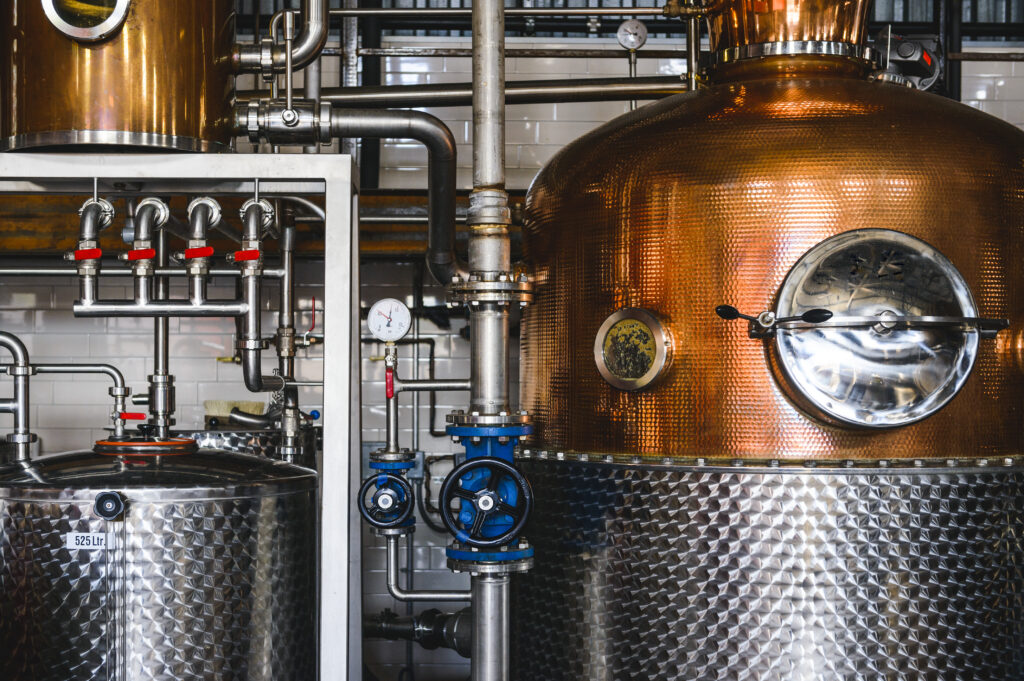
• Pot Still: The pot still is a single large kettle-shaped vessel in which the fermented liquid, or “wash,” is heated. It is the original method of distilling. Pot stills can be customized for optimal performance in distilleries ranging from small craft operations to larger commercial producers.
• Continuous Column Still: Distilling using a column still can speed up the distillation process. The wash is continuously injected into the column with rising steam, stripping the alcohol, and leaving the undesired, or bad, compounds behind. Column stills require less cleaning while allowing more columns to be added when needed. Repeated distillation in column stills yields more neutral, higher-ABV spirits than pot stilling. Additionally, column stills can offer greater control and consistency in high-volume production facilities.
• Hybrid Still: Hybrid stills combine the best qualities of both pot and column stills into a single unit, used for distilling all spirits.
Needs Versus Wants
Rick Morris is the Owner and President of Brewhaus Distilling Experts in Keller, Texas. Brewhaus is the oldest manufacturer of small-scale distilling equipment and supplies in North America. They manufacture, cut, weld, and test all their systems in-house.
While Morris hasn’t seen any significant trends in systems over the past 10-15 years, he has some thoughts on systems and what commercial distillers should consider before buying or updating their core production equipment.
“Multiple smaller systems can be better,” said Morris. “Depending on what a distiller wants to do, I’ve had startups with as little as a one-gallon pot still and then added another and another until they had about eight of them lined up. It’s one way to keep costs down at startup. In general, it can be beneficial to use a couple of smaller systems rather than one large one. Yeah, you’re monitoring two systems instead of one, but redundancy isn’t a bad thing when you consider downtime. If one system breaks or needs to be down for cleaning, you’re not down, just reduced, and that can be huge for a small craft distiller.”
“We’ve also had distillers use 55- or 85-gallon drums and put multi heads on them”, said Morris. “They cap the heads they don’t need, and as capacity increases, they open those heads up for use. If they only want to use two heads to start, we can set it up for four and cap two. It allows a distiller to scale up when needed. You don’t want to jump into a quarter-million setup on startup if you can avoid it, especially as volatile as the liquor market is right now.”
Morris says that budget and space requirements always factor in which system components a distiller chooses. “A larger system means more warehouse space,” said Morris. “Typically, the systems we provide craft distillers are basic and not as computerized as larger systems. That means less breaking down. But if, say, a heater goes out, that’s where the idea of two smaller systems can help. Reduced capacity over complete downtime is huge for a small producer.”
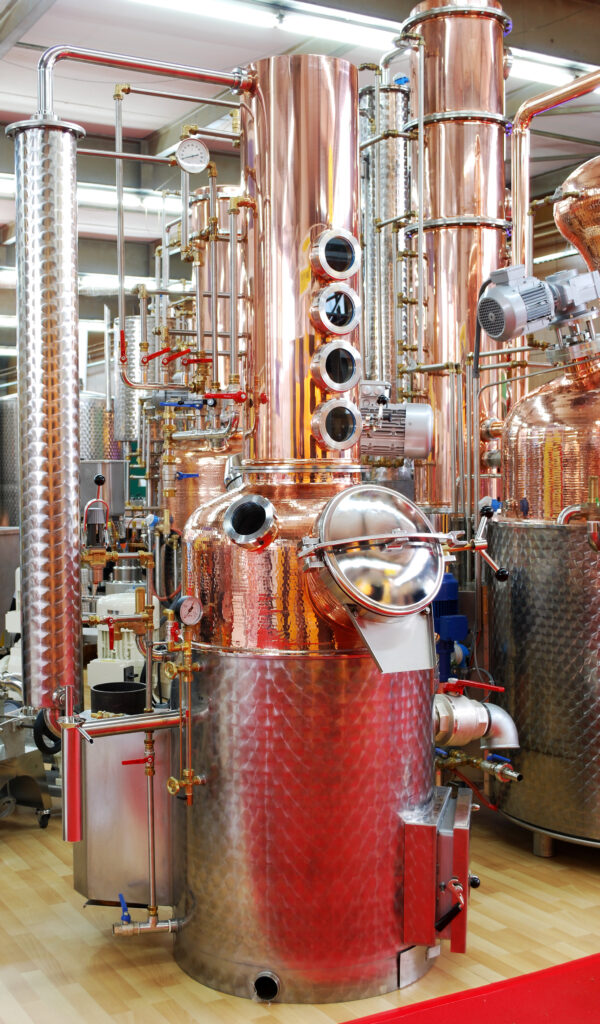
Morris tells Beverage Master Magazine that frequently potential distillers get caught up in seeing those massive, beautiful copper Vendome systems that run a quarter- to half-million dollars and become obsessed with them. When he sits down and looks at their needs, he can often put together a system for them for under ten thousand dollars.
“We all like to drool over the copper eye candy, but what is needed is usually not aligned with that vision,” said Morris. “If that money is truly in their budget, that’s great, and they can save the money for when growth occurs. Just don’t jump into the deep end immediately because it looks great behind the tasting room glass. You can buy a 4-inch copper system with copper plates, or a 4-inch stainless column with copper plates, and they will do the exact same thing, function the exact same way, and produce the exact same quality product because you have the same copper in both systems. But wanting everything in copper will be 60-70% more expensive. If you have copper in the vapor path, you are good with either system.”
Morris says he hasn’t seen a meaningful change in system choice, but they are being tailored specifically to the distillery’s projected needs. “It’s a way to keep costs down upfront,” said Morris. “Is this a full-time distillery or weekends only? How many hours of running time will the system be in use? Get the system you need and maybe get a little larger kettle upfront. That’s a small expense, and you can set it up for a couple of 3-inch systems. Then, scaling up may be as easy as replacing those columns with 4-inch systems. You’re replacing the column but not needing to replace the entire system. Choices like that enable cheaper scaling later. The initial smaller columns can be tuned a little more for smaller volumes, while the larger columns don’t manage smaller volumes as well.”
The Future: More Fads Rather Than Trends
Morris says that rather than trends, they notice little fads that come and go. Trying to speed up the aging process is a big one because of the cost involved.
“The product sits in barrels for so long,” said Morris. “You’ve got the barrel cost, the product cost, and the warehouse storage space cost, along with the extended length of time involved. There’s been a lot of movement and potential technology over the years trying to speed up that process. We see things spike as the next wonderful thing, and then six months later, they’re gone. All the different flavor profiling is big as well. The NA market is increasing, but that doesn’t change the distilling process. It’s the same process, separating the bads from the goods.”
Morris said that the type of brewing or distillation system a craft beverage producer really needs depends on the quantity and type of products being produced, as well as the owners’ future production and expansion plans. The Brewhaus team encourages makers to adopt a system that, instead of being replaced, can be adapted for a fraction of the cost when needed for volume or product expansion.

