How modern bottling and canning machines power breweries
By Alyssa L. Ochs
In the craft brewing industry, packaging is a critical step where craftsmanship intersects execution. Many breweries can brew exceptional beers, but if carbonation is inconsistent or oxygen creeps in during packaging, the end product won’t reflect the hard work you put into it.
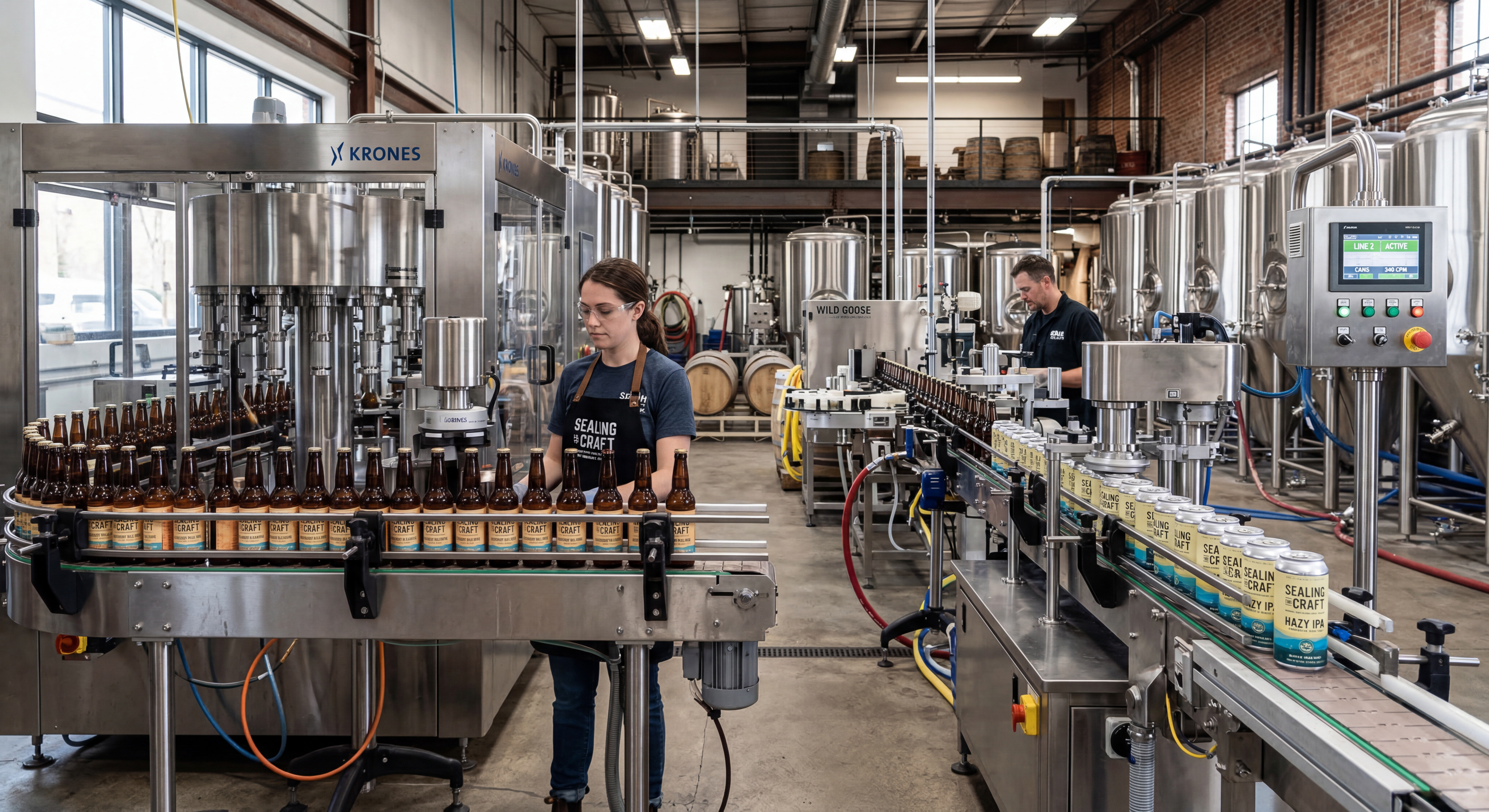
For modern breweries, packaging beer in bottles or cans is more than just the last step for to-go sales – it’s a natural extension of the business that impacts brand perception, quality, and profitability. As the years go by, many breweries are looking to scale production and expand distribution, making the need for precise, reliable, and efficient canning and bottling equipment more important than ever.
Beverage Master explores the packaging machine options available to breweries today and how to choose the right one for your current and future operations. To learn more from a successful brewery’s perspective, we connected with the team at New Realm Brewing Company, which has expanded its operations across multiple cities and states.
Types of Brewery Packaging Machines
There are three basic categories of brewery canning and bottling machines: manual, semi-automatic and fully automatic. Each type offers a different balance of speed, cost, labor, and control.
Manual systems are often the first entry point for new breweries because of their simplicity and affordability. Manual setups typically rely on counter-pressure or gravity fillers and require careful management of fill height, foam control and timing between the fill, seal, and sanitation between cycles. A manual canning or bottling machine may be sufficient for taproom-only breweries and for pilot systems used for experimental batches. They can produce excellent beer, but only with tight standard operating procedures to reduce risks.
Semi-automatic canning and bottling machines are helpful as a brewery’s production ramps up because they enable controlled filling speeds and provide more consistent carbon dioxide purging, which improves shelf life. They often reduce human error risks with integrated seaming and capping while allowing quick changeovers between assorted sizes and formats of cans or bottles. These systems may be ideal for breweries that package beer multiple times per week, are looking to increase distribution and want to reduce human error and worker fatigue.
The third category of canning and bottling machines is fully automated and may offer inline rinsing, filling, and sealing in a continuous flow. Fully automatic machines typically have programmable controls for repeatable settings and integrate packaging with labeling and case packing. It’s usually time to move to this type of system when you are expanding into wider distribution and when running the numbers proves that packaging efficiency directly impacts your revenue.
Kane Wille, the director of brewing for New Realm Brewing Company, told Beverage Master that his brewery is currently running a KHS Innofill Can C 21 head filler and a Kosme Barifill 28 head filler. New Realm is a craft brewery and distillery founded in 2016. It has a flagship brewery and restaurant in Atlanta, Georgia, a production brewery and restaurant in Virginia Beach, Virginia and a brewery and restaurant in Charleston, South Carolina.
There’s also a stylish New Realm taproom in Auburn, Alabama, a barrel-aging and blending-focused location in Greenville, South Carolina and an outdoor-and-music-focused venue in Suffolk, Virginia.
“The KHS line was chosen for its versatility (12 oz. standard, 12 oz. sleek, 16 oz. standard and 19.2 oz. standard) and speed,” Wille explained.
“The Kosme line was purchased at auction and commissioned to meet the projected demand of on-the-books business and the anticipation of a swing back to bottles in the craft market.”
Benefits of Modern Canning and Bottling Machines
Whether you choose to can or bottle your beer, the equipment you choose helps protect it from oxygen ingress, as even tiny amounts can dull the hop aroma, darken the beer’s color, and shorten its shelf life. Optimal packaging machines ensure the best consistency across batches, offer higher throughput for faster packaging cycles, and optimize your labor force. With more accurate pours and better foam control, you’ll use less beer and save money over time.
Wille from New Realm Brewing Company said that since commissioning their KHS line, the most noticeable benefits have been a significant increase in shelf life and drastically improved throughput.
“Since commissioning the Kosme line, our biggest win has been the ability to capitalize on the untapped market of bottles in the craft space since the heavy shift to aluminum,” Wille said.
However, Wille also shared that commissioning any new piece of equipment is a tough endeavor and always takes longer than expected.
“The KHS line took the most time to dial in the underlet gas and the bubble breaker to reduce HSO across the various package sizes it can handle,” he said. “Training and troubleshooting just take time due to the complexity of the machinery, and navigating the world of parts and service post-initial-commissioning is a chore. The Kosme line, as it was purchased at auction and was ‘used’ equipment, was a much taller mountain to climb. For quality and dependability reasons, many of the wear parts and gaskets on the line have been rebuilt or replaced or are on the radar to require some serious attention as we tack on the run hours.”
Cans vs. Bottles: Strategic Considerations
Beyond just branding and costs, the choice between cans and bottles affects many aspects of a brewery’s coordination and beer’s product stability.
With cans, you’ll get the best protection from light and lower dissolved oxygen potential. Industry trends show that many beer drinkers now prefer cans, which are also lighter weight than bottles and more cost-effective to ship. However, canning beer requires precise seaming, and the initial investment in a canning line is significant.
The advantages of bottles include compatibility with refermentation in the package and the traditional, premium perception, which is critical for certain beer styles. Bottles are also the preferred option for some highly carbonated and specialty beers, such as Belgian beers. But when you package beer in bottles, you’ll also face the risk of light exposure and must account for the heavier packages that may be more expensive to transport.
Quality Metrics to Monitor in Packaging
The initial investment in brewery packaging equipment is just part of the equation; successful brewers know they must continuously monitor its performance to achieve consistent results.
One key quality metric to pay attention to is dissolved oxygen and aim to keep it as low as possible for flavor stability and shelf life. Seam and cap integrity are also essential to prevent leaks and contamination. To ensure compliance and reduce product loss, brewers pay attention to fill height and volume accuracy. Meanwhile, carbonation levels need to remain stable during transfer and packaging, as over- or under-carbonated beer affects mouthfeel and overall perception.
How to Choose the Right Packaging System
If you are opening a new brewery or thinking of upgrading your canning or bottling equipment, it’s important to think beyond today’s volume so you don’t outgrow it too quickly. If you invest in slightly higher-capacity equipment now, you may be able to prevent an expensive upgrade later.
Choosing a packaging system requires evaluating the total cost of ownership beyond the purchase price. Maintenance frequency, downtime risks, and the cost of replacement parts are all considerations. It’s also wise to look at how a packaging system integrates with your cold storage space, fermentation schedule, and distribution timeline. Choosing the right equipment manufacturer can lead to a long-term partnership that includes operator training, installation support and troubleshooting help. Having dependable, on-demand support can often be just as valuable as the machine itself when something goes wrong.
Wille from New Realm Brewing Company agreed and told Beverage Master why he thinks it’s always important to account for access to support and spare parts.
“Many of the more complex lines are coming from Europe, and there is a significant time difference to keep in mind when in dire need of assistance during your production hours, even if there is stateside service available,” Wille said. “Many high-speed lines also use proprietary parts that may need to ship from overseas, and since COVID, it seems the availability of parts sitting on the shelf domestically or abroad is reduced.
Wille also noted that breweries should account for service contracts and consider building in options like teleservice.
“Scheduling and training on staff personnel for preventative maintenance should be a day-one consideration,” he said. “It’s also very important to size your line to not only match current throughput demand but allow yourself room to grow into its capacity.”
Whether you’re manually filling limited releases or running a high-speed, fully automated line, choosing the right equipment boils down to your production goals and growth trajectory. As competition in the craft beer market remains strong and steady, breweries that shop around for the best packaging machine fit will stand out for their consistency in every can or bottle that comes off the line.

