With ultimate focus on lager beers
By Gary Spedding, BDAS, LLC, Lexington, KY
From raw materials (including terroir) through processing to packaging, and during product shelf life, we are all aware that many factors and volatiles impact the flavor profile of our beers. In the US, the focus for many years dealt with pale ales and ever more hoppy beers – IPAs. Then along came the sour beer “revolution.” Now, recalling that in olden times the term ale referred to unhopped – beverages and beer to hopped styles. Thus, old definitions of ales without hops refer primarily to gruit (or gruyt), a mixture of herbs, spices, and botanicals used for bittering and preservation before hops became standard in the 16th century. These unhopped brews, were often called gruit ales and made use of ingredients like Myrica gale (bog myrtle), yarrow, and wild rosemary. Recipes for such beverages were included in an article by this author (Zymurgy, Vol. 16 #4, 1993). Today brewers are beginning to really expand their horizons and are using some long lost or less familiar to modern brewing practice ingredients – including cannabis-infused beers. Hence the brief note on overall flavor origins here. A growing concern over alcohol consumption has led to non-alcohol or lower alcohol concentration beers (NAB’s, LAB’s – NABLABS). The new realm requiring careful attention to attaining a truly, not “worty,” more representative beer-like flavor per style and allowing for shelf-life stability. Such beer especially NAB’s really requiring a Pasteurization process – to protect against microbial off flavors. And some issues of can corrosion and beer spoilage issues of late need thinking about in relation to all this.
Now a plethora of brewing research papers have appeared recently covering such topics noted above – however, many not accessible/discoverable by brewers. Thus, this article is focusing on a few keys to flavor and leads readers to some relevant publications for them to gain further insights allowing for continued flavorful high quality beer production. In addition, the tools for understanding sensory properties, known as flavor wheels, are considered with new versions made for this article.
Flavor wheels (new and older published versions) and now flavor maps, created by this author exist for beers – including barrel aged or rested beers, base malts, specialty malts, and hops (1,2). Data collected from across the entire process of beer production (including from flavor wheels) fits now into a term called Omics. In simple terms this refers to the masses of collective data that helps us see the holistic (or more complete) picture of a topic (3), including full and complete sensory profiling (2,4).
So now, the idea behind this short article and the three flavor wheels, and the schematic map of yeast (fermentation associated flavors) (Figures 1-4) is to present, in a hopefully more easily accessible format, the key terms associated with beer flavor characteristics. With a drive to get to the “blueprint” of the taste active components – all the key volatiles in the glass that are interpreted by the human sensory apparatus. Furthermore, the combinations of which are providing the flavor profile for each beer and style. Malt, hops and yeast the thrust of the content here. With respect to a fuller account of microbiological flavors and issues, coauthor Tony Aiken and I covered the subject in some depth in a recently published Microbiology volume (4). The base on that chapter being microbiological associated flavors and taints – thus, the good, the bad and the ugly flavor notes, involved in brewing beer, including non-alcoholic and low alcoholic beers, and how they are assessed using sensory evaluation methods and tools such as the flavor wheels and now flavor maps. More detail on beer in wood – rested or maturation flavors are covered elsewhere (2).
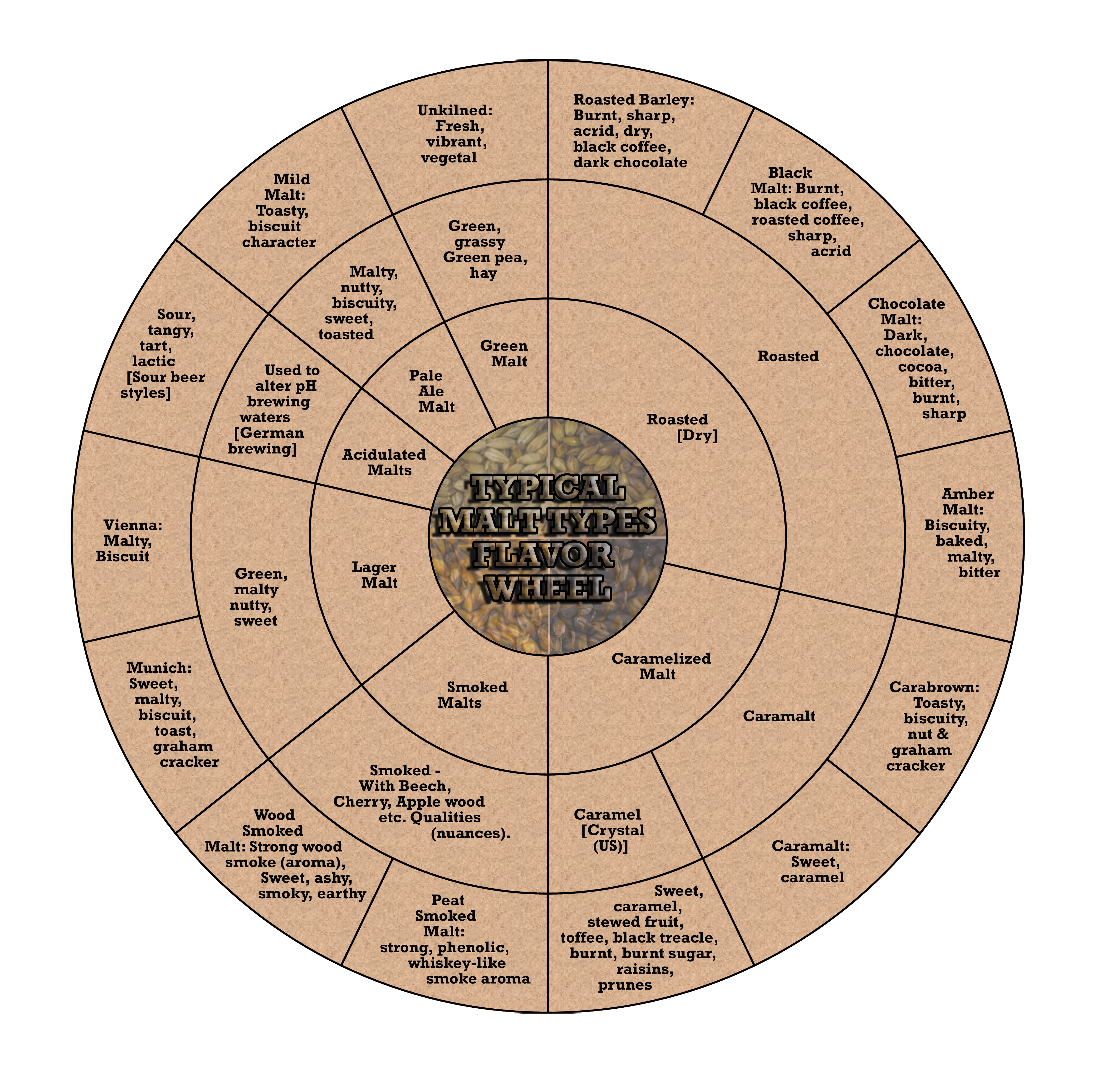
Typical beer flavor notes that can be expected in beers based upon the choices of malts available to brewers.
While this is a general paper the idea for the thread came from a very recently published work dealing with aroma component analysis to characterize lager, ale, and sour beer styles (5). This is quite the work – highly detailed and will be further covered in a subsequent article in this magazine (and noted below plus in Figure 5). Cutting now to the chase – or sniffing out the details, Figure 1 – base Malt Flavors, Figures 2 and 3 – Hop Flavors and Figure 4 – Yeast/Fermentation Flavors present a global view of beer flavor via origins and chemistry during processing. Aromatics (flavor = aroma and taste) – associated with raw materials – malt, hops and the cooking reactions known as the Maillard reaction – toasty, burnt, caramellic qualities – nutty, coffee, chocolate are included here. Figure 1 – Malt flavors – data is now enhanced by recent new data including terms: smoky, vinegar, earthy, roasty, malty, fruity, caramel, banana, floral/honey – with more specific odorant chemical names and odor descriptors included (6). The general data in Figure 1 obtained from an article by the author in the Scandinavian Brewers Review (Vol. 73, No. 1, 2016). With pale malt coverage and a sensory wheel of brewing malts noted and cited in another recent publication (7). For top fermented beers and influence of malt composition on the quality and flavors see Liguori, et al (8 and see 9). While things can get specific in terms of chemical names, common names, thresholds (the concentration of molecules – detectable and identifiable by the brewer and consumer) this article adheres mainly to the basics.

The basics of simple hop aroma/flavor delivery encompassed eight “positive” attribute classes and one off-flavor first tier class. Figure 3 shows a more expanded view today.
Now, hopping to it, Figures 2 and 3 – Hop Flavor Wheels present the generalizations of flavor associated with and expected from hops. Details derived from the author’s works in the Scandinavian Brewers Review (Figure 2 – the general profiles of flavors conveyed by different hops and fresh and aged hops, and Figure 3 – new class hop descriptors – SBR, Vol. 73, No 2, 2016). Leading now into yeast and fermentation, a discussion of the interplay of hop varieties, harvest time, and yeast via seeking out sensory factors was presented very recently (10). A set of sensory terms that will lead us to the finale of this article, and thus to Figure 5 appear in this latter work.
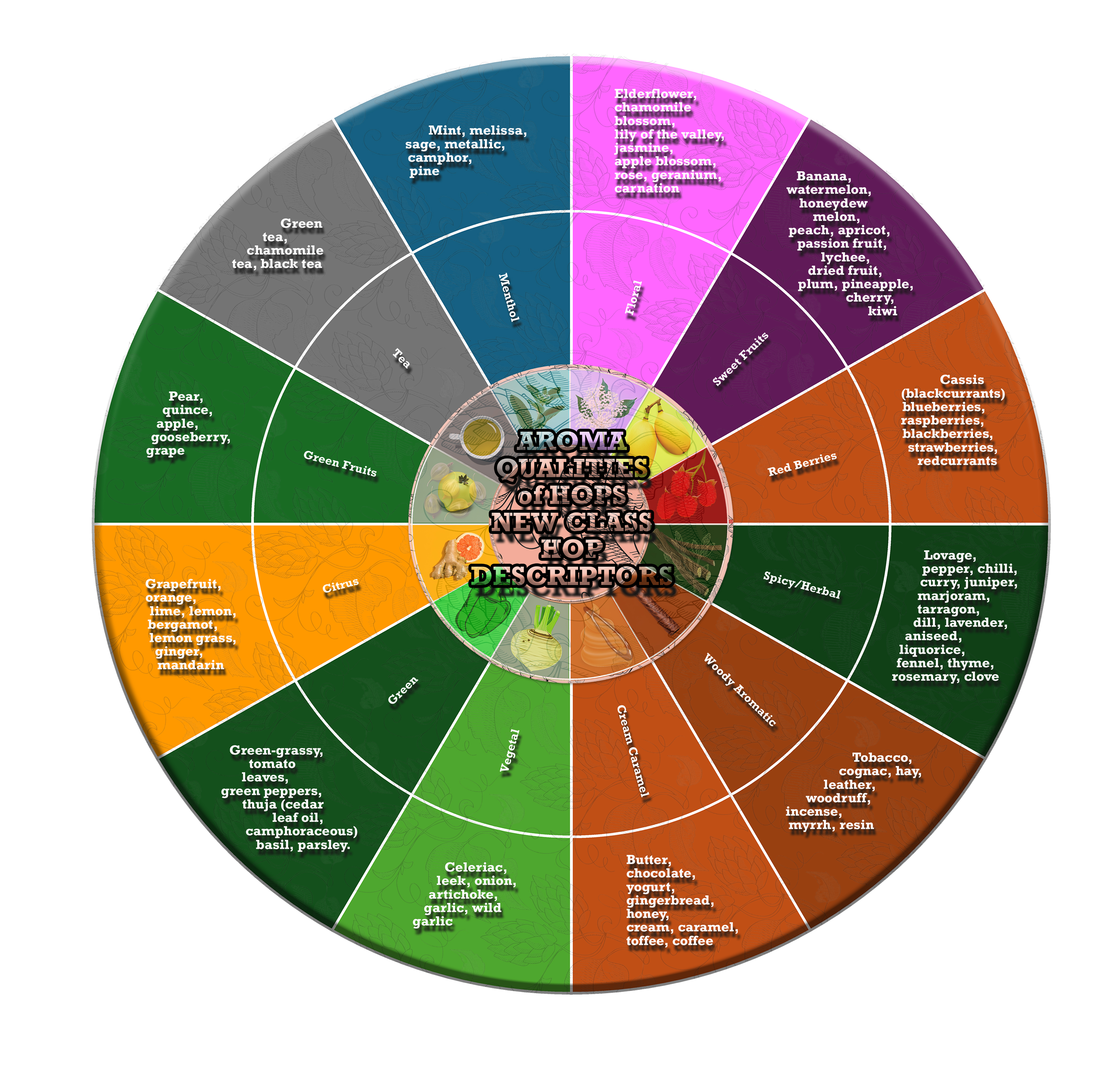
A detailed set of twelve first tier terms, as standard terminology for hop-derived flavor classes, appears here along with flavor descriptors in the second tier.
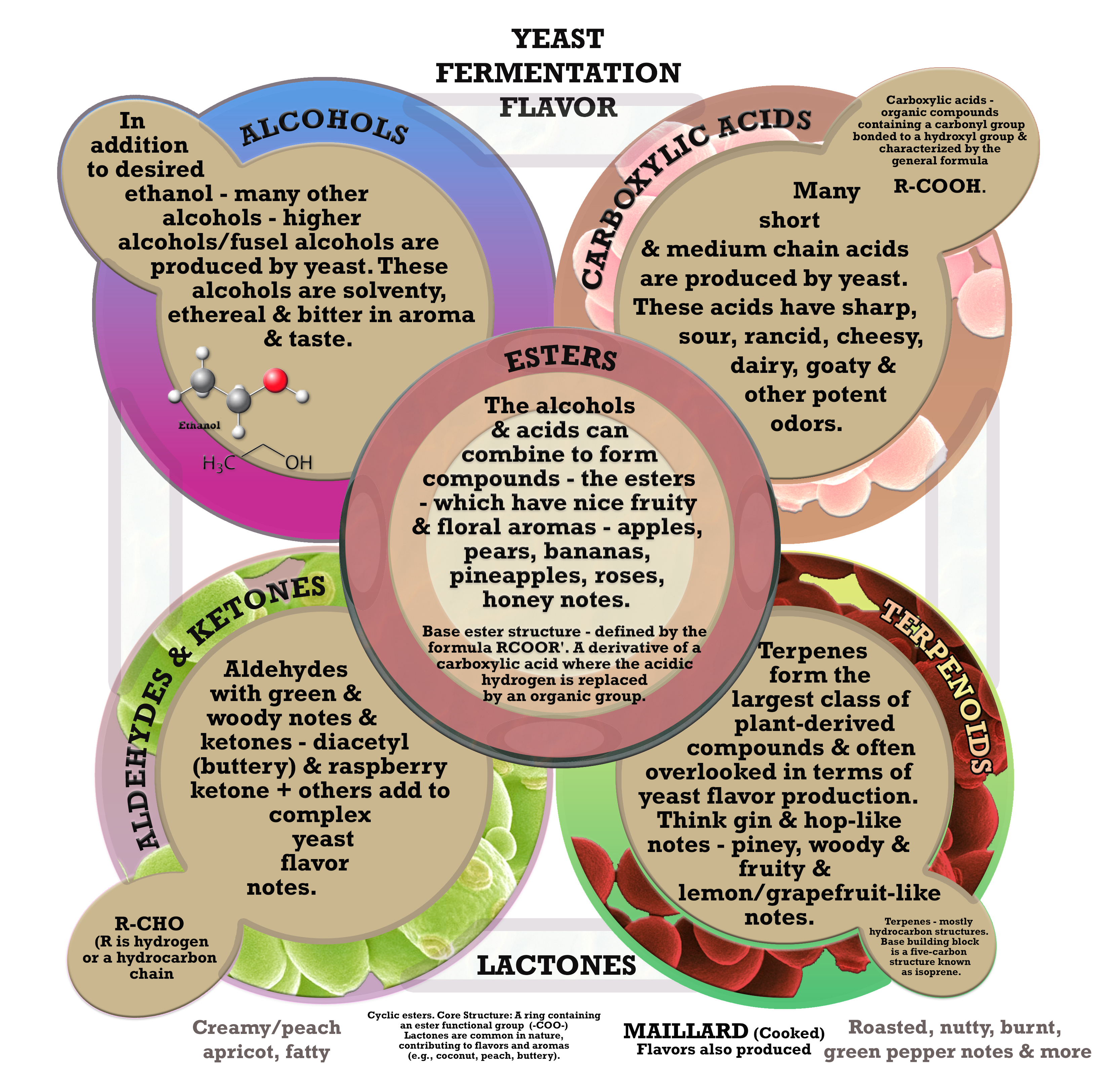
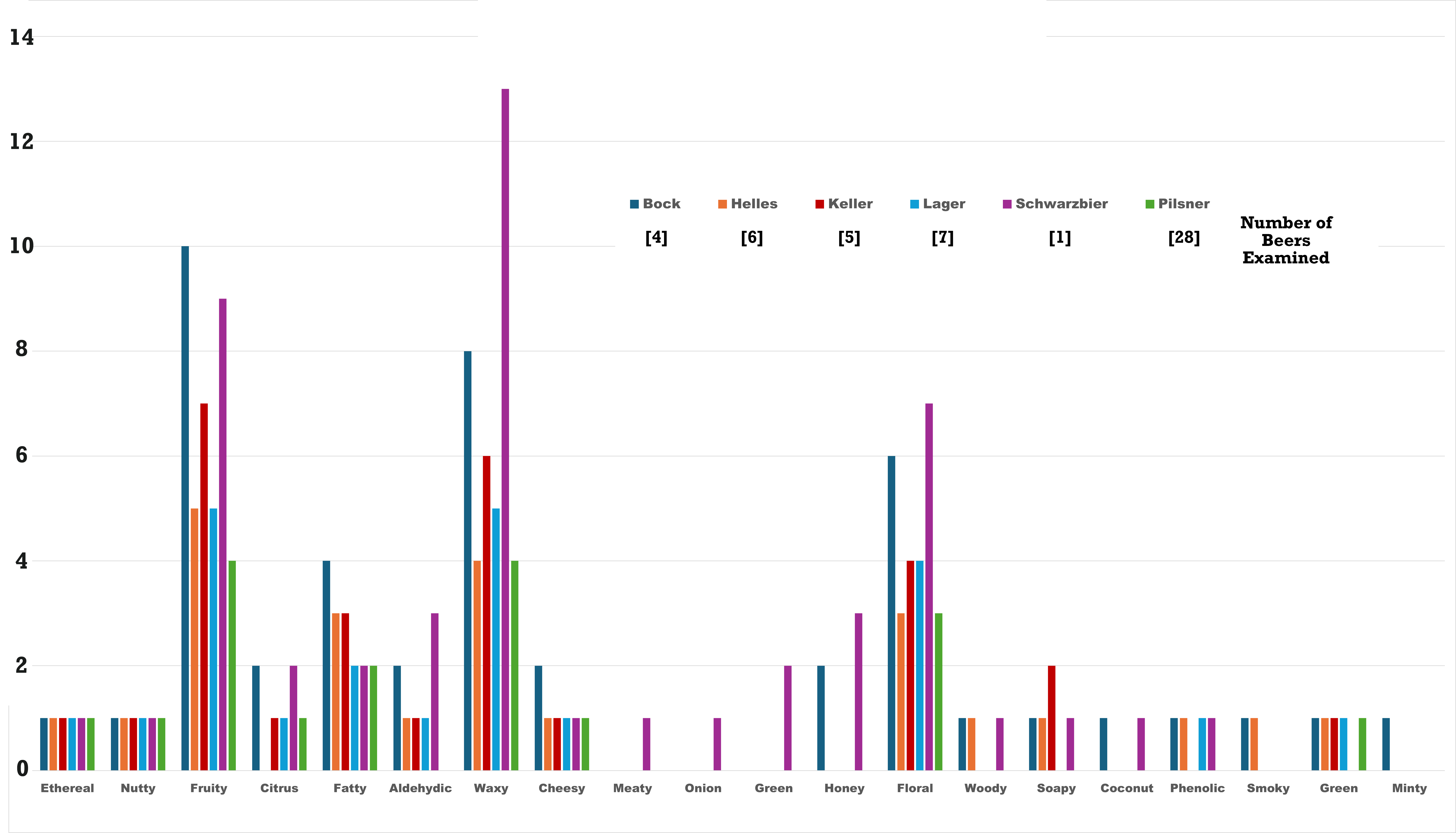
Yeast generated flavor notes – a hugely complex topic, are summarized in Figure 4. With that figure reviewed it provides the final notes summarizing the basics of raw materials and fermentation and lead us back to work noted above by Herkenhoff, Broedel, and Frohme (5). Aroma component analysis leads to the characterization of lagers, ales, and sour beers. Here we focus only on the Lager world. Bringing general sensory characteristics as noted from raw materials and yeast into focus on a substyle specific basis. Creating even a basic flavor wheel from the data for six lager class substyles – Bock, Helles, Keller (cellar), Lager, Schwarzbier and Pilsners proved to overbearing and unreadable even with base descriptions for over fifty distinct chemical compound volatiles. So, a quick summary graph displaying twenty baseline flavor classes is presented here instead. Each class term deriving from or built up in flavor profile attribute from many of those fifty distinct compounds. Many individual compounds – acids/fatty acids leading to waxy, soapy, and cheesy classifications for example.
See Figure 5. The general similarities in flavor profiling and differences for the six lager class substyles are illustrated there. The y-axis numbers refer to the number of chemical component volatiles associated with the x-axis general class descriptors, ethereal, nutty, fruity etcetera. Brewers could evaluate such styles and agree or disagree, learn from, or add to their understanding of the flavor profile qualities of this overall class of lager beers. Building up their sensory lexicon. Note, the bar heights represent the numbers of components in that base class as noted for the number of beers examined per style. They do not represent the perceived intensity of those compounds adding to that category. Compounds are discerned and identified by consumers based on concentrations present that achieve their threshold of detection values. Volatile concentrations also vary in the different beer styles. Also, compounds can act together – synergistically (enhancing the detection of others) or antagonistically (masking other compounds’ aroma detection) by the human sensory apparatus. Moreover, we are all sensitive to different degrees in our sensory perceptions.
In summary, beer flavor is complex. Noting here that flavor is the combination of aroma and taste – with aroma the major player in the overall flavor profile delivery. It is hoped though that the article has shown the basic – origins and flavor descriptors derived from raw materials to finished product – your quality beers. With the end note that things can change with pasteurization and during shelf-life of the beer in trade. We leave off here with three final references – one that characterizes key factors in lager beer flavor (11) and another discussing both positive key odorants and off-flavor notes in many different beer styles and detailing how to enhance aroma control and improve beer quality (12). The latter complementing well the work of Herkenhoff, Broedel, and Frohme (5). And finally, one on how pasteurization and storage can affect the aroma compounds in lager beer (13). Cheers.
A flavor wheel for this set of data proved way too detailed so a bar chart graph has been presented in place of either wheel or map. Here seen is a breakdown of key differences in flavor profiles for six lager style categories. The y-axis values represent the number of different chemical components (the aroma/flavor volatiles) detected that fall within the respective first tier – general class descriptors – nutty, fruity, floral etcetera for the six styles examined. Many components exhibiting similar or different fruity, floral etcetera attributes. Not detailed herein. The number of each style examined is shown below the style name. The reader may need to seek out information on the styles as presented here. A starting point would be the Beer Style guidelines from the Brewers Association. https://www.brewersassociation.org/edu/brewers-association-beer-style-guidelines/
References: [Or footnotes]1) Spedding, G. A brief history and use of sensory flavor wheels. Artisan Spirit. 2022.
Issue 39.[Readable online at Artisan Spirit’s website and at the neat open access
repository of papers and articles – ISSUU.}
2) Silvello, G. C.; Bortoletto, A. M.; Alcarde, A. R. The barrel aged beer wheel: a tool for
sensory assessment. Journal of the Institute of Brewing 2020, 126 (4), 382–393.
3) Spedding, G. OMICS and the Future of Brewing and Distilling Research. In
Chemistry of Alcoholic Beverages, ACS Symposium Series, Vol. 1455; American
Chemical Society, 2023; pp 135–157, ch007.
4) Spedding, G.; Aiken, T. Chapter 19 – Sensory analysis as a tool for microbial quality
control in the brewery. In Brewing Microbiology (Second Edition), Hill, A. E. Ed.;
Woodhead Publishing, 2025; pp 325–374.
5) Herkenhoff, M.; Broedel, O.; Frohme, M. Aroma component analysis by HS
SPME/GC–MS to characterize Lager, Ale, and sour beer styles. Food Research
International 2024, 194, 114763.
6) Féchir, M.; Reglitz, K.; Mall, V.; Voigt, J.; Steinhaus, M. Molecular Insights into the
Contribution of Specialty Barley Malts to the Aroma of Bottom-Fermented Lager Beers.
Journal of Agricultural and Food Chemistry 2021, 69 (29), 8190–8199.
7) Svoboda, Z.; Hartman, I.; Běláková, S.; Pernica, M.; Boško, R.; Benešová, K.
Sensory Analysis of Malt. KVASNY PRUMYSL, 2022, 68(3+4), 628-636.
8) Liguori, L.; De Francesco, G.; Orilio, P.; Perretti, G.; Albanese, D. Influence of malt
composition on the quality of a top fermented beer. J Food Sci Technol 2021, 58 (6),
2295–2303.
9) Bettenhausen, H. M.; Barr, L.; Broeckling, C. D.; Chaparro, J. M.; Holbrook, C.;
Sedin, D.; Heuberger, A. L. Influence of malt source on beer chemistry, flavor, and flavor
stability. Food Res Int 2018, 113, 487–504.
10) Lino, T.; Forte, T. a. G. W.; Rodolfi, M.; Costantini, A.; Galaverni, M.; Forestello, G.;
Carbone, K.; Tsolakis, C.; Pulcini, L.; Bonello, F.; et al. Exploring the interplay of hop
variety, harvest time and yeast: Sensory and chemical dynamics in beer brewing.
Applied Food Research 2026, 6 (1), 101729.
11) Hong, J.; Wei, H.; Yin, R.; Xie, J.; Huang, H.; Guo, L.; Zhao, D.; Song, Y.; Sun, J.;
Huang, M.; et al. Characterization of Key Factors Associated with Flavor Characteristics
in Lager Beer Based on Flavor Matrix. Foods 2025, 14 (10).
12) Șutea, C. M.; Mudura, E.; Pop, C. R.; Salanță, L. C.; Fărcaș, A. C.; Balaș, P. C.; Gal,
E.; Geană, E. I.; Zhao, H.; Coldea, T. E. Beer Aroma Compounds: Key Odorants, Off
Flavour Compounds and Improvement Proposals. Foods 2025, 14 (24).
13 Gagula, G.; Đurđević-Milošević, D.; Ncube, T.; Magdić, D. The effect of pasteurisation
and storage on aroma compounds in lager. Journal of the Institute of Brewing 2024, 130
(2), 83–92.
About the Author
Gary Spedding, Ph.D., Brewing and Distilling Analytical Chemist. Moved from academic research and teaching into the world of brewing analysis and education in 1999 when appointed as manager then, subsequently, director of the laboratories at the Seibel Institute of Technology in Chicago. Now with over 25 years of experience in testing and judging/evaluating beers and spirits. Founded Brewing and Distilling Analytical Services in Kentucky (2002): analytical testing/educational training – beverage production and sensory experiences. Basic research and developing/improving methods of analysis. Invited speaker at renowned beverage and chemistry society conferences, author and editor of numerous articles, papers, and book chapters. Spedding is currently lead editor for the Journal of Distilling Science (JDS).

